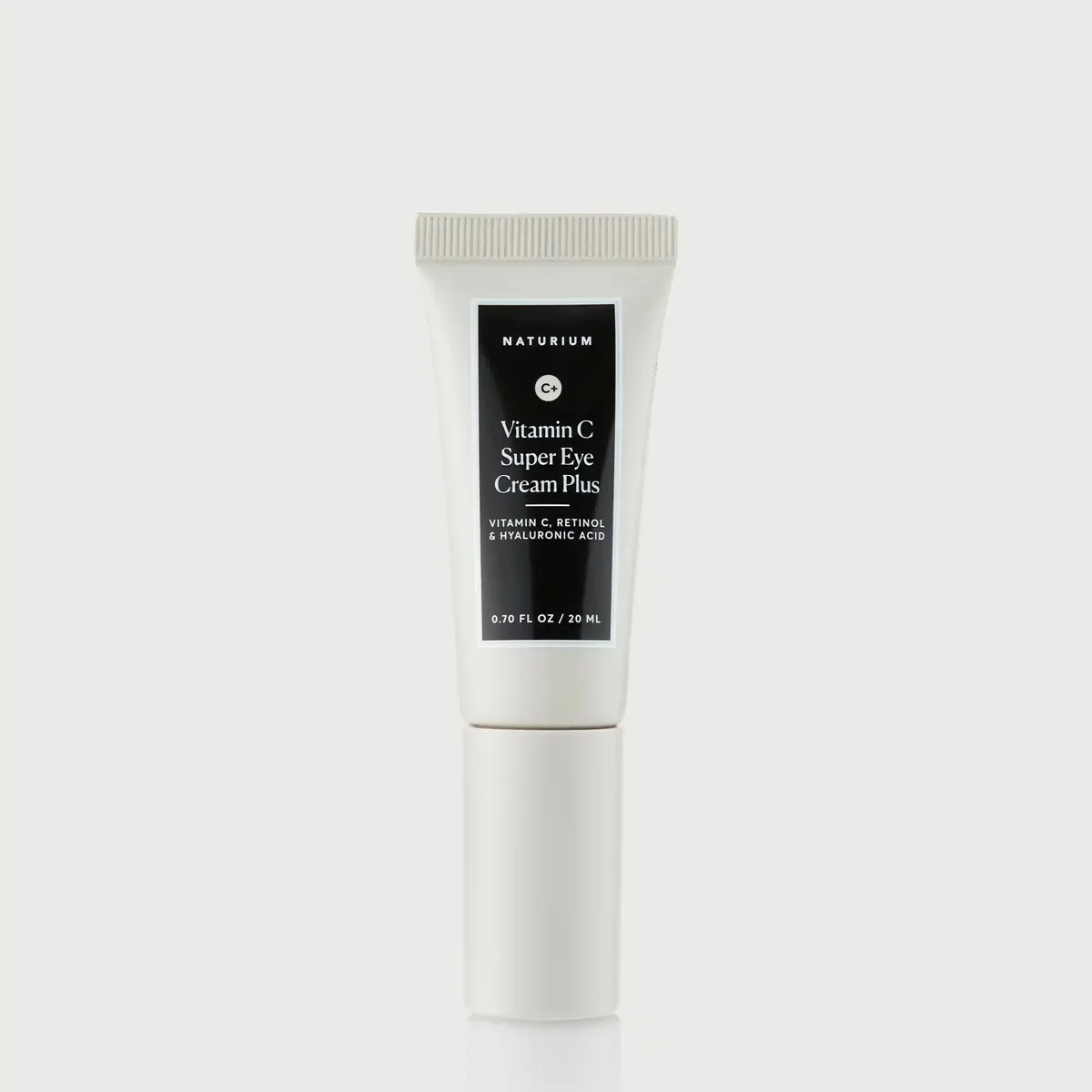
Most affordable brightening eye creams pick one vitamin C derivative and stop; this one stacks ethyl ascorbic acid, L-ascorbic acid and sodium ascorbyl phosphate, adds a phosphatidylcholine-encapsulated retinol and glutathione, and wraps it in a silicone-and-silica base that blurs on contact — a treatment-and-cosmetic hybrid at a Target price, with a colloidal gold flourish that adds tint and nothing else.
For twenty dollars this packs three vitamin C forms, a low encapsulated retinol, glutathione and a blurring silicone base into a fragrance-free eye cream — real actives at a real price, with an honest day-one cosmetic effect and a slow, modest treatment effect on pigment and lines. It will not touch vascular or shadow circles, the gold is decoration, and the retinol earns a gentle start.
This eye cream has two and a half years of retail feedback but no published efficacy data and only an in-house tolerability panel, so the review count and rating are drawn from retailer listings rather than a single verified source and the performance expectations come from the separate literatures on vitamin C derivatives and low-dose periorbital retinol. Whether the three C forms at their listed positions brighten pigment circles measurably over months has not been tested on the product itself.
Verdicts
How well it fits each concern
Verdict by concern tap a concern for the case
Supporting rolefor Dark CirclesIn your profileYou chose · Vitamin C has early evidence for dark circles, and hydration of the periorbital area is the recognised companion to treating it — a reasonable supporting choice, short of a recommendation.Moderate evidenceGentleNo reviews collected yet
The case for it
Ethyl Ascorbic Acid has early or mechanistic evidence for this concern, not trial-backed standing.
It is plausibly present at a working level, though the concentration is not declared.
The formula carries none of the triggers this concern is sensitive to.
What would change this: A declared concentration would move this to a firmer reading of the dose.
Same rule for everyone. “Supporting role” is the verdict on 8,197 of 45,024 concern verdicts across the catalog; rule R8a decided 1,489 of them.
As of September 25, 2026, engine 5.1.1.
R8a — A plausible-tier active in a category with a supportive job: the sentence names the active instead of saying nothing targets the concern (the AmLactin / CeraVe SA case for keratosis pilaris, where no guideline and single trials leave the keratolytics at early evidence). · the full register
Carrying active
Ethyl Ascorbic Acid
Standing
plausible — trials support it
Form
plausible — studied range 10%, from the OTC monograph or label; needs leave-on contact; judge it after ~12 weeks
Tolerability
gentle
Row checked
against its sources on July 17, 2026 (evidence table ev-2026.09-r228)
Good choicefor AgingIn your profileYou chose · Retinol is a trial-supported active for aging; this cream carries it, though the concentration is not declared.Moderate evidenceGentleNo reviews collected yet
The case for it
Retinol has trial-supported standing for this concern.
It is plausibly present at a working level, though the concentration is not declared.
The formula carries none of the triggers this concern is sensitive to.
What would change this: A declared concentration would move this to a firmer reading of the dose.
Same rule for everyone. “Good choice” is the verdict on 9,564 of 45,024 concern verdicts across the catalog; rule R5 decided 9,072 of them.
As of September 25, 2026, engine 5.1.1.
Promisingfor DullnessIn your profileYou chose · Hyaluronic Acid has trial-level evidence for dullness but no guideline or regulatory standing yet — promising, short of a recommendation; the other actives here are not yet assessed for it.Moderate evidenceGentleNo reviews collected yet
The case for it
Shea Butter + Squalane + Hyaluronic Acid has trial-level evidence for this concern but no guideline or regulatory standing yet.
It is plausibly present at a working level, though the concentration is not declared.
The formula carries none of the triggers this concern is sensitive to.
What would change this: A declared concentration would move this to a firmer reading of the dose.
Same rule for everyone. “Promising” is the verdict on 7,858 of 45,024 concern verdicts across the catalog; rule R9p decided 7,858 of them.
As of September 25, 2026, engine 5.1.1.
R9p — 0.5.0: 'Unproven' beside three filled dots read as one question answered twice with opposite words (7,018 rows). The chip measures standing, the dots measure trial volume; where the row carries at least one RCT or a tier-2 source (moderate dots) and the active is present at a working level, the honest word is Promising. Unproven is reserved for plausible-standing rows with limited or weak evidence, or an under-dosed form. Same rank as Unproven — a bet either way; the dots order them. · the full register
Carrying active
Shea Butter + Squalane + Hyaluronic Acid
Standing
plausible — trials support it
Form
plausible
Tolerability
gentle
Row checked
against its sources on July 17, 2026 (evidence table ev-2026.09-r228)
Good choicefor DehydrationIn your profileYou chose · Hyaluronic Acid is a reference standard by mechanism for dehydration; this cream carries it.Moderate evidenceGentleNo reviews collected yet
The case for it
Shea Butter + Squalane + Hyaluronic Acid has trial-supported standing for this concern.
It is plausibly present at a working level, though the concentration is not declared.
The formula carries none of the triggers this concern is sensitive to.
What would change this: A declared concentration would move this to a firmer reading of the dose.
Same rule for everyone. “Good choice” is the verdict on 9,564 of 45,024 concern verdicts across the catalog; rule R5 decided 9,072 of them.
As of September 25, 2026, engine 5.1.1.
R5 — Trial-supported or guideline-supported active, adequately or plausibly dosed. · the full register
Carrying active
Shea Butter + Squalane + Hyaluronic Acid
Standing
supported — its mechanism is established
Form
plausible — studied range 0.1%, from the trials on the row; needs leave-on contact; judge it after ~1 weeks
Tolerability
gentle
Row checked
against its sources on July 17, 2026 (evidence table ev-2026.09-r228)
The studies behind the evidence row
Draelos ZD, Cosmetic Dermatology: Products and Procedures — hyaluronic acid classified as a humectant water-binding agent holding many times its weight in water — reference work
Does the jobDoes what a eye cream is for: safe for eye skin, targets a real eye concern. Not measured from the label: hydrates without heaviness, stays where it's put.
A verdict is DermApproved’s assessment of how well a product’s ingredients fit a concern — never a claim about what the product treats. Evidence dots and collected reviews sit beside it and are never blended in.
Rules 0.5.1 · evidence table ev-2026.09-r228 · how we decide
Assessment
Pros & Cons
Pros
✓ Three vitamin C forms led by stable ethyl ascorbic acid
✓ Encapsulated low-dose retinol suitable for the eye area
✓ Silicone-and-silica base blurs and sits cleanly under concealer
✓ Fragrance-free, alcohol-free and sting-free around the eyes
✓ Shea, squalane and hyaluronic acid keep it hydrating despite the silicones
✓ Glutathione adds a second brightening antioxidant
✓ Twenty dollars for actives that cost far more elsewhere
Cons
✗ Vitamin C forms sit at modest positions — brightening is gradual and subtle
✗ Does nothing for vascular or shadow-type dark circles beyond blurring
✗ Retinol requires a slow start and rules out pregnancy use
✗ Gold is decorative, not active
✗ Can pill over rich serums
✗ Small tube empties in two months at twice-daily use
Review
Full Review
Dark circles are three different problems wearing one name. Some are pigment — brown or grey-brown melanin in the skin under the eye, from sun, rubbing, allergies or ancestry. Some are vessels — the blue-purple of blood showing through skin that is thin and pale. And some are shadow — the darkness a hollow casts when the light comes from above. A vitamin C eye cream can, in principle, do something about the first. It can do nothing about the second or third except blur them, and any review of Naturium's Vitamin C Super Eye Cream Plus that does not begin there will end up either too enthusiastic or too harsh. Read against the right circle, it is a good, honest, inexpensive product with a cosmetic trick on top; read against the wrong one, it is a tube of disappointment.
Naturium is the accessible-actives brand founded in 2019 and owned by e.l.f. Beauty since 2023, sold at Target and Ulta on the promise of disclosed ingredients at fair prices. It extended its Vitamin C Super line to the eye area in February 2024, and the 'Plus' in the name marks what was layered on: an encapsulated retinol and a 'gold complex'. Two and a half years in, it sits comfortably in the brand's range with a steady retail following and the same pair of recurring comments — brighter under concealer, no sting — that a well-made eye cream earns.
The formula is more interesting than its price suggests. Water, then dimethicone and isododecane — a silicone-and-volatile base that sets fast and blurs — then hydrogenated polydecene, propanediol, glycerin and shea butter for cushion. Ethyl ascorbic acid is eleventh: a stable, oil-and-water-compatible vitamin C ether that will not brown in a cream, and the form most likely to reach the under-eye skin at a working level. L-ascorbic acid appears eighteenth and sodium ascorbyl phosphate twenty-eighth, so the 'vitamin C complex' is real, if weighted toward modest levels of the two supporting forms. Retinol is twenty-second, with phosphatidylcholine a few lines later — the encapsulation that lets a retinoid sit near the eyes without the peeling a face-strength retinol would cause. Squalane, aloe, hyaluronic acid, tocopherol and glutathione fill the middle; then, thirty-fourth, gold, which contributes a faint luminous tint and a luxury note and nothing that the literature would recognise as an effect. The whole thing is fragrance-free and alcohol-free.
In use, the day-one effect is the silicone base doing what silicones do. A pea-sized amount tapped around the orbital bone spreads thin, sets in under a minute to a soft-focus, matte-satin finish, and makes the under-eye look smoother and a shade brighter before any active has had time to act. Concealer sits on it cleanly, which is why morning users like it; over a rich serum it can pill, which is why the directions say a small amount. That blur is cosmetic, it is honest, and it is what most 'brighter after one use' reviews are describing.
The treatment effect is slower and narrower. On pigment-based circles, six to twelve weeks of twice-daily use produces a modest brightening — the ethyl ascorbic acid and glutathione earning their places — and the same period of low-dose retinol softens the fine crepe lines at the outer corners a little. On vascular or shadow circles, nothing changes except the blur, and no vitamin C on earth would do better. The retinol also asks for respect: a few users find mild dryness at the outer corners in the first weeks, and Naturium's alternative schedule of two or three times a week is the right starting point, particularly for anyone who has never used a retinoid near the eyes. Pregnancy rules it out, as it does every retinoid.
What the twenty dollars does not buy is depth. Placing pure ascorbic acid eighteenth and the phosphate twenty-eighth means this is a vitamin-C-flavoured eye cream rather than a concentrated one, and buyers who have used a proper 10 to 15 percent vitamin C serum on the face should not expect the same punch in a tube designed to be gentle around the eyes. That is the correct trade-off for the location, and it is why the product can be used twice a day without incident; it is also why the results are measured in shades, not transformations.
On value, $20 for 20 mL is a dollar a millilitre — ordinary for the category, cheap for the ingredient list, and roughly two months of twice-daily use or four months at the lower frequency. Comparable vitamin-C-and-retinol eye creams from dermatology-adjacent brands cost three to five times as much for the same 15 to 20 mL, usually with one vitamin C form rather than three. There is no research premium here because there is no research; there is a disclosed list and a fair price.
The recommendation is easy once the circle is identified. If your under-eyes are dull, faintly brown, beginning to crepe, and you want a fragrance-free eye cream that looks good under makeup in the morning and does slow, gentle work at night, this is one of the best twenty dollars in the category. If your circles are blue or hollow, save the money for a concealer, a caffeine cream or a consultation, because this will only blur them. And whichever you are, start at three nights a week, ignore the gold, and give the vitamin C its twelve weeks.
Formula
Key Ingredients
The hero actives that drive this product's performance.
Eleventh in the list, the lead of three vitamin C forms — a stable, oil-and-water-compatible ether derivative that can sit in a silicone-rich cream without browning, and the one most likely to reach the thin under-eye skin at a useful level for brightening dark circles that are pigment-based.
Pure L-ascorbic acid eighteenth and the phosphate salt twenty-eighth — the second and third strands of the 'vitamin C complex', adding antioxidant depth at modest levels while the ethyl form carries the main load; their placement makes this a vitamin-C-flavoured eye cream rather than a concentrated one.
Twenty-second, delivered in a phosphatidylcholine encapsulation a few lines later — a low, eye-safe dose of the retinoid that lets the cream claim smoothing of fine lines over months without the peeling a stronger retinol would cause on the thinnest skin on the face.
Second and third in the list with a run of silicone crosspolymers and silica later — the optical, blurring, quick-set base that gives the cream its instant 'brighter' look under concealer, which is a cosmetic effect and the honest reason it reads as working on day one.
The hydration trio — shea eighth, squalane seventeenth, hyaluronic acid near the tail — that keeps a silicone-forward, retinol-bearing eye cream from feeling dry or tight on skin with almost no oil glands of its own.
Established mechanismfor Dehydration · established mechanism
Thirty-second in the list, just ahead of the decorative gold — a tripeptide antioxidant with a tyrosinase-dampening reputation that gives the three vitamin C forms a second brightening partner on pigment-type dark circles, at a level that supports rather than leads.
Not yet assessed
Ingredient standings describe the active at treatment-level doses and
vehicles; this product's own condition grades weigh its actual formula.
Tap a pea-sized amount around the orbital bone after serum and before moisturizer; it sets quickly under concealer in the morning. Because it carries a low dose of retinol, build from two or three nights a week and keep a separate retinoid off the eye area on the nights this is used. It pairs happily with a niacinamide or caffeine eye product on alternate nights.
Results Timeline
An immediate blurred, brighter look from the silicone-and-silica base and better hydration within days. Brightening of pigment-based dark circles from the vitamin C forms takes six to twelve weeks; smoothing of fine lines from the low-dose retinol needs three months or more and will be subtle.
Three questions decide whether an eye cream like this can work: does the vitamin C survive the formula, does it reach the target, and is the target one vitamin C can change. On survival, the formula's lead choice is sound. A 2022 review in the Journal of Cosmetic Dermatology surveyed the chemically modified vitamin C derivatives developed to improve on L-ascorbic acid's poor stability and absorption, weighing each for stability, percutaneous penetration and activity; ethyl ascorbic acid, the derivative placed eleventh here, is among the more stable and lipophilic of those forms and is compatible with the anhydrous-leaning silicone base in a way pure ascorbic acid, listed eighteenth, is not. Sodium ascorbyl phosphate, twenty-eighth, adds a water-soluble third form with a good tolerability record and weaker evidence for pigment. Together they give the cream a plausible vitamin C presence, though not a concentrated one — a sensible trade-off for skin that is thinner and more reactive than the rest of the face.
On the target, the periorbital literature is clear that 'dark circles' are heterogeneous. Pigmentary circles, driven by dermal or epidermal melanin, can respond to tyrosinase-inhibiting and antioxidant agents such as vitamin C and glutathione over months; vascular circles, from visible vessels through thin skin, and structural circles, from tear-trough hollowing and shadow, do not respond to topical brighteners at all and are addressed by fillers, energy devices or camouflage. The product's silicone, silica and volatile-alkane base produces a genuine optical smoothing on all three types, which is cosmetic and immediate rather than treatment and gradual, and the two effects should not be confused.
The retinol is the formula's second treatment element. Topical retinoids are the best-evidenced cosmetic agents for fine lines, and low-dose encapsulated retinol — here paired with phosphatidylcholine — is the standard approach to using them near the eyes, where the stratum corneum is thin and irritation arrives quickly; the trade-off is that the dose is low and the improvement in periorbital rhytides is correspondingly slow and modest. Glutathione, hyaluronic acid, squalane and tocopherol are reasonable supporting inclusions. Gold, at thirty-fourth, has no clinical evidence for any skin effect at cosmetic levels and functions as tint and marketing. The 'dermatologist tested' claim describes an in-house tolerability panel; no efficacy trial of the product exists, and the assessment rests on the ingredient literature rather than on the tube.
In practice the first thing done for a patient complaining of dark circles is to classify them — pigment, vascular or structural — because the treatment differs entirely, and an eye cream like this is relevant only to the first group. For pigmentary periorbital darkening a fragrance-free product combining stable vitamin C derivatives, an antioxidant such as glutathione and a low-dose encapsulated retinol is a reasonable over-the-counter starting point, with the expectation of gradual, partial improvement over three months and the usual retinoid precautions: evening introduction two or three times a week, daily sunscreen, avoidance in pregnancy, and separation from stronger retinoids or acids used elsewhere on the face. For vascular and structural circles the honest counsel is that no topical will change them and that the product's value is purely cosmetic blurring. The formulation is well suited to periorbital use — no fragrance, no alcohol, a low irritant load — and the gold should be regarded as inert. Patients with atopic or rosacea-affected eyelids should patch test the retinol-bearing cream at the outer corner before committing.
Guidance
Usage & Recommendations
How to Use
After cleansing and any serum, squeeze out a pea-sized amount — enough for both eyes — and, using the ring finger, tap it gently along the orbital bone beneath and beside each eye, avoiding the lash line and the lid itself. Let it set for a minute before moisturizer or concealer; it becomes matte-satin quickly and concealer sits well on it. Because it carries retinol, begin at two or three evenings a week and add mornings once the outer corners show no dryness; Naturium's own directions allow either twice daily or two to three times weekly. Use less if it pills over a rich serum, keep a separate face retinoid or acid off the eye area on the nights this is applied, wear sunscreen by day, and skip it during pregnancy or breastfeeding.
Value Assessment
At $20 for 20 mL — a dollar a millilitre, or about ten dollars a month at twice-daily use and half that at the brand's lighter schedule — this is priced like a drugstore eye cream and formulated like a considerably more expensive one: three vitamin C forms, an encapsulated retinol, glutathione, hyaluronic acid and squalane in a fragrance-free base. Dermatology-adjacent brands charge three to five times as much for vitamin-C-and-retinol eye creams with shorter lists. Naturium's seven years and e.l.f.'s scale bring reliability without a research premium, and the modest placement of the vitamin C forms is priced in. The value is excellent for pigment-type circles and early lines, and nil for vascular or shadow circles, where the only return is a cosmetic blur that a good concealer would also provide.
Who Should Buy
Anyone with dull, faintly pigmented or early-crepey under-eyes who wants a fragrance-free eye cream that looks polished under concealer in the morning and does slow, gentle brightening and smoothing at night — at a price that makes twice-daily use easy. It suits buyers who already like Naturium's vitamin C serum and want the same approach in an eye-safe dose.
Who Should Skip
Anyone whose dark circles are blue-vascular or shadow-from-hollows will get nothing but a cosmetic blur and should spend the money on concealer, a caffeine cream or a consultation. It is not for pregnancy or breastfeeding because of the retinol, and very reactive eyelids should patch test first; buyers wanting concentrated vitamin C should use a face serum, not an eye cream.
Ready to try Naturium Vitamin C Super Eye Cream Plus?
A light, pale-gold-tinted cream with a silky silicone slip that spreads thin, sets in under a minute to a soft-focus matte-satin finish and does not migrate into the eyes.
Scent
None — fragrance-free with no perceptible botanical note.
Packaging
A 20 mL off-white squeeze tube with a tall matching cap and a black label — the C+ badge marks the Vitamin C Super line; the slim nozzle doses a pea-sized amount cleanly and the opaque walls protect the vitamin C and retinol.
Finish
satinmattefast-absorbing
What to Expect on First Use
The first application is unremarkable in the best way: no tingle, no scent, a quick blur under the eyes and a slightly brighter look under makeup. Over the first two or three weeks a few users notice mild dryness at the outer corners from the retinol, which settles with a slower schedule.
How Long It Lasts
About two months at a pea-sized amount under each eye twice daily; closer to four months at the brand's alternative two-to-three-times-a-week schedule.
Naturium built its Vitamin C Super line around a serum and a cleanser before extending it to the eye area in February 2024, at a moment when 'eye cream with retinol' had become a mass-market category. The 'Plus' in the name signals the additions — encapsulated retinol and the gold complex — layered onto the brand's usual vitamin C approach, aimed at buyers who wanted brightening and line-smoothing from one twenty-dollar tube.
About Naturium Established Brand (5–20 years)
Naturium, founded in 2019 and part of e.l.f. Beauty since 2023, sells ingredient-forward formulas at Target-and-Ulta prices and generally discloses its actives. This February 2024 eye cream extends its Vitamin C Super line into the eye area with three vitamin C forms and an encapsulated retinol; the brand runs dermatologist tolerability panels but no efficacy trials.
Brand founded: 2019 · Product launched: 2024
Myth vs. Reality
Common Myths
Myth
Vitamin C fades all dark circles.
Reality
It can help the pigment kind — brown or grey-brown discolouration from sun, rubbing or genetics — over a couple of months. Dark circles caused by thin skin over blue vessels, hollows that cast shadow, or fluid puffiness do not respond to any topical vitamin C; the cream's blurring base will soften how they look, which is cosmetic.
Myth
The gold complex is an active that firms the eye area.
Reality
Gold is listed thirty-fourth, after the glutathione, and has no established biological effect on skin at cosmetic levels. It adds a faint luminous tint and a luxury note to the label; the firming claim belongs to the low-dose retinol, and it is a slow, subtle one.
FAQ
Frequently Asked Questions
Does Naturium Vitamin C Super Eye Cream Plus contain retinol?
Yes — an encapsulated retinol listed twenty-second, a low, eye-safe dose delivered with phosphatidylcholine. It is enough to smooth fine lines slowly over months and enough to warrant building from two or three nights a week, but far below the strength of a face retinoid.
Is Naturium's Vitamin C Super Eye Cream Plus good for dark circles?
For pigment-based dark circles, its three vitamin C forms and glutathione can brighten over six to twelve weeks. For circles caused by visible vessels, hollows or puffiness, no topical vitamin C helps; the cream's silicone-and-silica base will blur their appearance cosmetically, which is the day-one effect most reviewers describe.
Can I use the Naturium Vitamin C eye cream in the morning under makeup?
Yes, and it is one of its strengths — the silicone base sets in under a minute to a soft-focus finish that concealer sits on cleanly. Give it a moment before applying anything on top, and use less if it pills over a rich serum.
How is the Vitamin C Super Eye Cream Plus different from Naturium's Vitamin Bright Illuminating Eye Cream?
They are different formulas. Vitamin Bright is a richer, shea-and-triglyceride cream built around vitamin K and botanicals for shadowy, vascular circles; Super Eye Cream Plus is a lighter silicone-based cream with three vitamin C forms, an encapsulated retinol and gold, aimed at pigment and fine lines. Many people alternate them.
Is the Naturium Vitamin C Super Eye Cream Plus safe during pregnancy?
It contains retinol, so the usual precaution against topical retinoids in pregnancy and breastfeeding applies, even at this low dose. A vitamin-C-only or caffeine eye cream is the conventional substitute.
How often should I use the Naturium Vitamin C Super Eye Cream Plus?
Naturium gives two options: a pea-sized amount under each eye morning and night, or two to three times a week. Because of the retinol, starting at the lower frequency and building up is the sensible route, especially for skin that has never used a retinoid near the eyes.
Reviews
What Reviewers Tend to Say
Recurring themes our editors read across retailer reviews of this product — summaries in our words, not quotations, and not a substitute for your own patch test.
Common Praise
Sets fast and sits well under concealer
Under-eyes look brighter and less crepey after a few weeks
No sting or fragrance around the eyes
Common Complaints
Can pill over rich serums
Dark circles from shadows or vessels do not change
The standard product post opens with a percentage rather than a lifestyle photo, and the regulator makes brands publish their evidence. Both of those are ahead of the West. The metric they created is the problem.
It's a legitimately useful antioxidant with real anti-aging data — but 'nature's retinol' oversells a thin evidence base, and it isn't a retinoid at all.
Glow isn't a vibe or a filter. It's light bouncing off smooth, hydrated, evenly-toned skin, which means you can reverse-engineer it into a checklist instead of chasing it with a highlighter.
The thinnest skin on your body is a magnet for allergens carried in from your hands, your nails, and your hair, which is why the fix so rarely lives in your eye cream.
Products, answers, therapy guides, tools and articles in one search. Brand names,
slang and abbreviations all work — accutane finds isotretinoin, bacne finds truncal acne.