



Peptides: Signal, Carrier, Copper — Which Ones Actually Do Anything?
'Peptides' is one word standing in for a dozen unrelated molecules with wildly different evidence — most serums are hope in a bottle, but a few classes earn their place.
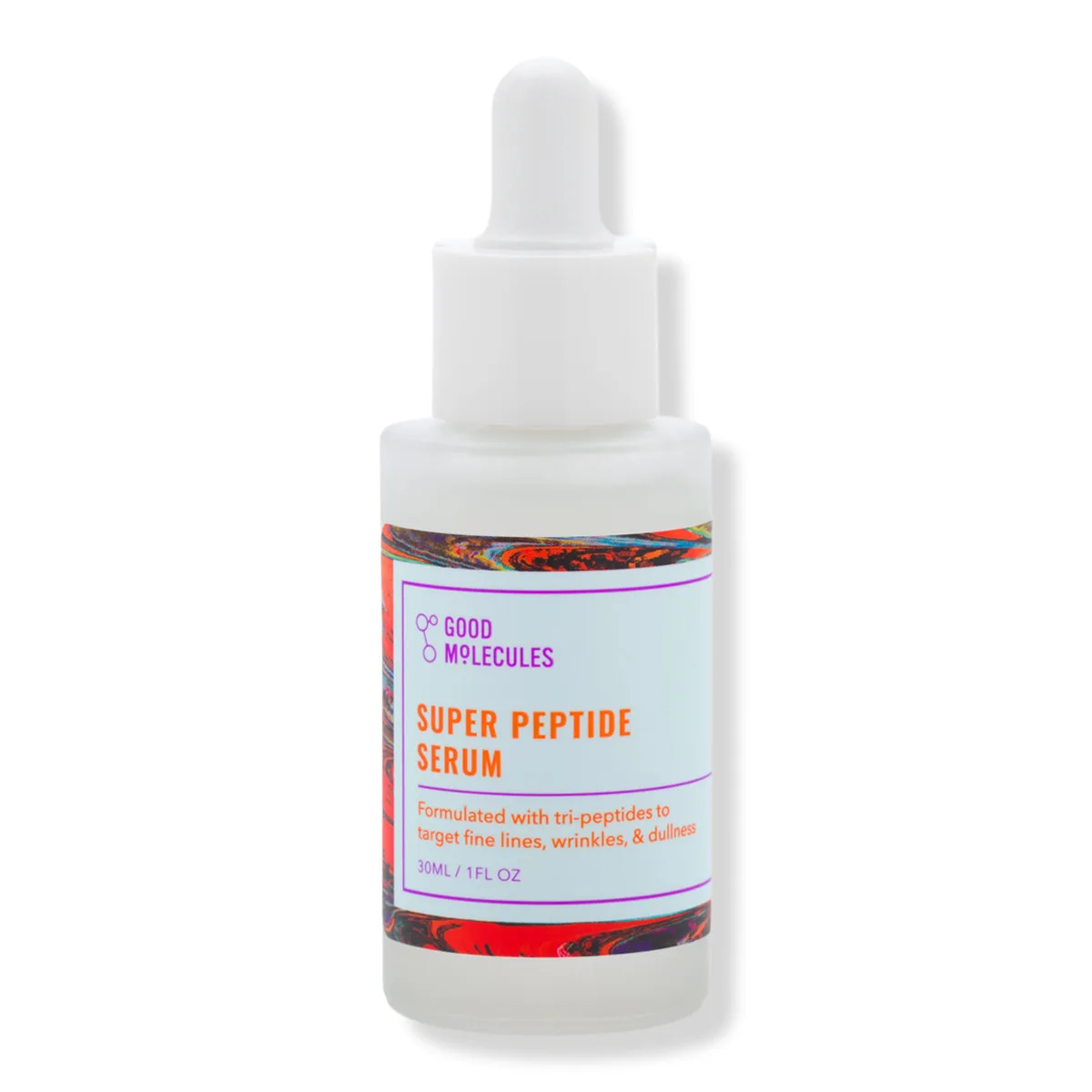
It stacks three different peptide types — two expression-line neuropeptides plus copper tripeptide — into one fragrance-free, fungal-acne-safe serum at around twelve dollars. Few peptide serums combine that trio at this price, even if the concentrations aren't disclosed.
A gentle, hydrating, multi-peptide serum that makes the category affordable at around twelve dollars. It stacks three peptide types into a fragrance-free base that plays nicely with everything, but with undisclosed concentrations sitting low on the list, treat it as pleasant anti-aging maintenance rather than a heavy-hitting wrinkle treatment.
This assessment leans more on ingredient analysis than on long-term outcome data: the serum has been available since 2021 with a moderate review count, and while its peptides are recognizable and studied, Good Molecules does not publish their concentrations. As a result, the anti-aging potency cannot be independently confirmed, and the score reflects the formula's gentleness, hydration, and value as much as its actives.
The case for it
What would change this: A declared concentration would move this to a firmer reading of the dose.
Same rule for everyone. “Promising” is the verdict on 7,858 of 45,024 concern verdicts across the catalog; rule R9p decided 7,858 of them. Unchanged since September 5, 2026, engine 5.1.1.
Brand or formulator? Disclose a concentration or correct a fact →
The studies behind the evidence row
The case for it
What would change this: A declared concentration would move this to a firmer reading of the dose.
Same rule for everyone. “Good choice” is the verdict on 9,564 of 45,024 concern verdicts across the catalog; rule R5 decided 9,072 of them. Unchanged since September 5, 2026, engine 5.1.1.
Brand or formulator? Disclose a concentration or correct a fact →
The studies behind the evidence row
The case for it
What would change this: A declared concentration would move this to a firmer reading of the dose.
Same rule for everyone. “Promising” is the verdict on 7,858 of 45,024 concern verdicts across the catalog; rule R9p decided 7,858 of them. Unchanged since September 5, 2026, engine 5.1.1.
Brand or formulator? Disclose a concentration or correct a fact →
The studies behind the evidence row
A verdict is DermApproved’s assessment of how well a product’s ingredients fit a concern — never a claim about what the product treats. Evidence dots and collected reviews sit beside it and are never blended in. Rules 0.5.1 · evidence table ev-2026.09-r228 · how we decide
Peptide serums occupy a strange corner of skincare: beloved by people who want anti-aging benefits without the irritation of retinoids, and quietly mistrusted by anyone who's tried to pin down what the peptides are actually doing at the concentrations used. Good Molecules' Super Peptide Serum is a perfect specimen to think through, because it's affordable enough to take a chance on and transparent enough — at least in its ingredient list — to read honestly. Let's start with what's in it, because the running order tells a story. Water, propanediol, and glycerin lead, which means this is fundamentally a well-hydrated, humectant-forward serum. Then come the texture and preservative ingredients. The peptides themselves — Acetyl Hexapeptide-8 (you may know it as Argireline), Acetyl Octapeptide-3 (SNAP-8), and Copper Tripeptide-1 (GHK-Cu) — appear toward the back of the list, after the preservatives. In cosmetic formulation that ordering generally signals low concentrations. This isn't a knock unique to Good Molecules; peptides are expensive and often used at small percentages even in pricey serums, and many actives are genuinely effective at low doses. But it's an honest flag worth raising: don't expect a transformative result from peptides sitting this far down the label. So what can you reasonably expect? The two neuropeptides, Argireline and SNAP-8, are marketed for softening the look of expression lines by modulating the muscle contractions that crease skin — the so-called 'topical alternative to injectables' angle. The reality is more modest. There's some supportive research, but the effects are subtle, gradual, and dependent on consistent use and adequate concentration. Copper Tripeptide-1 is the most interesting of the three from a research standpoint, with a track record in wound healing and signaling roles tied to skin firmness and repair — but it, too, sits at the very end of this list, so it's playing a supporting note rather than carrying the song. Here's where the serum genuinely shines, and it's worth giving credit: as a gentle, hydrating, everyday serum, it's lovely. The texture is a light, slightly slippy gel that absorbs fast and leaves skin feeling plumped and smooth, thanks largely to glycerin, propanediol, and sodium hyaluronate. It's fragrance-free, alcohol-free, and fungal-acne safe, which makes it one of the more universally tolerable serums you can buy. Peptides are non-acidic and famously easy to layer, so this slots into almost any routine without conflict — a real practical advantage for people building a regimen around stronger actives like retinoids and acids, where adding a gentle, supportive step is welcome. The immediate effect is hydration-driven: your skin looks a touch fresher and more cushioned right away. The slower, peptide-linked benefits — if they materialize for you — are the kind you evaluate over a couple of months and in photographs, not in the mirror the next morning. The honest framing is that this is maintenance, not magic. The packaging is the usual peptide-serum compromise: a dropper bottle, precise for dosing but not the most protective vessel for delicate actives over time. At this price and turnover rate, it's a forgivable trade-off. Where this serum earns its place is value and gentleness. Twelve dollars for a multi-peptide serum is genuinely affordable, and if you've been curious about peptides but unwilling to spend forty or fifty on a single bottle, this is a low-stakes way to find out whether the category does anything noticeable for your skin. Just go in with calibrated expectations. If you want demonstrable collagen remodeling and fine-line reduction with strong clinical backing, a retinoid remains the better-evidenced tool, and this serum makes a nice companion to one rather than a replacement. If you want a gentle, hydrating, broadly compatible serum that layers a few promising peptides into your routine without irritation or a big price tag, this delivers exactly that — no more, but pleasantly, no less. There's a broader point worth making about how to think about peptide products generally, because this serum is such a representative example of the category's promises and limits. Peptides are short chains of amino acids that act, in theory, as messengers — signaling the skin to behave in ways associated with younger, firmer tissue. It's an appealing idea, and the lab data on isolated peptides can look genuinely exciting. The gap between that lab data and a finished cosmetic, though, is where realism has to enter. Concentration, formulation stability, and whether the peptide can even penetrate to where it needs to act all matter enormously, and almost none of that information is disclosed on a typical product label. So when a serum like this stacks three different peptides, the honest reading isn't 'three times the benefit' — it's 'a thoughtful, hedged bet across a few promising actives, at doses we can't verify.' That's not cynicism; it's just calibrated optimism. For the right person — someone who already has the fundamentals (sunscreen, possibly a retinoid) in place and wants to layer in a gentle, hydrating extra that might offer some supportive firming over time — this is a sensible, low-risk, low-cost addition. For someone hoping a peptide serum will substitute for the proven heavy lifters, it won't, and no peptide serum at any price reliably will yet. Approached as a pleasant, compatible bonus step rather than a cornerstone, it's a likable product that does its quiet job well.
The hero actives that drive this product's performance.
| Ingredient | Function | Evidence |
|---|---|---|
| Acetyl Hexapeptide-8 (Argireline) | The headline 'expression-line' peptide here, paired with Acetyl Octapeptide-3 to target the look of fine lines from repeated muscle movement — though both sit low on this list, after the preservatives, suggesting modest concentrations. | Limited for Aging |
| Acetyl Octapeptide-3 (SNAP-8) | Works in tandem with Argireline in this formula on the same expression-line target, the two neuropeptides chosen to complement rather than duplicate each other's effect on the appearance of dynamic wrinkles. | Limited for Aging |
| Copper Tripeptide-1 (GHK-Cu) | The best-studied of the three peptides, included here for its signaling role in skin firmness and repair; its position at the very end of the list signals a low dose, so view it as a supporting note rather than the formula's workhorse. | Not yet assessed |
| Sodium Hyaluronate | Provides the immediate plumping, smoothing hydration that makes peptide serums feel like they're 'working' on day one, while glycerin and propanediol round out the watery, fast-absorbing base. | Established mechanism for Dehydration · established mechanism |
Ingredient standings describe the active at treatment-level doses and vehicles; this product's own condition grades weigh its actual formula.
Water, Propanediol, Glycerin, Ammonium Acryloyldimethyltaurate/VP Copolymer, 1,2-Hexanediol, Diheptyl Succinate, Capryloyl Glycerin/Sebacic Acid Copolymer, Glycine, Xanthan Gum, Ethylhexylglycerin, Caprylyl Glycol, Acetyl Hexapeptide-8, Acetyl Octapeptide-3, Sodium Hyaluronate, Copper Tripeptide-1
serum
AM & PM
Smooth onto clean skin before heavier creams. Because peptides are gentle and non-acidic, they slot in easily alongside almost anything; if you use a strong acid or vitamin C in the same routine, apply this afterward once the skin's pH has settled.
Immediate plumping and smoothness from the hydrating base. Any peptide-driven firmness or fine-line softening is gradual and subtle, generally evaluated over 8-12 weeks of twice-daily use, and best regarded as maintenance rather than dramatic change.
Evaluating this serum scientifically means separating the well-evidenced from the merely promising. The hydration story is solid: glycerin, propanediol, and sodium hyaluronate are established humectants that demonstrably improve surface plumpness and smoothness, and they account for most of the immediate visible effect. The peptides are a more nuanced picture. Acetyl Hexapeptide-8 (Argireline) and Acetyl Octapeptide-3 (SNAP-8) are neuropeptides studied for their ability to reduce the depth of expression lines by interfering with neurotransmitter release at the neuromuscular junction; small studies have reported measurable but modest reductions in wrinkle depth, typically at defined concentrations over weeks of use. The catch is that efficacy is concentration-dependent, and their position low on this ingredient list — after the preservative system — suggests doses likely below what those studies used. Copper Tripeptide-1 (GHK-Cu) has the deepest research base of the three, with documented roles in wound healing, antioxidant activity, and stimulation of collagen and glycosaminoglycan synthesis in laboratory and clinical settings; however, it appears last on the list, indicating a trace inclusion. The reasonable scientific conclusion is that the formula is well-designed and uses genuinely studied peptides, but that the strength of any anti-aging effect cannot be confirmed without disclosed concentrations, and the immediate benefits are predominantly hydration-driven. Peptides remain a category where evidence is promising rather than definitive, and this serum sits comfortably within that honest middle ground.
Peptide serums are generally viewed in clinical settings as gentle, low-risk additions rather than primary anti-aging treatments. Dermatologists often note that while certain peptides show promising data, the most reliable interventions for fine lines and collagen support remain retinoids, sunscreen, and antioxidants, with peptides serving a complementary role. A fragrance-free, well-tolerated peptide serum like this one is the kind of product that fits easily into a routine without creating conflicts, which is part of its appeal. The standard guidance is to maintain realistic expectations, to layer it with — not in place of — better-evidenced actives, and to remember that daily sun protection does more for the appearance of aging skin than almost any serum.
Smooth a few drops over clean skin morning and night, before heavier moisturizers and creams. Because peptides are gentle and pH-flexible, you can layer this with most other actives; if you also use a low-pH acid or vitamin C, apply those first and let them settle, then follow with this serum. Pat or smooth it in and allow a brief moment to absorb before your next step. In the morning, always finish with sunscreen, which protects against the photoaging that peptides alone cannot address. Consistency over two to three months is key for any peptide benefit.
At around twelve dollars, this is a fair-to-good value for a multi-peptide serum, especially as an affordable entry into a category that often runs three to five times higher. You're paying a sensible price to experiment with peptides without committing serious money, and the formula's gentleness and compatibility add practical value. The honest caveat is that, with concentrations undisclosed and the peptides sitting low on the list, you're partly paying for the hydrating base and the convenience of having several peptides in one bottle. For a budget-conscious shopper curious about peptides, that's a reasonable deal; for someone seeking documented potency, the value equation is less clear-cut.
It's a strong pick for anyone curious about peptides who wants an affordable, gentle place to start, and for those building an anti-aging routine who want a compatible supporting serum. Sensitive and reactive skin types will appreciate its fragrance-free, non-irritating profile.
Those seeking proven, dramatic wrinkle reduction will be better served by a retinoid and should treat this as a complement rather than a replacement. Anyone who wants disclosed active percentages or a single high-potency peptide may find this multi-peptide, undisclosed-dose approach unsatisfying.
Ready to try Good Molecules Super Peptide Serum?
Buy at Amazon ♥Clear, slightly slippy watery gel that glides on and absorbs quickly with a soft, hydrated afterfeel.
Free of added fragrance and essential oils; carries no noticeable smell.
Frosted plastic bottle with a dropper — precise for dosing but, as with most peptide serums, not the most air-tight choice for delicate actives.
First impressions are all about the hydration: skin looks a little plumper and smoother right away thanks to the humectant base. The peptide effects, if you notice them at all, reveal themselves slowly, so the early experience is comfortable but undramatic.
Roughly 2-3 months with twice-daily full-face use from the 1 oz bottle.
All Year
Peptides became a buzzword in the late-2010s anti-aging conversation, often at luxury prices. Good Molecules' serum exists to make the category approachable: a multi-peptide formula for people who want to dip into peptides without spending fifty dollars or more on a single bottle.
Good Molecules launched in 2019 with a focus on affordable, single-purpose formulas distributed through Beautylish. Its peptide serum follows that model — recognizable, well-documented peptide ingredients at an accessible price rather than a proprietary delivery system, with the usual caveat that peptide efficacy depends heavily on concentration, which the brand does not disclose.
Peptide serums work as well as retinoids for wrinkles.
Retinoids have far stronger clinical evidence for collagen remodeling. Peptides like the ones here are gentle and can offer supportive, subtle benefits, but they're best seen as a complement to — not a substitute for — a proven retinoid.
Copper peptides cancel out vitamin C, so you can't use them together.
This is overstated. While extreme formulation conditions can affect stability, using a copper-peptide serum and a vitamin C product in the same routine — ideally at different steps or times of day — is generally fine for the average user.
It contains three: Acetyl Hexapeptide-8 (Argireline), Acetyl Octapeptide-3 (SNAP-8), and Copper Tripeptide-1 (GHK-Cu). The two neuropeptides target expression lines, while the copper peptide supports firmness and repair. All sit low on the ingredient list, suggesting modest concentrations.
It can offer subtle, gradual softening of expression lines with consistent use, plus immediate plumping from its hydrating base. Results are modest, not dramatic — for stronger anti-aging effects, a retinoid remains better-evidenced, and this serum works best alongside one.
Yes. Peptides are gentle and easy to layer. Apply any acids or vitamin C first, let them settle, then follow with this serum. Pairing it with a retinoid is a common, complementary combination rather than a conflict.
Its ingredients — peptides, glycerin, and hyaluronic acid — are generally considered pregnancy-safe, and it contains no retinoids or high-strength acids. As always, anyone pregnant should confirm their full routine with a healthcare provider.
Peptides are costly and typically used at low concentrations, even in expensive serums. Their position after the preservatives suggests modest dosing here, which is normal for the category but means you should keep expectations realistic.
Yes. It's fragrance-free, alcohol-free, and non-acidic, making it one of the gentler serums available. Its peptides don't carry the irritation risk of acids or retinoids, so it's well-suited to reactive skin.
Recurring themes our editors read across retailer reviews of this product — summaries in our words, not quotations, and not a substitute for your own patch test.
Lightweight and hydrating
Affordable way to try peptides
Plays well with other actives
No fragrance or irritation
Subtle, slow results
Peptide concentrations undisclosed
Dropper packaging exposes formula to air
Not a replacement for retinoids