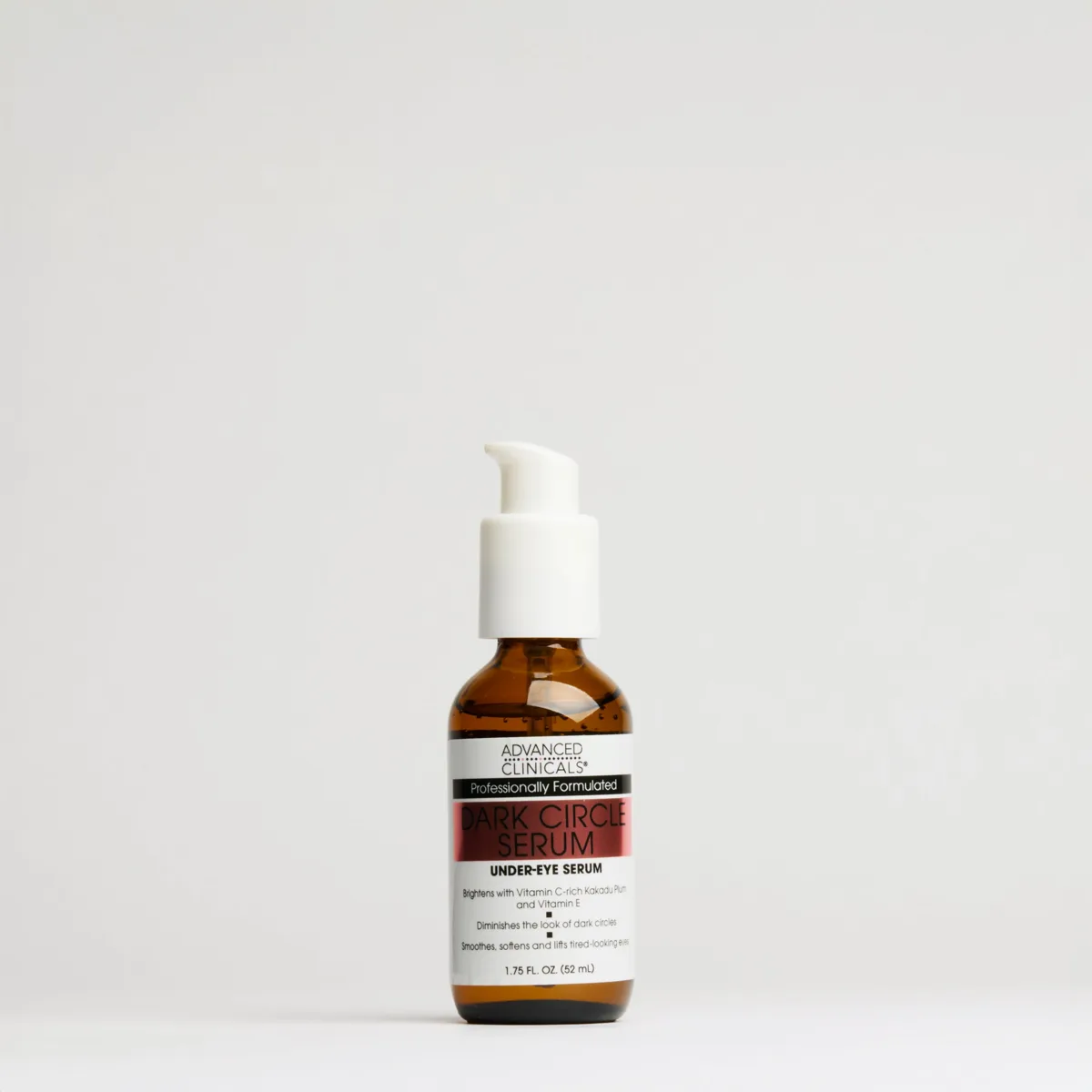
Most dark-circle products are 15ml jars priced by the gram. This one is a 52ml pump bottle of aloe-based caffeine gel for under fourteen dollars, with ferulic acid pushed to third on the list and two named peptides mid-formula. The size and price are the point; the formula is a sensible caffeine-and-humectant gel wearing a kakadu plum headline it cannot quite justify.
A fourteen-dollar, 52ml caffeine gel that de-puffs and brightens the under-eye for a few hours, with ferulic acid and two named peptides thrown in at sensible positions. It does not lighten pigmented circles, its kakadu plum headline is mostly label, and the rose extract is a needless risk around eyes. As a cheap daily de-puffer it is fine; as a dark-circle treatment it is not.
Roughly five hundred Amazon ratings and a handful on the brand's own site give a usable but shallow picture of this 2021 serum, and the mixed average hints at the gap between its name and its effect. The ingredient mechanisms cited are from published cosmetic research on caffeine and peptides, not from any test of this product, and no concentration is disclosed, so the assessment weighs the list and user reports rather than measured outcomes.
Verdicts
How well it fits each concern
Verdict by concern tap a concern for the case
Supporting rolefor Dark CirclesIn your profileYou chose · Caffeine has early evidence for dark circles, and hydration of the periorbital area is the recognised companion to treating it — a reasonable supporting choice, short of a recommendation.Moderate evidenceGentleNo reviews collected yet
The case for it
Caffeine has early or mechanistic evidence for this concern, not trial-backed standing.
It is plausibly present at a working level, though the concentration is not declared.
The formula carries none of the triggers this concern is sensitive to.
What would change this: A declared concentration would move this to a firmer reading of the dose.
Same rule for everyone. “Supporting role” is the verdict on 8,197 of 45,024 concern verdicts across the catalog; rule R8a decided 1,489 of them.
As of September 25, 2026, engine 5.1.1.
R8a — A plausible-tier active in a category with a supportive job: the sentence names the active instead of saying nothing targets the concern (the AmLactin / CeraVe SA case for keratosis pilaris, where no guideline and single trials leave the keratolytics at early evidence). · the full register
Carrying active
Caffeine
Standing
plausible — trials support it
Form
plausible — studied range 1–3%, from the OTC monograph or label; needs leave-on contact
Tolerability
gentle
Row checked
against its sources on July 17, 2026 (evidence table ev-2026.09-r228)
Good choicefor DehydrationIn your profileYou chose · Hyaluronic Acid is a reference standard by mechanism for dehydration; this gel carries it.Moderate evidenceGentleNo reviews collected yet
The case for it
Sodium Hyaluronate, Sodium PCA & Sodium Lactate has trial-supported standing for this concern.
It is plausibly present at a working level, though the concentration is not declared.
The formula carries none of the triggers this concern is sensitive to.
What would change this: A declared concentration would move this to a firmer reading of the dose.
Same rule for everyone. “Good choice” is the verdict on 9,564 of 45,024 concern verdicts across the catalog; rule R5 decided 9,072 of them.
As of September 25, 2026, engine 5.1.1.
R5 — Trial-supported or guideline-supported active, adequately or plausibly dosed. · the full register
Carrying active
Sodium Hyaluronate, Sodium PCA & Sodium Lactate
Standing
supported — its mechanism is established
Form
plausible — studied range 0.1%, from the trials on the row; needs leave-on contact; judge it after ~1 weeks
Tolerability
gentle
Row checked
against its sources on July 17, 2026 (evidence table ev-2026.09-r228)
The studies behind the evidence row
Draelos ZD, Cosmetic Dermatology: Products and Procedures — hyaluronic acid classified as a humectant water-binding agent holding many times its weight in water — reference work
Promisingfor DullnessIn your profileYou chose · Hyaluronic Acid has trial-level evidence for dullness but no guideline or regulatory standing yet — promising, short of a recommendation; the other actives here are not yet assessed for it.Moderate evidenceGentleNo reviews collected yet
The case for it
Sodium Hyaluronate, Sodium PCA & Sodium Lactate has trial-level evidence for this concern but no guideline or regulatory standing yet.
It is present at an effective concentration, declared or high in the ingredient list.
The formula carries none of the triggers this concern is sensitive to.
What would change this: Guideline or regulatory standing for the active on this concern would move this from a promising bet to a recommendation.
Same rule for everyone. “Promising” is the verdict on 7,858 of 45,024 concern verdicts across the catalog; rule R9p decided 7,858 of them.
As of September 25, 2026, engine 5.1.1.
R9p — 0.5.0: 'Unproven' beside three filled dots read as one question answered twice with opposite words (7,018 rows). The chip measures standing, the dots measure trial volume; where the row carries at least one RCT or a tier-2 source (moderate dots) and the active is present at a working level, the honest word is Promising. Unproven is reserved for plausible-standing rows with limited or weak evidence, or an under-dosed form. Same rank as Unproven — a bet either way; the dots order them. · the full register
Carrying active
Sodium Hyaluronate, Sodium PCA & Sodium Lactate
Standing
plausible — trials support it
Form
adequate
Tolerability
gentle
Row checked
against its sources on July 17, 2026 (evidence table ev-2026.09-r228)
Unprovenfor AgingIn your profileYou chose · Ferulic Acid has early or mechanistic evidence for aging — a reasonable bet, not a recommendation; the other actives here are not yet assessed for it.Limited evidenceGentleNo reviews collected yet
The case for it
Ferulic Acid has early or mechanistic evidence for this concern, not trial-backed standing.
It is plausibly present at a working level, though the concentration is not declared.
The formula carries none of the triggers this concern is sensitive to.
What would change this: A declared concentration would move this to a firmer reading of the dose.
Same rule for everyone. “Unproven” is the verdict on 1,111 of 45,024 concern verdicts across the catalog; rule R9 decided 1,111 of them.
As of September 25, 2026, engine 5.1.1.
R9 — Plausible-tier actives alone do not earn a recommendation, and 'not for this' would overstate the case against them. 'Unproven' with the evidence dots lets the reader judge the bet (added 0.2.0 after the first shadow run put a 10% niacinamide serum at 'not for this' for hyperpigmentation). 0.5.0: the closing clause reads the other heroes — "nothing else here addresses it" only when every other active has a researched 'none' row; "not yet assessed" when that is the truth. Rows whose dots read moderate or better now reach R9p first. · the full register
Carrying active
Ferulic Acid
Standing
plausible — trials support it
Form
plausible — studied range 0.5–1%, from the OTC monograph or label; needs leave-on contact
Tolerability
gentle
Row checked
against its sources on July 17, 2026 (evidence table ev-2026.09-r228)
Does the jobDoes what a eye cream is for: safe for eye skin, targets a real eye concern. Not measured from the label: hydrates without heaviness, stays where it's put.
A verdict is DermApproved’s assessment of how well a product’s ingredients fit a concern — never a claim about what the product treats. Evidence dots and collected reviews sit beside it and are never blended in.
Rules 0.5.1 · evidence table ev-2026.09-r228 · how we decide
Assessment
Pros & Cons
Pros
✓ Caffeine placed eighth gives a reliable short-term de-puffing effect
✓ Acetyl hexapeptide-8 and palmitoyl tripeptide-37 at plausible mid-list positions
✓ Three humectants leave thin under-eye skin looking plumper and brighter for hours
✓ 52ml for under fourteen dollars is several times the volume of typical eye serums
✓ Cool, water-light gel dries invisibly and sits under makeup
✓ No retinoid or acid, so it layers with any routine
✓ Made in the Midwest USA and dermatologist-tested, per the brand
Cons
✗ Does not lighten pigmented dark circles, which is the name on the bottle
✗ Kakadu plum vitamin C sits twenty-first, far too low to matter
✗ Rosa damascena extract adds scent and sting risk to an eye product
✗ Pump is sized for a face product and over-dispenses
✗ Formula is near-identical to the brand's Puffy Eye Serum
Review
Full Review
The first ingredient is aloe leaf juice and water does not appear until sixth, after quinoa seed extract, ferulic acid, glycerin and apple fruit extract. That ordering is the honest summary of this serum before the marketing has a chance to speak: it is an aloe and fruit-extract gel with caffeine, two peptides and a run of humectants, built to feel cool and tightening under the eye, and sold under a name that promises something the formula only gestures at. Read that way, it is a decent product. Read the way the label wants, as a dark-circle corrector with kakadu plum vitamin C, it disappoints, and roughly a third of its Amazon reviewers say so.
Advanced Clinicals is a Chicago-area value brand founded in 2004 that made its name on sixteen-ounce jars of retinol and collagen cream at TJX and Amazon, and the under-eye serums arrived in 2021 as a pair, one for dark circles and one for puffiness, sharing almost the same base. This one is the dark-circle version. It is a 1.75-ounce pump bottle, several times the size of a normal eye product, for under fourteen dollars, and that ratio of volume to price is the brand's whole proposition. Nobody at this price is running trials, and the concentrations of anything are undisclosed.
The formula rewards a look. Ferulic acid at third is genuinely unusual; it is normally a stabiliser for vitamin C, and here there is no real vitamin C to stabilise, since the kakadu plum extract that carries the vitamin C story sits twenty-first, behind green tea and centella. Caffeine at eighth is the ingredient with the best case for the claim, because it constricts the small vessels that give thin under-eye skin a bluish cast and helps shift fluid, and a 2013 review in Skin Pharmacology and Physiology sets out that mechanism and the evidence for it. Acetyl hexapeptide-8, the muscle-relaxing peptide, has a small randomized, placebo-controlled trial from 2013 showing a modest effect on wrinkles at the eye corner. Palmitoyl tripeptide-37 is a collagen-signalling peptide with less behind it. Then hyaluronate, sodium PCA and sodium lactate for hydration, a handful of botanical extracts, and a rose flower extract that supplies the scent.
In use it is simple and, for the first hour, satisfying. The gel is cool and thin, spreads with a fingertip, and dries to a faint tightness within a minute. Puffiness visibly reduces, the skin looks plumper and a shade lighter, and the effect lasts most of a morning. That is caffeine and humectants doing what they do, and it is a real benefit for anyone whose circles are mostly about fluid and thin, dehydrated skin. The pump is comically large for an eye product and dispenses enough for a cheek; the bottle lasts four or five months as a result, which is part of the value story. Under makeup it behaves well, drying to a smooth, grip-free surface that concealer sits on without pilling, which is more than many richer eye creams manage. Kept in the fridge, the cooling effect is stronger and the de-puffing a little quicker, a trick the brand does not mention but the format invites.
What it does not do is change pigment. Dark circles come in three kinds, and the serum can only touch one and a half of them. Pigmented circles, common in darker skin tones and often hereditary, need a real tyrosinase-directed active at a working dose and months of sunscreen; a fruit extract at position twenty-one is not that, and a 2024 study of a multi-ingredient topical for infraorbital circles found even purpose-built formulas deliver modest, gradual gains. Vascular circles, the bluish kind, may improve a little with daily caffeine over a month or two, which is where the serum's best long-term hope lies. Structural circles from hollowing beneath the eye will not respond to anything in a bottle, and the users leaving one-star reviews are, mostly, describing those.
Two smaller complaints are worth airing. Rosa damascena flower extract has no business in an eye product for the same reason fragrance does not; it is there for a pleasant rose note and it is the most likely cause of the stinging some reviewers report. And the near-identical formula in the Puffy Eye Serum, sold beside it, makes the dark-circle positioning look like a naming exercise rather than a distinct product. Neither is a scandal at fourteen dollars, but both are the kind of thing a reader deserves to know before choosing this over the sibling.
So who is it for? Someone with morning puffiness and thin, dehydrated under-eye skin who wants a cooling gel by the litre and does not need it to be unscented; for that person it is good value and pleasant to use. Someone with hereditary pigmented circles should skip it and put the money toward a vitamin C or azelaic acid product and a sunscreen habit. The serum's list says aloe, caffeine and peptides. Believe the list.
Formula
Key Ingredients
The hero actives that drive this product's performance.
Listed eighth, ahead of the hyaluronate and both peptides, which is a respectable position for a gel of this size. It is the ingredient with the best case for the dark-circle claim, constricting the small vessels that give a bluish tint under thin skin and helping move fluid out of the area; here it does the visible work in the first hour while everything else is decorative.
Unusually high, third on the list, straight after the aloe and quinoa. In this serum it is doing antioxidant duty without the vitamin C it normally stabilises, since the only vitamin C source is the kakadu plum extract far down the list, so its brightening contribution is indirect at best.
The proprietary peptide blend the label promotes: a muscle-relaxing signal peptide with a small controlled trial behind it for crow's feet, plus a collagen-supporting tripeptide. Both are placed mid-list at concentrations that are plausibly cosmetic, and in an aloe-water gel they are the reason the serum feels tightening for a few hours.
The headline botanical, famous for its vitamin C content, but positioned twenty-first in this list behind green tea and centella. At that level it is a marketing anchor more than a pigment active, and the serum's brightening claim leans on it more heavily than its dose can bear.
A trio of humectants that give the under-eye a temporarily plumped, hydrated look, which on thin, dehydrated skin can itself lighten the shadow a little. They are why the serum reads as an instant improvement even though the pigment underneath has not changed.
Established mechanismfor Dehydration · established mechanism
Ingredient standings describe the active at treatment-level doses and
vehicles; this product's own condition grades weigh its actual formula.
Dab a few drops under each eye after cleansing and before moisturizer, morning and night. It is a thin gel, so it belongs beneath any eye cream rather than on top, and it plays fine under sunscreen. Because it has no retinoid or acid, there is nothing to space it away from; the only caution is the rose extract if your eye area is easily irritated.
Results Timeline
A cooler, slightly tighter and less puffy under-eye within the first hour, which is the caffeine and the humectants, and it fades by evening. Genuine lightening of pigmented circles is unlikely at any timescale; vascular, bluish circles may look marginally better with consistent daily use over four to six weeks, and structural shadows from hollowing will not change at all.
Pairs Well With
Mineral sunscreenRetinol eye cream at nightCold compressVitamin C serums
The serum's defensible claim is caffeine. A 2013 review in Skin Pharmacology and Physiology by Herman and Herman summarised caffeine's cosmetic pharmacology: it penetrates the skin barrier readily, acts as a vasoconstrictor on superficial vessels, has antioxidant activity, and reduces the accumulation of fluid in tissue, which together explain why caffeine-containing eye products produce a measurable short-term reduction in puffiness and can soften the bluish cast of vascular dark circles. The effect is temporary and dose-dependent, and this serum's caffeine concentration is undisclosed, though its eighth-place position in a water-light gel is consistent with a functional cosmetic level. A 2024 study in the Journal of Cosmetic Dermatology of a multicorrective topical for infraorbital dark circles and puffiness found improvements over weeks of use, but with a purpose-built combination of actives rather than a single caffeine gel, and the gains were gradual and modest, which is a fair ceiling for what any leave-on can do.
The peptide claim rests on acetyl hexapeptide-8, which a 2013 randomized, placebo-controlled study in the American Journal of Clinical Dermatology found reduced wrinkle depth at the lateral eye area in Chinese subjects over four weeks, a modest but real effect attributed to interference with the neurotransmitter release that drives expression lines. Palmitoyl tripeptide-37 lacks comparable published data. The brightening claim is the weak point: reviews of periorbital hyperpigmentation treatment, such as the 2023 Clinics in Plastic Surgery overview, describe pigmented circles as needing tyrosinase inhibitors, retinoids, sunscreen and often procedural treatment, and a kakadu plum fruit extract listed twenty-first, with no stabilised ascorbic acid in the formula, does not meet that bar. Ferulic acid at third is a capable antioxidant but is best known as a stabiliser for vitamin C and E, neither of which is present at a working level here.
The first thing a dermatology consultation for dark circles does is sort them by cause, because the treatment depends on it entirely. Pigmented circles call for sunscreen, a topical tyrosinase inhibitor or retinoid and patience; vascular circles respond modestly to caffeine and vitamin K products and better to lasers; structural circles from tear-trough hollowing are a filler conversation, not a skincare one. Against that framework, a caffeine and humectant gel is a reasonable comfort product for the vascular and puffiness component and an irrelevant one for pigment and hollowing, which is how clinicians generally describe the entire category of over-the-counter dark-circle serums. The rose extract would draw a caution for the periorbital area, where fragrance components are a frequent cause of contact dermatitis, and patients with eyelid eczema would be steered toward an extract-free product.
Guidance
Usage & Recommendations
How to Use
After cleansing, dispense a small amount, ideally onto the back of the hand rather than straight from the pump, and pick up a few drops on the ring finger. Dab gently along the orbital bone under each eye, staying below the lash line and away from the lid, and let it dry for a minute before applying moisturizer or sunscreen. Use morning and evening; the morning application is where the de-puffing effect is most useful. Keep the bottle in the fridge if you like a stronger cooling effect. If the area stings or reddens, the rose extract is the likely culprit and the product should be stopped rather than pushed through.
Value Assessment
Under fourteen dollars for 52ml is remarkable volume for an eye product; comparable caffeine gels at prestige brands cost three to five times as much for a third of the quantity. Whether that is value depends on what you expect. As a cooling de-puffer used liberally twice a day it is excellent value and lasts four or five months. As a dark-circle corrector it is money spent on a claim the formula cannot honour, and even a cheap product is poor value if it does not do the job on the label. Advanced Clinicals is a two-decade mass-market brand with no clinical program, so the low price reflects what you get: a competent generic gel with a marketing name. Only one size is sold, and the bottle is already oversized.
Who Should Buy
People whose under-eye issue is mostly morning puffiness and thin, dehydrated skin, who want a large, cheap caffeine gel to use generously every day. Shoppers who already know dark circles need sunscreen and a real pigment active elsewhere and just want a cooling, quick-drying first layer under makeup.
Who Should Skip
Anyone with hereditary or pigmented dark circles expecting them to lighten; this formula cannot do it. People with sensitive or eczema-prone eyelids, because of the rose extract and botanical load. Anyone who owns the brand's Puffy Eye Serum already, since the two are near-duplicates.
Ready to try Advanced Clinicals Dark Circle Eye Serum?
A thin, cool, water-light aloe gel with a slight slip from the PEG-12 dimethicone; it spreads with a fingertip and dries to a faintly tight, invisible finish in under a minute.
Scent
A soft rose note from the Rosa damascena extract, noticeable on application and gone within a few minutes; there is no added parfum, but it is not unscented.
Packaging
A 1.75 fl oz white plastic bottle with a pump, several times the size of a typical eye product; the pump is generous, so one press is enough for both eyes and then some.
Finish
invisiblefast-absorbinglightweight
What to Expect on First Use
First use is pleasant: cool, quick, faintly tightening, with puffiness visibly reduced within the hour. That instant effect can be mistaken for the serum working on circles; over the first two weeks most people find the de-puffing reliable and the shadow unchanged. A minority with reactive eye skin notice a light sting from the rose extract.
How Long It Lasts
Roughly four to five months at a few drops under each eye twice daily, given the oversized 52ml bottle.
Advanced Clinicals built its business on sixteen-ounce jars of retinol and collagen cream sold through TJX and Amazon, and in 2021 it added a pair of matching under-eye serums, one for dark circles and one for puffiness, using the same base gel with the actives shuffled. The dark-circle version leads with ferulic acid and kakadu plum for the brightening story, and inherits the brand's habit of oversized packaging at a drugstore price.
About Advanced Clinicals Established Brand (5–20 years)
Advanced Clinicals is a US value brand founded in 2004, formulated by an in-house team in the Midwest and sold through Amazon, Walmart and TJX stores in oversized, single-hero-ingredient formats. Its standing rests on price and two decades of mass-market sales rather than on published trials; actives are undisclosed in concentration and the brand runs no clinical studies of its own.
Brand founded: 2004 · Product launched: 2021
Myth vs. Reality
Common Myths
Myth
Kakadu plum in an eye serum delivers a meaningful dose of vitamin C.
Reality
The fruit is genuinely rich in vitamin C, but the extract sits twenty-first in this list behind green tea and centella, and nothing about a diluted fruit extract in a water gel guarantees stable ascorbic acid reaching the skin. The serum's real brightening is the temporary hydration effect, not the plum.
Myth
Dark circles are one problem that one serum can fix.
Reality
They have at least three causes: pigment in the skin, visible blood vessels through thin skin, and shadow from hollowing beneath the eye. Caffeine can help the vascular kind a little, humectants soften the look of thin, dry skin, and nothing topical touches structural shadow, which is why this serum satisfies some users and does nothing for others.
FAQ
Frequently Asked Questions
Does the Advanced Clinicals Dark Circle Eye Serum actually lighten dark circles?
It reliably reduces puffiness and makes the under-eye look brighter for a few hours through caffeine and humectants, which is why first impressions are good. Pigmented circles rarely change with it, because its only vitamin C source is a low-dose kakadu plum extract; bluish, vascular circles may improve modestly with daily use over a month or two.
What is the difference between the Advanced Clinicals Dark Circle and Puffy Eye serums?
They share nearly the same base of aloe, quinoa, apple extract, caffeine, peptides and humectants. The Dark Circle version moves ferulic acid to third on the list and keeps kakadu plum as the brightening headline, while the Puffy Eye version is water-first with caffeine placed lower and algae extract as its story. In practice they perform very similarly.
Is the Advanced Clinicals Dark Circle Eye Serum fragrance-free?
No added parfum, but it contains Rosa damascena flower extract, which gives a light rose scent and can sting on sensitive eye-area skin. If you need a truly unscented eye product, this is not it.
How much of the Advanced Clinicals eye serum should I use?
A few drops per eye, dabbed on with the ring finger and kept below the lash line. The pump is sized for a face product and will dispense more than the eye area needs, so press lightly or dispense onto the back of the hand first.
Can I use the Advanced Clinicals Dark Circle Eye Serum with retinol or vitamin C?
Yes. It contains no retinoid or exfoliating acid, so it layers under a retinol eye cream at night or a vitamin C serum in the morning without interaction. Apply the thin gel first and let it dry before anything heavier.
Is the Advanced Clinicals eye serum safe during pregnancy?
Nothing in the list is a recognised concern in pregnancy; caffeine applied topically in these amounts is not considered an issue, and there are no retinoids, hydroquinone or salicylic acid. As always, a quick check with a doctor is reasonable for any new product.
Reviews
What Reviewers Tend to Say
Recurring themes our editors read across retailer reviews of this product — summaries in our words, not quotations, and not a substitute for your own patch test.
Social media says every full upper lip is migrated product. The industry would rather not discuss it at all. Both positions bury the thing that actually matters: one filler class has an eraser and the others do not.
Products, answers, therapy guides, tools and articles in one search. Brand names,
slang and abbreviations all work — accutane finds isotretinoin, bacne finds truncal acne.