Norwood and Ludwig: Finding Your Stage on the Scales Dermatologists Use
Two staging diagrams drawn in the 1970s still decide what your treatment can realistically achieve — and they encode an uncomfortable deadline.
Read the preview
From the DermApproved blog, in Hair Loss: the two scales your dermatologist uses. One was drawn in 1975, the other in 1977, and where you land predicts what any drug can do for you. Because these treatments rescue follicles that are shrinking — not ones already gone. And that deadline passes more quietly than you'd expect. For the full breakdown, visit dermapproved.com/blog.
Two diagrams from the 1970s that never got replaced
In 1975, O'Tar Norwood published a classification of male pattern baldness in the Southern Medical Journal, built from examining a thousand adult men and refining a scheme James Hamilton had proposed in 1951. Two years later, in the British Journal of Dermatology, Erich Ludwig published a classification for women, drawn from 468 patients, because the male scheme described a pattern most women with hair loss do not have.
Half a century on, these two sets of line drawings remain the working language of hair loss. Every trial you have read about recruited by them. Every consultation stages by them. Any treatment recommendation you receive is, underneath, a function of which drawing you resemble.
That persistence is worth a moment's scepticism. Norwood's sample was a thousand white men, so the incidence figures attached to it do not transfer cleanly across populations. Both scales are ordinal categories imposed on a continuous process, which means the gap between stages is not uniform and two people at the same stage can have quite different amounts of hair. And Ludwig's three grades compress a great deal — the scale describes diffuse central thinning with a preserved frontal hairline, which is the classic female pattern but not the only one women present with.
They survive anyway, for the reason imperfect instruments usually survive: they are reliable enough between observers, they require nothing but eyes, and the alternative — hair counts in a marked area, or trichoscopic miniaturisation ratios — needs equipment and a controlled setting. The Hair Loss Stages tool walks the same staging logic, and its actual value is not the label at the end. It is that a stage recorded today is something a stage recorded next year can be compared against.
What the stages are really tracking
The drawings show recession and thinning. The process underneath is miniaturisation, and understanding it is what makes the rest of this make sense.
A scalp follicle cycles: a long growth phase, anagen, lasting years; a brief transitional catagen; then telogen, a resting phase after which the hair is shed and a new one begins. In androgenetic alopecia, susceptible follicles respond to dihydrotestosterone — converted from testosterone by 5-alpha reductase in the follicle itself — by progressively shortening anagen and shrinking the follicle with each successive cycle.
The consequences compound. A shorter anagen means the hair has less time to grow, so it is shorter before it sheds. A smaller follicle produces a thinner shaft. Over cycles, a thick pigmented terminal hair is replaced by a shaft so fine and pale it is essentially vellus — and eventually the follicle stops producing anything and the ostium is lost.
So what changes across Norwood II to Norwood V is not that hairs are being pulled out. It is that the diameter distribution of hairs in that region is sliding downward, and enough of them have crossed below the threshold of visibility that scalp shows through. Density, in the sense of follicles per square centimetre, falls much later than appearance does.
This is also why hair loss looks like it happens suddenly. Nothing perceptible occurs while the average shaft is thinning from thick to slightly-less-thick. Then a threshold is crossed and the change appears to arrive in a season, having actually taken a decade. The people who notice earliest are usually the ones who kept photographs.
The stages, described physically
Norwood I is a mature hairline with no meaningful recession — the reference state rather than a stage of loss. Norwood II shows symmetrical triangular recession at the temples, which is common enough in men in their twenties to be unremarkable in isolation. Norwood III is the point Norwood defined as the minimum for cosmetically significant baldness: deeper temporal recession, and in the vertex variant, thinning at the crown alongside it.
Norwood IV brings a larger bare crown area and further frontal recession, with a bridge of hair still separating the two. Norwood V is that bridge narrowing and thinning. Norwood VI is the bridge gone, front and crown now confluent. Norwood VII leaves only the horseshoe band of hair at the sides and back — the persistently androgen-insensitive follicles, which is exactly why that band is what transplant surgeons harvest.
The female scale runs differently because the pattern does. Ludwig I is perceptible thinning across the crown with the frontal hairline intact — most visibly, a part line that has begun to widen. Ludwig II is pronounced thinning of that same area, with the widened part now obvious and scalp visible through it. Ludwig III is near-total loss of hair across the crown, still with the frontal fringe preserved.
That preserved frontal hairline is the diagnostic signature, and its absence matters: a woman losing hair at the hairline, particularly with a receded band and loss of eyebrows, may be dealing with frontal fibrosing alopecia rather than pattern loss — a scarring condition on an entirely different treatment path. The widening part is the earliest reliable self-observable sign, and it is worth photographing under the same lighting rather than trusting an impression. The Photo Tracker is more use here than in almost any other application, because hair loss is precisely the change that daily observation cannot detect.
Why the early stages respond and the late ones don't
This is the part the scales quietly encode, and it changes what a delay costs.
Both of the drugs with strong evidence act on follicles that are still alive and still cycling. Finasteride inhibits type II 5-alpha reductase, cutting scalp DHT and slowing or partially reversing miniaturisation. Minoxidil, whose mechanism remains incompletely characterised, extends anagen and appears to increase follicular size, converting some vellus hairs back toward terminal. Neither creates a follicle. Once the follicle is gone and the ostium has closed, nothing topical or oral brings it back.
So the ceiling on treatment is set by how many miniaturised-but-surviving follicles you have — which is, near enough, what your Norwood or Ludwig stage is measuring.
The effect sizes are worth stating precisely, because they are routinely inflated in both directions. In the pivotal finasteride trials — two one-year studies in 1,553 men, with 1,215 continuing into a second year — treatment produced increases of 107 and 138 hairs at one and two years within a one-inch circle of balding vertex, against a baseline of 876 hairs in that circle. That is a genuine, statistically robust, roughly one-in-eight improvement. It is not a restored head of hair, and the larger part of the benefit is that the placebo group kept losing while the treated group didn't.
Minoxidil concentration matters and is often gotten wrong. A randomised trial comparing 5% topical minoxidil against 2% and placebo in men found 5% superior, and a 48-week placebo-controlled trial of 5% and 2% solutions in 381 women with female pattern hair loss likewise favoured the higher concentration on patient-assessed benefit.
Which gives the honest per-stage picture. Early Norwood II–III and Ludwig I: this is where drugs do their best work, mostly by preserving what is there. Mid-range Norwood IV–V and Ludwig II: partial response, meaningful stabilisation, restoration unlikely to satisfy. Late Norwood VI–VII and Ludwig III: medical therapy protects the margins, and anything approaching restoration is surgical, drawing on that androgen-insensitive donor band — and surgery still requires ongoing medical treatment, or the untransplanted hair around the grafts continues to go.
So the scale is really posing a question about timing. Treatment preserves far more reliably than it restores, which means every year of deliberation is spent moving down the scale that determines your ceiling. That is not an argument for panic. It is an argument for making the decision consciously rather than by default.
When it isn't pattern hair loss at all
A meaningful share of people who arrive convinced they are going bald have something else, with a different trajectory and often a much better one.
Telogen effluvium is the most common impostor and the most reassuring. A systemic stressor — illness, surgery, childbirth, a crash diet, a new medication, severe psychological stress — pushes an abnormally large cohort of follicles into telogen simultaneously. Because telogen runs roughly three months, the shedding begins around two to three months after the event, by which time people have usually stopped connecting the two. It presents as diffuse shedding from the whole scalp, with alarming quantities of hair in the shower, and it is self-limiting: the follicles are not damaged, and density recovers over six to nine months once the trigger is gone. Pattern loss, by contrast, is regional and involves thinning rather than dramatic shedding. If your complaint is how much is coming out, it is more likely effluvium; if it is how much is left in one particular area, it is more likely pattern.
Alopecia areata is autoimmune, presenting as discrete round or oval patches of complete loss with normal skin underneath, sometimes with short tapered exclamation-mark hairs at the margins. It is staged on its own instrument, the Severity of Alopecia Tool, introduced in the National Alopecia Areata Foundation assessment guidelines: the scalp is divided into four quadrants weighted 40% top, 24% back and 18% each side, and the percentage of loss in each is summed to a score from 0 to 100. The SALT Calculator runs that arithmetic, and the score matters practically — it is the entry criterion for the newer systemic therapies. Norwood and Ludwig have nothing useful to say about it.
Scarring alopecias are the group where delay genuinely costs the most, and there is a single sign to look for: loss of the follicular openings themselves. Skin that has gone smooth and shiny with no visible pores where hairs should emerge is scarred, and that is permanent. Redness, scale or tenderness around the hairline or part alongside loss makes this urgent rather than routine — the window for preserving what remains is measured in months.
What the shelf can honestly offer
Almost everything sold for hair loss without a prescription sits in a wide gap between the two drugs above and doing nothing, and it is worth being clear about where each thing falls.
Rosemary oil has the most interesting evidence, and it is more nuanced than its social-media reputation. A 2015 randomised comparative trial assigned 100 people with androgenetic alopecia to rosemary oil or minoxidil 2% for six months. Neither group changed at three months; both showed significant increases in hair count at six, with no significant difference between them — and scalp itching was more frequent in the minoxidil group. That is a real result, and it comes with a real asterisk: the comparator was 2% minoxidil, the concentration that lost to 5% in randomised trials in both men and women. "As good as the weaker version of the drug" is a more modest claim than "as good as minoxidil," and it is the claim the trial actually supports. A rosemary preparation like Mielle Rosemary Mint Scalp & Hair Strengthening Oil or Briogeo Scalp Revival Rosemary Pre-Wash Oil is a reasonable low-risk addition on that basis. It is not a substitute for treatment at a stage where treatment is indicated.
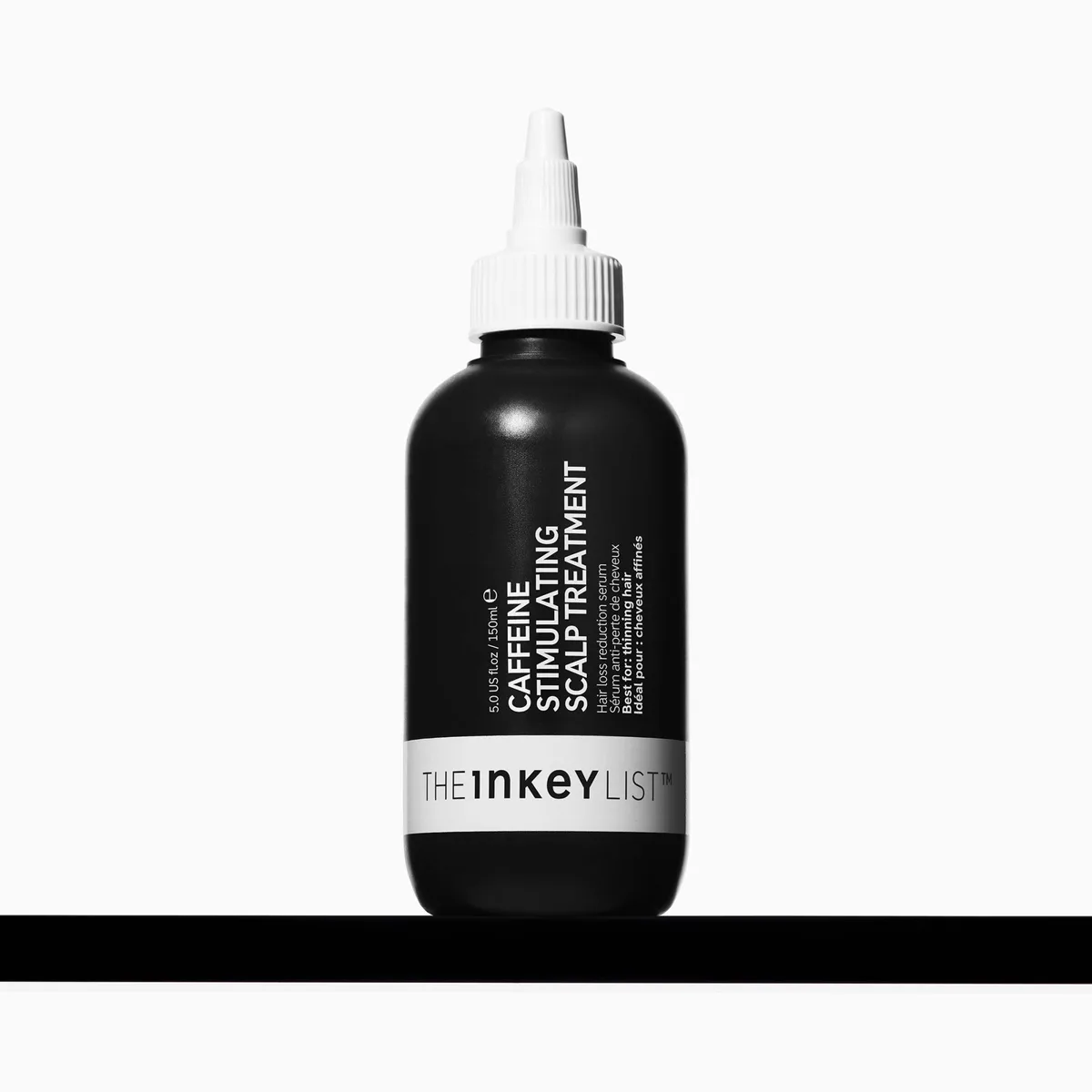
Caffeine has plausible in-vitro mechanism — antagonising testosterone-induced suppression of hair shaft elongation in cultured follicles — and thin clinical evidence at the concentrations and contact times cosmetic products achieve. A caffeine treatment such as The INKEY List Caffeine Stimulating Scalp Treatment is inexpensive and harmless. Treat it as adjunct rather than therapy.
Peptide serums are the category where price and evidence diverge most sharply. Copper tripeptide-1 and acetyl tetrapeptide-3 appear across formulations from Dr. FORHAIR Folligen Thickening Scalp Serum to Aromatica Rosemary Root Volumizing Scalp Ampoule, with mechanistic rationale and no trials remotely comparable to the finasteride or minoxidil literature. At the top of the range, something like Act+Acre Stem Cell Scalp Serum asks a luxury price for plant cell-culture extracts whose relevance to human follicles is, being generous, unestablished. These are pleasant scalp care. They are not staged treatment, and buying one instead of getting staged is the expensive version of waiting.
Which returns to the argument the two old drawings have been making since the 1970s. Find your stage, photograph it, and understand that the number you're at sets the ceiling on everything that follows. The treatments that work, work best on hair you still have — and the scale is, in the end, a picture of how much of that is left.
Products mentioned
Independently reviewed and scored — the real products behind this piece.




- Ingredient Rosemary (Rosmarinus officinalis) The botanical with the most interesting comparative trial data in this category.
- Ingredient Caffeine Mechanistically plausible, clinically thin at cosmetic concentrations.
- Ingredient Copper Peptides (GHK-Cu) Recurring active in premium scalp serums without comparable trial support.
References
- Male pattern baldness: classification and incidence — Southern Medical Journal, 1975
- Classification of the types of androgenetic alopecia (common baldness) occurring in the female sex — British Journal of Dermatology, 1977
- Finasteride in the treatment of men with androgenetic alopecia. Finasteride Male Pattern Hair Loss Study Group — Journal of the American Academy of Dermatology, 1998
- A randomized clinical trial of 5% topical minoxidil versus 2% topical minoxidil and placebo in the treatment of androgenetic alopecia in men — Journal of the American Academy of Dermatology, 2002
- A randomized, placebo-controlled trial of 5% and 2% topical minoxidil solutions in the treatment of female pattern hair loss — Journal of the American Academy of Dermatology, 2004
- Rosemary oil vs minoxidil 2% for the treatment of androgenetic alopecia: a randomized comparative trial — Skinmed, 2015
- Alopecia areata investigational assessment guidelines--Part II. National Alopecia Areata Foundation — Journal of the American Academy of Dermatology, 2004
Every cited link is verified to resolve to the paper named. Where a source could not be independently confirmed, it is listed without a link rather than pointing you somewhere wrong.
Frequently asked
What do the Norwood and Ludwig stages actually measure?
They stage the visible result of miniaturisation — follicles shrinking and their growth phase shortening under the influence of DHT, until thick terminal hairs are replaced by fine vellus ones and scalp shows through. Norwood runs I to VII for the male pattern of temporal recession and crown loss; Ludwig runs I to III for diffuse central thinning with the frontal hairline preserved.
Why does my stage determine what treatment can achieve?
Because finasteride and minoxidil act on follicles that are still alive and cycling — one by reducing scalp DHT, the other by extending the growth phase. Neither creates a new follicle, so once a follicle has been lost and its opening closed, no topical or oral treatment recovers it. Your stage is effectively a count of how much rescuable hair remains.
How much hair does finasteride actually regrow?
Less than the marketing implies and more than the sceptics claim. In the pivotal trials of 1,553 men, treatment increased hair count by 107 and 138 hairs at one and two years within a one-inch circle of balding vertex, from a baseline of 876 in that area. Much of the benefit is that the placebo group kept losing hair while the treated group did not.
Is rosemary oil really as good as minoxidil?
As good as the weaker concentration of it, in one trial. A 2015 randomised comparison of rosemary oil against 2% minoxidil in 100 people found no significant difference in hair count at six months, with less itching in the rosemary group. But 5% minoxidil beat 2% in randomised trials in both men and women, so the comparator was not the standard-strength version.
How do I tell pattern hair loss from stress-related shedding?
By pattern and by complaint. Telogen effluvium is diffuse shedding from the whole scalp, typically beginning two to three months after an illness, surgery, childbirth or major stressor, and it recovers over six to nine months. Pattern loss is regional thinning without dramatic shedding. If your worry is how much hair is coming out, suspect effluvium; if it's how little remains in one area, suspect pattern.
When is hair loss urgent rather than routine?
When the follicular openings disappear. Smooth, shiny scalp with no visible pores where hairs should emerge indicates scarring alopecia, and that loss is permanent. Redness, scaling or tenderness at the hairline or part alongside the loss — or a receding hairline with eyebrow loss in a woman — should be assessed within weeks rather than months, because only the unscarred margin can be preserved.