




Does Oily Skin Actually Need Moisturizer? Yes — and Here's Why
Skipping moisturizer to 'dry out' oily skin is the most self-defeating move in skincare. Your barrier doesn't care about your aesthetic preferences.

Most water-gel moisturizers at this price tier rely on glycerin and a humectant cocktail with token barrier-lipid claims. CeraVe's version actually carries the 3:1:1 ceramide:cholesterol:fatty-acid ratio its R&D was built around, packaged into a base that finally meets oily and combination skin where it lives. It's also the first time CeraVe has put copper PCA in a moisturizer — an understated nod toward the broader 'antioxidant gel' trend.
CeraVe's first proper water gel takes the brand's 3:1:1 ceramide chemistry and finally delivers it in a format that oily and combination skin actually want to wear. The pale-blue, dry-touch finish punches above its drugstore price for daily use, though the 1.7oz size feels stingy and very dry winter skin will still want something heavier on top.
Released in March 2026 with under one hundred independent reviews collected so far, this assessment leans heavily on formula analysis and CeraVe's well-validated barrier-repair template rather than on accumulated long-term feedback. Expect refinements to the scoring as the gel accumulates more real-world wear data through summer 2026.
The case for it
What would change this: A declared concentration would move this to a firmer reading of the dose.
Same rule for everyone. “Good choice” is the verdict on 9,564 of 45,024 concern verdicts across the catalog; rule R5 decided 9,072 of them. Unchanged since September 5, 2026, engine 5.1.1.
Brand or formulator? Disclose a concentration or correct a fact →
The studies behind the evidence row
The case for it
What would change this: A declared concentration would move this to a firmer reading of the dose.
Same rule for everyone. “Promising” is the verdict on 7,858 of 45,024 concern verdicts across the catalog; rule R9p decided 7,858 of them. Unchanged since September 5, 2026, engine 5.1.1.
Brand or formulator? Disclose a concentration or correct a fact →
The studies behind the evidence row
The case for it
What would change this: A researched evidence row for the lead active would replace this with a verdict.
Same rule for everyone. “Good choice” is the verdict on 1,938 of 45,024 concern verdicts across the catalog; rule F2 decided 1,938 of them. Unchanged since September 5, 2026, engine 5.1.1.
Brand or formulator? Disclose a concentration or correct a fact →
Does the jobDoes what a moisturizer is for: supplies barrier lipids, draws in water.
Where our review and the verdict differ. The review below was written on the formulation and the published trials; the verdicts above apply the stricter standing test in our methodology — an active earns a recommendation only with guideline or regulatory standing for the concern. Where the two disagree, the verdict is DermApproved’s position.
A verdict is DermApproved’s assessment of how well a product’s ingredients fit a concern — never a claim about what the product treats. Evidence dots and collected reviews sit beside it and are never blended in. Rules 0.5.1 · evidence table ev-2026.09-r228 · how we decide
For roughly twenty years, CeraVe's moisturizer aisle was a quiet rebuke to anyone with oily skin. The brand owned dermatology offices on the strength of its ceramide chemistry, but its formats — heavy jar cream, slightly less heavy PM lotion, an SA-acid version of each — were calibrated for the dry-and-mature crowd. Anyone shopping for a lightweight gel walked past the white-and-blue CeraVe shelf and into K-beauty's territory, where COSRX, Beauty of Joseon and Torriden had been refining the water-gel format for a decade.
The Hydrating Hyaluronic Acid Water Gel, released in March 2026, is the brand's first credible answer. It is also one of the most genuinely engineered drugstore moisturizers to launch in recent memory — not because anything in it is rare, but because the chemistry has been carefully translated from one base into a fundamentally different one.
The formula carries CeraVe's signature ceramide trio (NP, AP, EOP) in roughly the 3:1:1 ratio that Peter Elias's seminal lipid-replacement research established as the ratio for functional barrier repair. Cholesterol sits a few lines down, completing the trio. That chemistry has appeared in every flagship CeraVe moisturizer since 2005, but moving it into a gel base posed a real problem: the ceramides need a lipid environment to deposit properly, and gels are mostly water. CeraVe's solution is a dimethicone crosspolymer matrix that holds the lipids as discrete pockets within the water-based gel, plus a small amount of triethyl citrate and behentrimonium methosulfate to keep the system stable. It is, to be clear, more engineering than glamour — but it works.
What reads on the skin is a cool, springy gel that dimensions out to nearly invisible in under a minute. There's a faint silicone smoothness to the finish, which is exactly what someone with combination skin who wants makeup to sit cleanly will appreciate. The dry-touch feel makes it easy to layer sunscreen on top without the rolling and pilling that some heavier creams produce.
The pale-blue tint, surprisingly, isn't a marketing dye. It comes from copper PCA, a copper-amino-acid chelate that's natively blue in solution. Copper PCA's evidence base is modest — it's a credible antioxidant with some supporting role in collagen-crosslinking enzymes — but it's a thoughtful inclusion that quietly raises the formula above its price tier. The niacinamide load is also notably higher here than in most CeraVe moisturizers, sitting in the top five ingredients rather than further down the list. That suggests the formulators wanted some active tone-evening and sebum-regulating work happening in the same step.
The formula isn't perfect. Isononyl isononanoate, a synthetic ester, shows up to give the gel its slip — it's mildly comedogenic on paper, and while real-world response varies wildly, it's worth knowing if you're acne-prone. The dimethicone crosspolymer also means the finish is decidedly silicone-y, which a small slice of users dislike. And the format choice — a screw-top jar rather than the airless pumps that most modern K-beauty gels use — feels like a holdover from CeraVe's pharmacy-aisle heritage. With a copper-containing formula that can theoretically oxidize, an airless pump would have been the more thoughtful choice.
Where the gel earns its keep is in versatility. For combination and oily skin it functions as a complete daily moisturizer, lightweight enough to wear in summer humidity without feeling clammy. For dry skin it works as the hydration step under a heavier overnight cream — letting the ceramides and hyaluronic acid penetrate first, then sealing them in with something occlusive. As a layering tool under retinoids it's particularly elegant: the ceramide chemistry buffers retinol's barrier disruption without smothering the active.
Results follow the standard ceramide timeline. Within minutes of the first application the skin feels plumper and more comfortable, courtesy of the layered humectants. The real barrier-strengthening benefit shows up around two to four weeks of consistent twice-daily use, with skin that reads visibly less reactive and reflects light more evenly. It's not a transformation-tier moisturizer; it's a quiet workhorse that does the unglamorous job of keeping the stratum corneum well-fed.
At $21.99 for 1.7oz, the value math is fine without being remarkable. CeraVe's classic Moisturizing Cream gives you 19oz of barrier-repair chemistry for around $19, which is impossible to beat per ounce — but it's the wrong texture for the audience this gel is courting. Compared to a comparable K-beauty water gel like COSRX's Advanced Snail 92, the CeraVe carries a higher ceramide:cholesterol payload and the niacinamide bonus, while the COSRX wins on humectant heft. Honestly, the two complement each other well in a routine.
Who should buy: combination, oily, and normal-skinned users who want the credibility of CeraVe's ceramide chemistry without the heavy feel of the original jar cream. Who should think twice: very dry skin in cold climates (you'll want a richer follow-up), and the fungal-acne-prone (the tocopherol and isononyl isononanoate are borderline). For everyone else, this is the CeraVe many of us have wanted for the better part of two decades.
The hero actives that drive this product's performance.
| Ingredient | Function | Evidence |
|---|---|---|
| Ceramides NP, AP, EOP (3:1:1 Ratio) | CeraVe's signature ceramide trio delivered in a 3:1:1 ratio that mirrors the lipid profile of healthy stratum corneum. Inside the water-gel base, the ceramides are pre-mixed with cholesterol and the dimethicone crosspolymer system so they deposit as discrete lipid pockets that integrate into the skin barrier rather than sitting on top — the key reason a gel-textured product can still claim measurable barrier repair. | Established mechanism for Compromised Skin Barrier · established mechanism |
| Sodium Hyaluronate | The hyaluronic acid in this formula sits high in the ingredient list, paired with glycerin and propanediol to build a layered humectant matrix. Because the gel base contains no heavy occlusives, the HA depends on the dimethicone film above and the ceramide chemistry below to keep the drawn-in water from evaporating off — a more elegant feel than CeraVe's classic Moisturizing Cream, but more dependent on a sealing follow-up step in dry climates. | Established mechanism for Dehydration · established mechanism |
| Niacinamide | Positioned in the top five ingredients here (notably high for a CeraVe moisturizer), niacinamide supports ceramide biosynthesis within the keratinocyte and helps tune sebum behavior — useful given that the lightweight gel base is targeting combination and oily skin types who often skip CeraVe's heavier offerings. It also takes some of the brightening/tone-evening work that copper PCA gestures at lower in the list. | Established mechanism for Compromised Skin Barrier · established mechanism |
| Copper PCA | The reason the formula has that distinctive pale-blue tint without added dye — copper PCA delivers chelated copper, which acts as a mild antioxidant and supports the enzymatic crosslinking involved in collagen and elastin maturation. Concentration is low and the marketing claim around it is modest; treat the copper PCA as a pleasant additive rather than the formula's load-bearing active. | Not yet assessed |
| Cholesterol | Completes the 3:1:1 ceramide:cholesterol:fatty-acid ratio that the formula is engineered around. Without cholesterol, the ceramides alone don't reassemble into a functional barrier matrix — Peter Elias's lipid-replacement research showed barrier repair only proceeds when all three lipid classes are present at roughly physiological ratios, and CeraVe's R&D was built on translating that protocol into commercial form. | Not yet assessed |
Ingredient standings describe the active at treatment-level doses and vehicles; this product's own condition grades weigh its actual formula.
Aqua / Water / Eau, Glycerin, Niacinamide, Propanediol, Dimethicone, Isononyl Isononanoate, Ceramide NP, Ceramide AP, Ceramide EOP, Carbomer, Dimethicone Crosspolymer, Cetearyl Alcohol, Behentrimonium Methosulfate, Triethyl Citrate, Safflower Glucoside, Silica, Sodium Hydroxide, Sodium Hyaluronate, Sodium Lauroyl Lactylate, Sodium Citrate, Cholesterol, Phenoxyethanol, Tocopherol, Chlorphenesin, Copper PCA, Caprylyl Glycol, Trisodium Ethylenediamine Disuccinate, Biosaccharide Gum-1, Xanthan Gum, Phytosphingosine, Benzoic Acid
moisturizer
AM & PM
Pat into damp skin after serums and let the gel set for thirty seconds before layering — the dimethicone crosspolymer wants a moment to film-form before you apply sunscreen. In humid climates this can be your only moisturizer; in dry winters or with retinoids, layer a heavier occlusive cream on top at night.
Skin feels plumper and more comfortable within minutes of the first application thanks to the layered humectants. Barrier-strengthening benefits from the ceramide trio show up over 2–4 weeks of consistent twice-daily use, with visibly more resilient, less reactive skin around the four-week mark.
The formula's load-bearing claim — that a gel base can deliver functional barrier repair — rests on three decades of lipid-replacement research, much of it associated with Peter Elias's lab at UCSF. The foundational finding, published across multiple papers in the 1990s and refined through the 2000s, is that the stratum corneum's intercellular lipid matrix requires ceramides, cholesterol, and free fatty acids in roughly equimolar ratios to function as a permeability barrier. Topically applying ceramides alone, without cholesterol and fatty acids in the right proportions, can paradoxically delay barrier recovery rather than accelerate it. CeraVe's original 2005 launch was built on translating this protocol into a commercial form via the MultiVesicular Emulsion (MVE) delivery system — multilamellar lipid spheres that gradually release the ceramide trio over hours.
This Water Gel takes that same MVE chemistry and embeds it within a dimethicone crosspolymer matrix instead of the brand's classic cream emulsion. The mechanism is well-validated in cosmetic chemistry: silicone crosspolymers form a porous film that allows water-soluble actives to migrate freely while keeping lipid pockets discrete until they're sheared into the skin during application. The niacinamide load is supported by a long-standing evidence base — particularly Hakozaki et al.'s 2002 work in the British Journal of Dermatology demonstrating that 2–5% topical niacinamide upregulates ceramide biosynthesis in keratinocytes, meaning niacinamide functions as a partner active to ceramide formulas rather than a redundant one.
The copper PCA inclusion is more modestly evidenced. Copper-amino-acid complexes have been studied since the late 1980s for their roles in superoxide dismutase activity and as cofactors in lysyl oxidase, the enzyme that crosslinks collagen and elastin. The pioneering work was done with copper tripeptide GHK-Cu (Pickart's research at the Skin Biology lab) rather than copper PCA specifically; the leap from GHK-Cu's clinical results to a pale-blue PCA chelate in a drugstore gel is significant, and the copper PCA here should be treated as a pleasant additive rather than a clinically validated active.
Dermatologists frequently reach for CeraVe formulations as a starting point for patients rebuilding compromised barriers, and the Water Gel adds a useful tool to that toolkit — specifically for patients whose oily or combination skin has caused them to skip moisturizer entirely or under-moisturize after retinoid prescriptions. Clinical guidance often emphasizes that texture compliance matters as much as ingredient efficacy: a patient who finds a cream too heavy and stops using it gets zero benefit, while the same chemistry in a wearable gel gets used twice daily. Working dermatologists writing for major outlets have flagged this water-gel format as a meaningful gap-filler in the CeraVe lineup, particularly for younger patients on tretinoin who need ceramide support without the occlusive feel of the original cream. The standard cautions still apply: patch-test along the jaw for those with sensitive or fungal-acne-prone skin, and don't expect a gel-format moisturizer to fully substitute for a richer cream in cold dry winter conditions.
After cleansing and any treatment serums, dispense a generous pea-sized amount onto fingertips and press into damp skin across the face and neck. Allow thirty seconds for the dimethicone crosspolymer to film-form before layering sunscreen in the morning or an additional occlusive cream at night. In humid summer weather this can be your only moisturizer; in cold dry climates, layer a richer cream on top after the gel has absorbed. For combination skin, the gel works well as an all-over base with a heavier cream spot-applied to dry zones only.
At $21.99 for 1.7oz, the gel sits at the upper end of CeraVe's pricing — roughly double the per-ounce cost of the classic Moisturizing Cream. That gap is partly justified by the engineered base, the higher niacinamide load, and the copper PCA inclusion, but it's also influenced by L'Oréal-owned CeraVe's expansion into prestige-adjacent SKUs at the slight premium that demands. For a drugstore moisturizer with this chemistry, the price is reasonable; against K-beauty competition like COSRX's Advanced Snail 92 Cream (around $25 for 100ml), it's slightly worse value per milliliter but better dermatology backing. CeraVe's legacy of nearly twenty years of clinical recommendation lets this gel earn its price in a way a hyped indie launch couldn't.
Combination, oily, or normal-skinned users who have wanted CeraVe's ceramide chemistry in a texture that doesn't feel heavy. Particularly recommended for anyone newly on a prescription retinoid who needs barrier support without the occlusive weight of the classic cream, and for summer-routine users in humid climates.
Very dry skin in cold winters will find the gel insufficient on its own and may prefer the classic Moisturizing Cream or a richer alternative. Anyone with confirmed fungal acne should patch-test carefully — the tocopherol and isononyl isononanoate aren't strictly malassezia-feeding but sit in a borderline zone.
Ready to try CeraVe Hydrating Hyaluronic Acid Water Gel?
Buy at Amazon ♥Pale-blue water gel with a cool, slightly springy feel on application, dimensions out almost transparent and leaves a dry, slightly silicone-smooth finish
Genuinely scentless — no detectable masking note, in keeping with CeraVe's fragrance-free pharmacy positioning
Standard CeraVe screw-top jar in a translucent pale-blue tinted plastic — not the most hygienic format compared to the airless pumps that competing K-beauty water gels often use
Cool to the touch on application and absorbs within a minute, leaving skin that reads matte but feels supple. The blue tint disappears on the skin. Some users with very dehydrated skin notice they still want a heavier product on top during the first week of use; this fades as the ceramide replenishment kicks in.
Roughly 2–3 months at twice a day face-and-neck use, slightly less if you apply heavily after retinoid nights
All Year
CeraVe's catalog had historically been jar creams and lotions, which left oily-skinned customers reaching for K-beauty water gels instead. The March 2026 launch closes that gap, using research the L'Oréal-owned brand has done into 'ceramide booster' technology — pre-ceramide precursors that activate within the skin to extend the ceramide-repair window beyond what a single topical dose can do.
CeraVe was co-developed with dermatologists in 2005 and remains one of the most-recommended skincare brands in U.S. dermatology offices, anchored by its patented MultiVesicular Emulsion ceramide-delivery system. The Water Gel is a March 2026 line extension into the lightweight-gel format that K-beauty made dominant, applying CeraVe's signature 3:1:1 ceramide ratio to a non-occlusive, dry-touch base.
A gel moisturizer can't deliver real barrier repair — that needs a cream or balm.
Barrier repair depends on the lipid chemistry reaching the stratum corneum, not the texture carrying it there. This gel uses dimethicone crosspolymer and the MultiVesicular Emulsion approach to deposit ceramides effectively despite the lightweight feel.
The blue color means there's added dye.
The tint comes from copper PCA, a copper-amino-acid complex that's pale blue in solution and doubles as a mild antioxidant. The formula lists no added colorants.
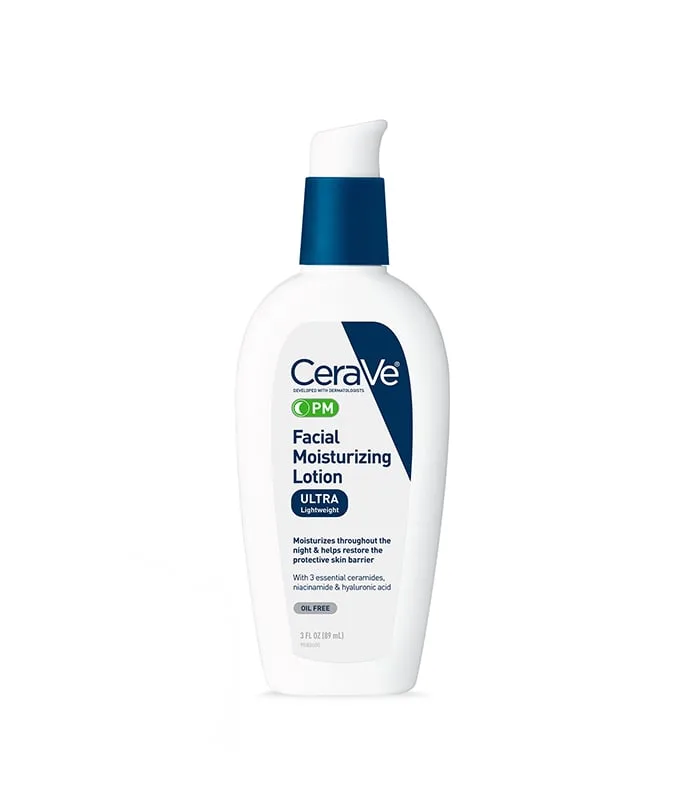
The Water Gel uses a gel base built on dimethicone crosspolymer and a heavier copper PCA / niacinamide load, designed to feel dry-touch on oily-leaning skin. The PM Lotion is a thin lotion that flows differently and leaves a softer film. Both share the 3:1:1 ceramide ratio, so the choice comes down to texture preference and what your skin type tolerates.
For most dry skin in cold dry climates, it isn't — the gel is engineered to be non-occlusive, so transepidermal water loss in single-digit humidity can outpace what the formula can hold. Layer a thicker cream or balm over it overnight in winter, or save the gel for warmer months.
Yes, and it's a thoughtful pairing — the ceramide and cholesterol chemistry buffers the barrier disruption retinol causes, and the gel's lightweight feel won't fight a retinoid's preference for clean, fully-absorbed skin underneath. Apply retinol first, wait a few minutes, then layer the gel.
No — the pale-blue tint disappears as the gel absorbs (it's chelated copper, not a colorant), and the formula leaves no residue that would transfer to pillowcases or shirts.
Not strictly. While the formula is fragrance-free and free of straight fatty acids, it contains tocopherol and isononyl isononanoate, which can be borderline for malassezia-prone skin. Patch-test along the jawline for two weeks before committing if you've struggled with fungal acne.
Like most of CeraVe's U.S.-distributed catalog it is manufactured in the United States under L'Oréal's supply chain. The brand has not specified the exact facility for this particular SKU.
Recurring themes our editors read across retailer reviews of this product — summaries in our words, not quotations, and not a substitute for your own patch test.
Among the limited reviews available, the dry-touch finish under makeup is the most-mentioned positive
Several reviewers note the gel layers well under sunscreen without pilling
Early adopters with combination skin appreciate the lightweight feel that still delivers ceramide chemistry
A few reviewers find the 1.7oz size small for the $21.99 price
Some users with very dry skin report needing a heavier moisturizer on top in winter
Initial impressions from a handful of users mention the gel takes longer to absorb than expected
Verified answers from our questions library — the nuance a product page cannot carry.