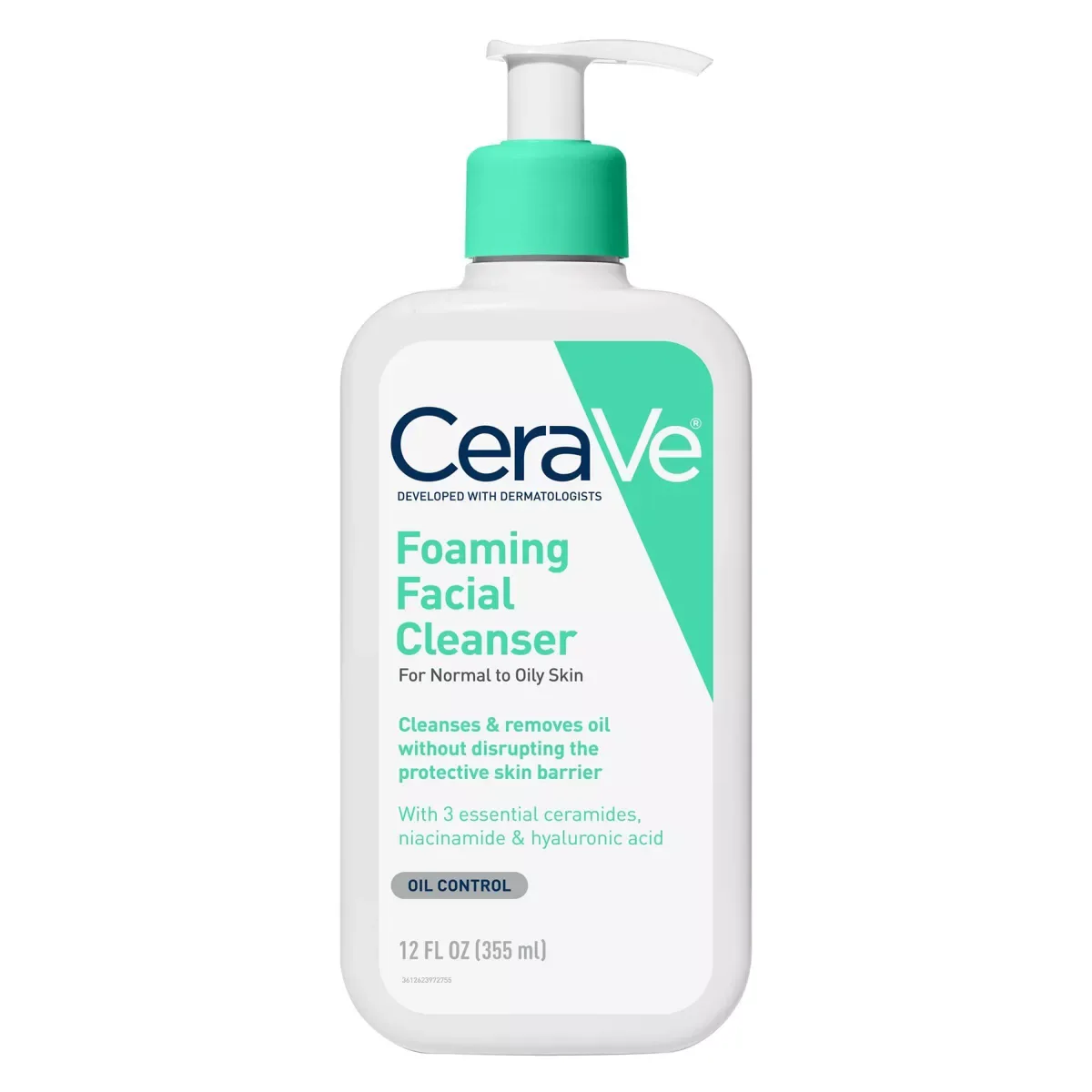
While most foaming cleansers rely on sulfates that indiscriminately strip everything from the skin surface, this formula uses amino acid-based surfactants (sodium lauroyl sarcosinate, sodium methyl cocoyl taurate) paired with three ceramides and cholesterol to selectively remove excess sebum while actively replenishing the barrier lipids that other cleansers destroy. The result is a foaming cleanser that oily skin types can use twice daily without the rebound oil production that harsh cleansers trigger.
The CeraVe Foaming Facial Cleanser is the rare drugstore cleanser that dermatologists actually use themselves — a genuinely gentle foaming wash that removes excess oil without triggering the rebound sebum production that plagues most lathering cleansers. At under sixteen dollars for a bottle that lasts months, it makes skipping it almost irrational.
Supporting rolefor AcneIn your profileYou chose · Rinse-off gel: Niacinamide gets seconds of contact, so this supports a routine for acne rather than treating it.Moderate evidenceStandard tolerability250 reviews collected
The case for it
Niacinamide has early or mechanistic evidence for this concern, not trial-backed standing.
It is in a rinse-off product, so it gets seconds of contact rather than the leave-on exposure the evidence assumes.
The formula carries no trigger this concern is sensitive to, with the cautions noted.
What would change this: The same active in a leave-on form would be judged on its evidence rather than its contact time.
Same rule for everyone. “Supporting role” is the verdict on 8,197 of 45,024 concern verdicts across the catalog; rule R6 decided 2,017 of them.
Unchanged since September 5, 2026, engine 5.1.1.
R6 — Contact time cannot deliver a leave-on claim; the product is judged on its job (cleansing without aggravating). Explicit exceptions (BPO wash, SA cleanser, medicated shampoos) never reach this rule because their rows set rinse_off_ok. · the full register
Carrying active
Niacinamide
Standing
plausible — trials support it
Form
contact limited — studied range 4–5%, from the OTC monograph or label; needs leave-on contact; judge it after ~8 weeks
Tolerability
standard
Row checked
against its sources on July 17, 2026 (evidence table ev-2026.09-r228)
Supporting rolefor Excess OilinessIn your profileYou chose · Rinse-off gel: Niacinamide gets seconds of contact, so this supports a routine for excess oiliness rather than treating it.Moderate evidenceStandard tolerability92% report improvement · n = 31
The case for it
Niacinamide has early or mechanistic evidence for this concern, not trial-backed standing.
It is in a rinse-off product, so it gets seconds of contact rather than the leave-on exposure the evidence assumes.
The formula carries no trigger this concern is sensitive to, with the cautions noted.
What would change this: The same active in a leave-on form would be judged on its evidence rather than its contact time.
Same rule for everyone. “Supporting role” is the verdict on 8,197 of 45,024 concern verdicts across the catalog; rule R6 decided 2,017 of them.
Unchanged since September 5, 2026, engine 5.1.1.
R6 — Contact time cannot deliver a leave-on claim; the product is judged on its job (cleansing without aggravating). Explicit exceptions (BPO wash, SA cleanser, medicated shampoos) never reach this rule because their rows set rinse_off_ok. · the full register
Carrying active
Niacinamide
Standing
plausible — trials support it
Form
contact limited — studied range 2%, from the trials on the row; needs leave-on contact; judge it after ~8 weeks
Tolerability
standard
Row checked
against its sources on July 17, 2026 (evidence table ev-2026.09-r228)
Supporting rolefor Large PoresIn your profileYou chose · Rinse-off gel: Niacinamide gets seconds of contact, so this supports a routine for large pores rather than treating it.Moderate evidenceStandard tolerability250 reviews collected
The case for it
Niacinamide has early or mechanistic evidence for this concern, not trial-backed standing.
It is in a rinse-off product, so it gets seconds of contact rather than the leave-on exposure the evidence assumes.
The formula carries no trigger this concern is sensitive to, with the cautions noted.
What would change this: The same active in a leave-on form would be judged on its evidence rather than its contact time.
Same rule for everyone. “Supporting role” is the verdict on 8,197 of 45,024 concern verdicts across the catalog; rule R6 decided 2,017 of them.
Unchanged since September 5, 2026, engine 5.1.1.
R6 — Contact time cannot deliver a leave-on claim; the product is judged on its job (cleansing without aggravating). Explicit exceptions (BPO wash, SA cleanser, medicated shampoos) never reach this rule because their rows set rinse_off_ok. · the full register
Carrying active
Niacinamide
Standing
plausible — trials support it
Form
contact limited — studied range 4%, from the trials on the row; needs leave-on contact; judge it after ~8 weeks
Tolerability
standard
Row checked
against its sources on July 17, 2026 (evidence table ev-2026.09-r228)
Supporting rolefor BlackheadsIn your profileYou chose · Nothing here targets blackheads directly; gentle cleansing is the recognised companion to treating it, and this gel does that without known triggers.Not yet assessedStandard tolerability250 reviews collected
The case for it
Niacinamide has no evidence row yet for this concern — it is in the research queue.
The formula carries no trigger this concern is sensitive to, with the cautions noted.
What would change this: A researched evidence row for the lead active would replace this with a verdict.
Same rule for everyone. “Supporting role” is the verdict on 8,197 of 45,024 concern verdicts across the catalog; rule R8 decided 4,250 of them.
Unchanged since September 5, 2026, engine 5.1.1.
R8 — The category's job (barrier care, humectant hydration, gentle cleansing, photoprotection) is the documented supportive role for this concern. This is the honest verdict for a moisturizer on an acne page. · the full register
Excellent at the jobDoes what a cleanser is for, on every measure we can take from the label: pH match to skin, puts something back.
A verdict is DermApproved’s assessment of how well a product’s ingredients fit a concern — never a claim about what the product treats. Evidence dots and collected reviews sit beside it and are never blended in.
Rules 0.5.1 · evidence table ev-2026.09-r228 · how we decide
Assessment
Pros & Cons
Pros
✓ Amino acid-based surfactants provide effective foaming without sulfate-level irritation
✓ Three skin-identical ceramides actively protect the barrier during cleansing
✓ Fragrance-free formula eliminates a major source of contact sensitization
✓ Exceptional value at under sixteen dollars for a four-to-five month supply
✓ Rinses completely clean with no residue or film on the skin
✓ pH-balanced at approximately 5.5 to match the skin's natural acid mantle
✓ National Eczema Association Seal of Acceptance confirms gentle formulation
Cons
✗ Too stripping for genuinely dry skin types despite gentle surfactant system
✗ Contains methylparaben and propylparaben which some consumers prefer to avoid
✗ Will not remove heavy makeup or waterproof sunscreen without double cleansing
✗ Pump dispenser can clog toward the end of the bottle
✗ Niacinamide concentration is too low for standalone sebum-control benefits
Review
Full Review
There was a time when foaming cleansers occupied a very specific place in the skincare hierarchy: effective but punishing. You used one because your skin was oily, you accepted the tightness as evidence that it was working, and you moved on with your day wondering why your face felt like parchment by noon. The CeraVe Foaming Facial Cleanser arrived and politely dismantled that entire premise.
Launched as part of CeraVe's original lineup in the mid-2000s, this cleanser was built on an idea that sounded almost paradoxical at the time — a foaming face wash that actively repairs the skin barrier while it cleans. The brand's dermatologist developers understood something that the mass market had largely ignored: that the lipids stripped away by harsh surfactants were the same ceramides your skin desperately needed to function properly. So they formulated a cleanser that puts them back.
The ingredient list reads like a masterclass in thoughtful formulation. Instead of sodium lauryl sulfate or its slightly gentler cousin sodium laureth sulfate, CeraVe chose amino acid-based surfactants — sodium lauroyl sarcosinate and sodium methyl cocoyl taurate. These create the satisfying lather that oily-skin users crave without the indiscriminate lipid stripping that sulfates are notorious for. It is the difference between a surgeon and a sledgehammer, and your sebaceous glands know it.
The ceramide complex — NP, AP, and EOP — is where this cleanser earns its clinical reputation. These three ceramides are identical to the ones naturally found in your skin's lipid matrix, and they work alongside cholesterol and phytosphingosine to form the same lamellar structures that make up a healthy stratum corneum. In a cleanser, their job is not so much to build up the barrier as to prevent the cleansing process from tearing it down. Think of it as a renovation crew that cleans the site while simultaneously reinforcing the foundation.
Niacinamide appears mid-list, which in a cleanser formula means it is present at a functional but not therapeutic concentration. The research on topical niacinamide and sebum regulation is solid — a well-cited 2006 study in the Journal of Cosmetic and Laser Therapy demonstrated that even 2% niacinamide significantly reduced sebum excretion rates over four weeks. In a rinse-off product, the contact time is brief, but twice-daily use means cumulative exposure adds up. It is not going to replace a dedicated niacinamide serum, but it sets the stage.
Hydrolyzed hyaluronic acid rounds out the active roster. The hydrolyzed form is deliberately chosen over standard hyaluronic acid because its smaller molecular weight gives it a fighting chance of depositing moisture during the thirty to sixty seconds this product spends on your face. It is a small detail that reveals big thinking — this is a formula where every ingredient was chosen for the specific context of a rinse-off product, not just borrowed from a leave-on moisturizer spec sheet.
In use, the experience is almost disarmingly simple. A small amount of the transparent gel dispensed onto wet hands transforms into a soft, airy foam that spreads easily across the face. There is no fragrance — not a pleasant one, not a masked one, simply none. The foam rinses completely, leaving behind nothing — no film, no residue, no tightness. The first time you use it, the absence of that post-wash squeak might feel wrong if you have spent years with harsher cleansers. Give it three days. Your skin will educate you.
For oily and combination skin types, this cleanser performs its core job — removing excess sebum, environmental debris, and light makeup — with remarkable consistency. It will not dissolve a full face of waterproof makeup or heavy sunscreen on its own, so double-cleansing advocates will want an oil-based first step in the evening. But as a morning cleanser and a second-step evening cleanser, it hits the sweet spot between thorough and gentle with a precision that explains its two-decade staying power.
The limitations are real but narrow. If your skin is genuinely dry — not dehydrated-combination-that-thinks-it-is-dry, but actually lacking oil production — this cleanser will likely feel stripping despite its gentle surfactants. The foaming action, however mild, removes sebum that dry skin cannot afford to lose. CeraVe makes the Hydrating Facial Cleanser for exactly this reason, and the brand deserves credit for clearly delineating who each product serves rather than claiming universal suitability.
The paraben question will arise, as it always does. This cleanser contains methylparaben and propylparaben as preservatives. Every major regulatory body, including the FDA, Health Canada, and the EU Scientific Committee on Consumer Safety, considers parabens safe at cosmetic concentrations. But consumer preference is consumer preference, and if parabens are a dealbreaker for you, this product does not accommodate that preference.
The packaging is functional rather than inspired — a white plastic pump bottle that dispenses product cleanly and reliably. The pump occasionally clogs near the end of the bottle's life, a minor annoyance that affects approximately zero dermatologists' willingness to recommend it. The 16-ounce size represents extraordinary value, lasting four to five months with twice-daily use, which works out to roughly three to four dollars per month for a cleanser containing ceramides, niacinamide, and hyaluronic acid.
In an era when the average cleanser launch comes wrapped in influencer partnerships and ingredient-count one-upmanship, the CeraVe Foaming Facial Cleanser remains stubbornly, almost defiantly boring. It does not photograph well. It does not trend on social media for its aesthetic. It does not promise to transform your skin in seven days. What it does is clean oily skin thoroughly, protect the barrier while doing it, and cost less per use than a mediocre cup of coffee. Nearly twenty years of dermatologist recommendations and tens of thousands of positive reviews suggest that boring, in this case, is exactly what works.
Formula
Key Ingredients
The hero actives that drive this product's performance.
This trio of skin-identical ceramides works with the cholesterol and phytosphingosine in the formula to replenish the lipid matrix that surfactants can strip during cleansing, helping the skin barrier stay intact even as the foaming agents remove excess oil.
Included at a functional level to help regulate sebum output in the oily and combination skin types this cleanser targets, while providing anti-inflammatory support that reduces post-cleansing redness — a smart pairing with the surfactant system.
The hydrolyzed form has a smaller molecular weight than standard hyaluronic acid, allowing it to deposit moisture into the skin during the brief contact time of a cleanser rather than simply rinsing away.
Completes the ceramide-cholesterol-fatty acid triad that mirrors the skin's natural lipid composition, ensuring the barrier-replenishing ingredients in this cleanser integrate with the stratum corneum rather than sitting on top of it.
A ceramide precursor with inherent antimicrobial properties that supports the three ceramides in this formula while helping to keep acne-prone skin clear — a dual-purpose ingredient that adds both barrier support and gentle antimicrobial action.
Not yet assessed
Ingredient standings describe the active at treatment-level doses and
vehicles; this product's own condition grades weigh its actual formula.
Use as the second step in a double-cleansing routine (after an oil cleanser or micellar water in the PM) or as your sole morning cleanser. Follow immediately with toner or serum while skin is still slightly damp.
Results Timeline
Skin feels clean without tightness immediately after first use. Within 1-2 weeks of consistent use, oiliness and shine throughout the day should noticeably decrease. Full benefits to skin barrier health and reduced breakout frequency typically become apparent after 4-6 weeks.
Pairs Well With
Niacinamide serumsHyaluronic acid serumsLightweight gel moisturizersChemical sunscreens
The CeraVe Foaming Facial Cleanser's formulation centers on the interplay between its surfactant system and its barrier-replenishing lipid complex. The surfactants — sodium lauroyl sarcosinate and sodium methyl cocoyl taurate — belong to the amino acid surfactant class, which research has consistently shown to be less disruptive to stratum corneum lipids than traditional anionic surfactants like sodium lauryl sulfate.
The ceramide complex (NP, AP, and EOP) combined with cholesterol and phytosphingosine reflects the physiological ratio of lipids found in healthy human stratum corneum. A 2023 consensus review published in the Journal of Drugs in Dermatology, titled "The Importance of a Healthy Skin Barrier From the Cradle to the Grave Using Ceramide-Containing Cleansers and Moisturizers," concluded that ceramide-containing cleansers help maintain barrier integrity and are particularly beneficial for patients using potentially irritating topical treatments such as retinoids or benzoyl peroxide.
The inclusion of niacinamide is supported by a 2006 study by Draelos et al. published in the Journal of Cosmetic and Laser Therapy, which demonstrated that topical 2% niacinamide significantly reduced facial sebum excretion rates in a four-week trial of 50 subjects. While the contact time in a cleanser is limited compared to leave-on formulations, the cumulative effect of twice-daily application provides meaningful niacinamide exposure over time.
Phytosphingosine, a sphingoid base and ceramide precursor, contributes both to barrier lipid synthesis and to the formula's antimicrobial properties. Research has shown phytosphingosine to have activity against Cutibacterium acnes, the bacterium implicated in inflammatory acne, making it a strategically chosen ingredient for a cleanser targeting oily and acne-prone skin.
Dermatologists have long recommended the CeraVe Foaming Facial Cleanser as a first-line cleanser for patients with oily and acne-prone skin, particularly those using prescription topicals like tretinoin or adapalene that can compromise the skin barrier. Dermatology practitioners typically acknowledge that the ceramide-based formula allows patients to cleanse thoroughly without exacerbating the irritation and dryness that prescription treatments can cause. The gentle surfactant system makes it suitable for twice-daily use even in patients on aggressive acne regimens, and its non-comedogenic, fragrance-free profile reduces the variables that can complicate acne treatment outcomes. It is commonly recommended as part of a simplified routine where the cleanser and moisturizer handle barrier support while active treatments handle the condition.
Guidance
Usage & Recommendations
How to Use
Wet your face with lukewarm water. Dispense a nickel-sized amount onto your fingertips and gently massage across the face in circular motions for thirty to sixty seconds, avoiding the eye area. The gel will transform into a light foam as you work it in. Rinse thoroughly with lukewarm water and pat dry. Use morning and evening. In the PM, if wearing heavy makeup or sunscreen, precede with an oil-based cleanser or micellar water for a complete double cleanse. Follow immediately with your next skincare step while skin is still slightly damp.
Value Assessment
At approximately fifteen to sixteen dollars for the 16-ounce bottle, the CeraVe Foaming Facial Cleanser offers value that borders on absurd. A bottle lasts four to five months with twice-daily use, bringing the cost to roughly three to four dollars per month for a ceramide-containing, niacinamide-infused, dermatologist-developed cleanser. Other sizes are available — including 3-ounce, 8-ounce, and 12-ounce options — though the 16-ounce pump provides the best per-ounce value. For a brand with CeraVe's two decades of clinical validation and dermatologist backing, this pricing reflects genuine accessibility rather than budget corner-cutting.
Who Should Buy
Anyone with oily, combination, or normal skin looking for an affordable, no-nonsense daily cleanser that cleans effectively without barrier damage. Particularly well-suited for acne-prone skin types and those using prescription retinoids or other potentially irritating treatments who need their cleanser to support rather than undermine their routine.
Who Should Skip
People with dry or very dry skin who need a non-foaming, cream-based cleanser. Also not ideal for anyone with a strict paraben-free preference, as this formula uses methylparaben and propylparaben as preservatives.
Transparent gel that transforms into a light, airy foam when worked between wet hands. Rinses completely clean with no residue.
Scent
Fragrance-free with a very faint, clean, almost clinical scent from the base ingredients that dissipates immediately upon rinsing.
Packaging
Tall cylindrical bottle with a pump dispenser. Available in white plastic bottles with the signature CeraVe blue and green labeling.
Finish
non-greasymattefast-absorbing
What to Expect on First Use
From the first wash, skin feels clean but not stripped — the hallmark of the ceramide-buffered surfactant system. There is no adjustment period, purging, or tingling. Some users with very oily skin may notice a slight reduction in midday shine within the first few days.
How Long It Lasts
4-5 months applied morning and night from the 16 fl oz bottle
National Eczema Association Seal of AcceptanceCradle to Cradle Certified Silver
Background
The Story Behind This Product
CeraVe launched in 2005 as a dermatologist-developed brand built around a singular idea: that skincare products should contain the ceramides your skin naturally produces. The Foaming Facial Cleanser was among the brand's earliest offerings, designed to prove that a drugstore cleanser could be both effective for oily skin and genuinely barrier-friendly — a combination that barely existed in the mid-2000s mass market.
About CeraVe Legacy Brand (20+ years)
CeraVe was developed with dermatologists in 2005 and has become the number-one dermatologist-recommended skincare brand in the U.S. Its formulations are backed by peer-reviewed research and the brand holds National Eczema Association seals of acceptance across multiple products.
Brand founded: 2005 · Product launched: 2006
Myth vs. Reality
Common Myths
Myth
Foaming cleansers always strip and damage the skin barrier.
Reality
This formula uses gentle amino acid-based surfactants rather than harsh sulfates, and includes three ceramides plus cholesterol to actively replenish barrier lipids during cleansing. The foam itself is not the enemy — it is the surfactant type that matters.
Myth
The niacinamide in this cleanser is wasted because it rinses off too quickly to work.
Reality
While contact time is limited in a cleanser, research shows that even brief exposure to niacinamide can deposit enough on the skin to provide measurable sebum-regulating benefits, especially with twice-daily use over weeks.
FAQ
Frequently Asked Questions
Is CeraVe Foaming Facial Cleanser good for acne-prone skin?
Yes — this cleanser's combination of niacinamide for sebum regulation, phytosphingosine for antimicrobial support, and gentle amino acid surfactants makes it well-suited for acne-prone skin. It removes excess oil that contributes to breakouts without damaging the skin barrier, which can worsen acne when compromised.
Can I use CeraVe Foaming Facial Cleanser if I have sensitive skin?
It works for many people with sensitive skin thanks to its fragrance-free, sulfate-free formula and ceramide content. However, if your skin is both sensitive and dry, the foaming action may still feel slightly stripping — in that case, the CeraVe Hydrating Facial Cleanser would be a better match for your skin type.
How is this different from CeraVe Hydrating Facial Cleanser?
The Foaming version uses amino acid-based surfactants that create a lather and more effectively remove excess oil, making it ideal for normal-to-oily skin. The Hydrating version is a non-foaming, cream-based cleanser designed for dry-to-normal skin. Both contain ceramides and hyaluronic acid, but the surfactant system and target skin type differ significantly.
Does CeraVe Foaming Facial Cleanser contain sulfates?
No. Despite producing a satisfying foam, this cleanser uses sodium lauroyl sarcosinate and sodium methyl cocoyl taurate — both amino acid-derived surfactants — instead of sulfates like SLS or SLES. These provide effective cleansing with significantly less irritation potential.
Can I use CeraVe Foaming Facial Cleanser with retinol?
Yes — this cleanser's ceramide-rich formula makes it a particularly good pairing with retinol. The barrier-supporting ingredients help counteract the dryness and irritation that retinol can cause, and the gentle surfactant system avoids compounding retinol-related sensitivity.
Is CeraVe Foaming Facial Cleanser pregnancy-safe?
Yes. This cleanser contains no retinoids, salicylic acid, or other ingredients typically flagged during pregnancy. Its ceramides, niacinamide, and hyaluronic acid are all considered safe for use during pregnancy and breastfeeding.
Why does CeraVe Foaming Facial Cleanser contain parabens?
Methylparaben and propylparaben are used as preservatives to maintain product stability and prevent microbial growth. While parabens have been controversial, regulatory bodies including the FDA and EU Scientific Committee on Consumer Safety consider them safe at the concentrations used in cosmetics. CeraVe prioritizes formula efficacy and stability in their preservation system.
Reviews
What Reviewers Tend to Say
Recurring themes our editors read across retailer reviews of this product — summaries in our words, not quotations, and not a substitute for your own patch test.
Common Praise
Removes oil without leaving skin tight or dry
Affordable for the ingredient quality
Gentle enough for daily use
Fragrance-free formula suitable for sensitive noses
Lathers nicely without harsh sulfates
Common Complaints
Too drying for genuinely dry skin types
Contains parabens which some users prefer to avoid
Pump dispenser can clog over time
Travel size is disproportionately expensive
Notable Endorsements
Number-one dermatologist-recommended cleanser brand in the U.S.National Eczema Association Seal of AcceptanceCradle to Cradle Certified at Silver level
The barrier-lipid science underneath the brand is real and older than the brand itself. The range built on top of it is flatter and stronger than its reputation suggests — with one clear weak spot and two categories it simply doesn't make.
Every beginner guide quietly wants to sell you nine. The physiology wants three — and the most valuable thing a skincare site can give a newcomer is the confidence not to buy things.
Products, answers, therapy guides, tools and articles in one search. Brand names,
slang and abbreviations all work — accutane finds isotretinoin, bacne finds truncal acne.