Poloxamer 184
Products with Poloxamer 184
 Gentle First Step
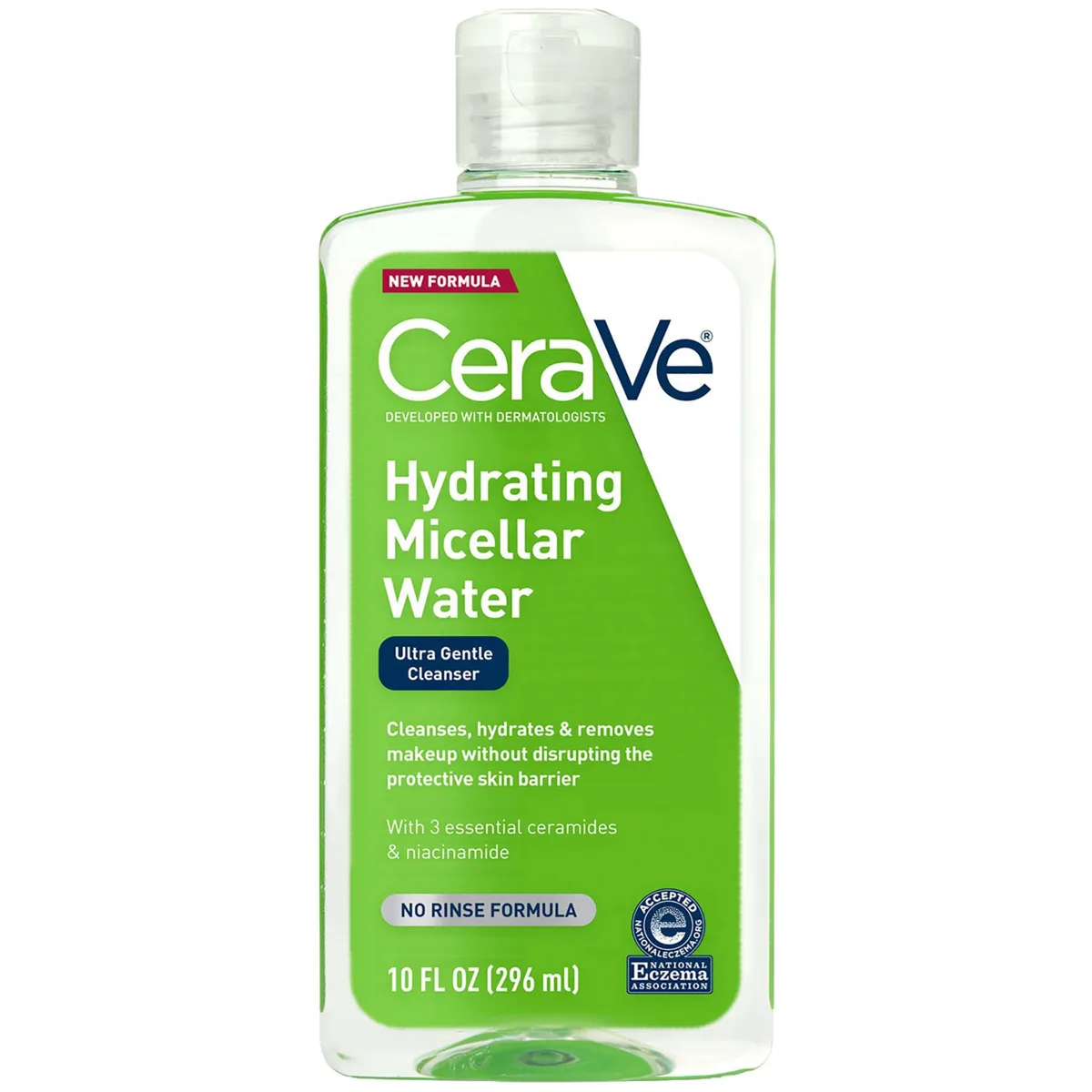
Hydrating Micellar Water
CeraVe's Hydrating Micellar Water takes a convenience product and gives it a clinical upgrade — depositing ceramides and niacinamide onto the skin during a no-rinse cleanse that most micellar waters accomplish with nothing but surfactant and water. It is the smartest micellar water at the drugstore, even if the category itself has inherent limitations.
 Community-Created Cult Cleanser
Milky Jelly Cleanser
Milky Jelly Cleanser is the rare product that genuinely delivers on the promise of 'gentle but effective' — the poloxamer surfactant system cleans without disrupting the lipid barrier, and the triple-soothing blend keeps skin conditioned during the wash. The price and mild nature may frustrate oily or acne-prone skin, but for sensitive and dry types, this is as good as daily cleansing gets.
 French Pharmacy Sensitive-Skin Staple
Make-up Remover Water with Soothing Cornflower
A six-ingredient micellar water from one of France's oldest botanical pharmacy brands — fragrance-free, gentle around the eyes, and priced for daily use. Three months of cleansing for less than the cost of a single luxury serum.
 Oily-Skin Quick Clean
Pureté Thermale Mineral Micellar Water for Combination to Oily Skin
A smarter-than-average micellar water that quietly folds salicylic and lactic acid into a no-rinse cleanse built for oily and combination skin. It degreases without leaving skin tight and gently smooths texture over time. The added fragrance and alcohol mean dry or reactive skin should look elsewhere, but for shiny T-zones it earns its place.
 Makeup Artist Go-To
Bi-Facil Double-Action Eye Makeup Remover
The original prestige bi-phase eye makeup remover that still sets the standard for effortless waterproof makeup dissolution. Genuinely effective and gentle in use, though the inclusion of a formaldehyde-releasing preservative in a product for the delicate eye area is hard to overlook at this price point.
The full poloxamer 184 guide
The number is not a model year or a marketing flourish — it is a specification you can decode.
In the poloxamer naming system the first two digits give the approximate molecular mass of the water-hating middle block, and the last digit multiplied by ten gives the percentage of water-loving polymer wrapped around it. So 184 describes a molecule with a propylene oxide core near 1,800 and roughly 40% polyethylene oxide. Almost nothing else on an ingredient list tells you its own structure that plainly.
How it's regulated in the US
FDA does not classify ingredients — it classifies products, by what they are sold to do. The same molecule can be a drug active in one product and a cosmetic ingredient in the next, and only the claim on the label decides which. What follows is a statement about that legal standing, not about whether it works — the evidence question is answered separately above.
Cosmetic Poloxamer 184 is a cosmetic ingredient in the US: no OTC monograph covers it and it is not an active in any FDA-approved drug, so a product built around it is a cosmetic rather than a drug.
There is nothing controversial to adjudicate here, which is itself worth saying clearly on a page a reader may have arrived at expecting a hidden nasty. The Cosmetic Ingredient Review expert panel assessed the poloxamer family — more than thirty members, 184 among them — and concluded they are safe as used in cosmetics, noting that clinical tests of dermal irritation and sensitization were uniformly negative. Its function as a nonionic surfactant, solubilizer and cleansing agent is established formulation chemistry rather than a claim requiring trial support. What does not exist, and should not be expected to, is evidence that poloxamer 184 treats any skin condition. It is not an active and makes no therapeutic claim; it is the thing that lets the actives and the oils and the water occupy the same bottle without separating.
How it works
A poloxamer is a triblock copolymer, which is a precise way of saying it is three chains joined end to end. The middle stretch is polypropylene oxide, which dislikes water; the two outer stretches are polyethylene oxide, which likes it. A molecule with both preferences in one body is amphiphilic, and amphiphilic molecules organise themselves at boundaries. In practice that means two useful behaviours. Above a certain concentration these molecules cluster into micelles — tiny spheres with the water-hating cores turned inward and the water-loving ends facing out. Oils, fragrance materials and poorly soluble actives tuck into those cores, which is how a clear liquid can contain something that ought to separate out. That is solubilisation, and it is why micellar waters and clear cleansers exist. The second behaviour is cleansing. The same structure lets a poloxamer surround sebum and makeup and carry them into rinse water, but it does so without an electrical charge. That distinction matters more than it sounds: the harsh cleansing surfactants are anionic, negatively charged, and much of their irritancy comes from how aggressively they bind skin proteins. Nonionic surfactants like this one lift oil with far less of that interaction, which is why they turn up in products built for reactive skin and around the eyes.
Key benefits
- Nonionic structure cleanses with far less protein binding than anionic surfactants
- Solubilises oils and fragrance so clear liquid formulas stay clear
- Assessed by the CIR panel as safe as used in cosmetics
- Clinical irritation and sensitization testing was uniformly negative
- Enables gentle eye makeup removers and micellar waters
- Stable and compatible across a wide range of formulations
Concentration & usage
There is no meaningful concentration to look for, because this is a functional excipient rather than an active and its level is set by what the formula needs to stay stable and clear. It appears mid-list on an INCI as Poloxamer 184, usually near other surfactants and solubilisers. The useful signal is contextual: a cleanser whose surfactant system leans on poloxamers and glucosides rather than on sodium lauryl sulfate is telling you something real about how gentle it intends to be. If you are choosing between products for reactive skin, the presence of nonionic surfactants and the absence of the named sulfates is a better guide than any claim printed on the front.
Who it's for & who should be cautious
Who it's for
Anyone, without needing to think about it. It is particularly welcome for people who react to conventional foaming cleansers, since nonionic surfactants are a large part of how micellar waters and low-irritancy cleansers achieve their gentleness. If you have moved away from sulfate cleansers, poloxamers are among the things doing the work in what you replaced them with.
Who should be cautious
There is no population with a specific reason to avoid this, and inventing one would be dishonest. Allergic contact dermatitis to poloxamers is very rare, and the CIR review found irritation and sensitization testing uniformly negative. The only realistic caveats are general to cleansers rather than to this molecule: any surfactant used too often or left in contact too long can dry skin, and a poloxamer-based cleanser is still a cleanser. If you react to a micellar water, the poloxamer is a less likely culprit than the fragrance or preservative in the same bottle, and identifying the actual trigger is worth more than avoiding the emulsifier. People sometimes avoid poloxamers because the name reads industrial; that is an aesthetic reaction to nomenclature, not a safety finding, and it is worth naming as such.
Pairs with & conflicts
Pairs well with: Coco-Glucoside, Cocamidopropyl Betaine (CAPB), Glycerin, Cleansing Surfactants, Emulsifiers
Myths & facts
Myth: Poloxamers are harsh synthetic detergents like the sulfates.
Reality: They sit in a different class. Sulfates are anionic — negatively charged — and much of their irritancy comes from binding and denaturing skin proteins. Poloxamers are nonionic, carrying no charge, and lift oil without that interaction; the CIR panel's review found clinical irritation and sensitization testing uniformly negative across the family. Both are synthetic surfactants, and stopping the comparison there misses the property that actually determines how a cleanser behaves on skin.
Myth: An unpronounceable polymer with a number in its name must be a filler or a cheap bulking agent.
Reality: It is doing structural work that the formula cannot function without. Solubilising an oil-soluble active into a clear aqueous product, or removing waterproof mascara without a scrubbing motion, requires a molecule with exactly this architecture. Judging an ingredient by how industrial its name sounds is a reliable way to end up avoiding the gentle surfactants and keeping the irritating botanical ones.
Frequently asked questions
What does the number 184 actually mean?
It encodes the molecule's structure. The first two digits, multiplied by 100, approximate the molecular mass of the hydrophobic polypropylene oxide core — about 1,800 here. The final digit, multiplied by ten, gives the percentage of hydrophilic polyethylene oxide, so roughly 40%. Different numbers in the family behave differently: poloxamer 407, for instance, gels when warmed and is used for that property.
Is poloxamer 184 the ingredient that makes micellar water work?
It is one of the ingredients that can. Micellar waters rely on mild surfactants organising into micelles that trap oil and makeup in their cores, and nonionic surfactants such as poloxamers are well suited to it. That structure is why micellar water lifts makeup without foaming or the aggressive rubbing an oil-based remover sometimes needs.
Can poloxamer 184 cause breakouts?
It is not associated with comedogenicity, and as a water-soluble cleansing agent that is mostly rinsed away it has limited opportunity to contribute. If a cleanser is breaking you out, the more likely candidates are residual oils and emollients in the formula, an occlusive left behind after rinsing, or simply over-cleansing driving a barrier problem that looks like acne.
Is it safe for use around the eyes?
Yes — eye makeup removers are among its common applications, and the CIR safety review covers use in eye products. Nonionic surfactants are chosen for that area precisely because they cause less stinging than charged surfactants. Any product used around the eyes should still be applied without dragging the skin, which is thin and easily irritated mechanically.
Does poloxamer 184 do anything for my skin, or is it just a formulation aid?
It is a formulation aid, and describing it as anything more would be overselling it. Its contribution is indirect but real: it makes gentler cleansing possible and allows actives that would otherwise separate out to be delivered in a stable product. Not every ingredient on a list needs to be an active for the product to be well made.