Phytosterols (Plant Sterols)
Products with Phytosterols (Plant Sterols)
 Sensitive Skin Gold Standard
Daily Facial Moisturizer
The most boringly excellent moisturizer you'll ever use. Five ceramides, hyaluronic acid, and zero irritants — Vanicream's Daily Facial Moisturizer is what happens when pharmacists who've spent fifty years listening to dermatologists design a face cream with no compromises and no marketing gimmicks.
 German Pharmacy Cream
Fragrance Free Hydrating Face Cream
Sebamed Fragrance Free Hydrating Face Cream delivers a minimalist sensitive-skin formula — avocado oil, glycerin, brassica phytosterols, and vitamin E in a pH 5.5 base — fragrance-free at 20 dollars for 50ml. A German pharmacy-brand essential.
 Pharmacy Five-Ceramide Workhorse
Enhanced Moisturizer
Vanicream's March 2026 launch is one of the more genuinely engineered sensitive-skin moisturizers to hit the market in years — a five-ceramide complex (NG, AS, AP, NP, EOP) plus phytosterols in a lightweight silicone-based lotion format, fragrance-free, allergen-free, and validated by the National Eczema Association. At $17.99 for 12oz, the price-to-formulation-depth ratio is exceptional. This is what pharmacy-tier sensitive-skin formulation actually looks like.
 Barrier Rescue Daily Sheet
Beta Panthenol Repair Daily Mask
The best of Some By Mi's daily-tub masks for the simple reason that it knows what it is for: a fragrance-free, ten-minute calm-down for skin that has been pushed too hard, built on a declared 1% panthenol, niacinamide in third place and ectoin. Ignore the parts-per-billion sterol in the name. Seal it with a real moisturizer and it earns its spot in a recovery routine.
 Budget Barrier Repair
Rich Cream with Ceramides
A surprisingly sophisticated barrier-repair cream for fourteen dollars: not just one token ceramide, but a fuller lipid complex of two ceramides, phytosterols, sphingolipids, and fatty acids that genuinely mirrors the skin's barrier. Rich, comforting, and fragrance-free, it's a standout for dry and compromised skin — just too heavy for oily or fungal-acne-prone types.
 Glossy Balm Steal
Phyto-Glow Lip Balm
A genuinely nourishing glossy lip balm that delivers a plumped, cushioned, glass-lip finish for ten dollars. The phyto-ester-and-butter base conditions as well as it shines, making it a strong everyday pick. The subtle vanilla flavor and lack of SPF in the standard version are the only real caveats.
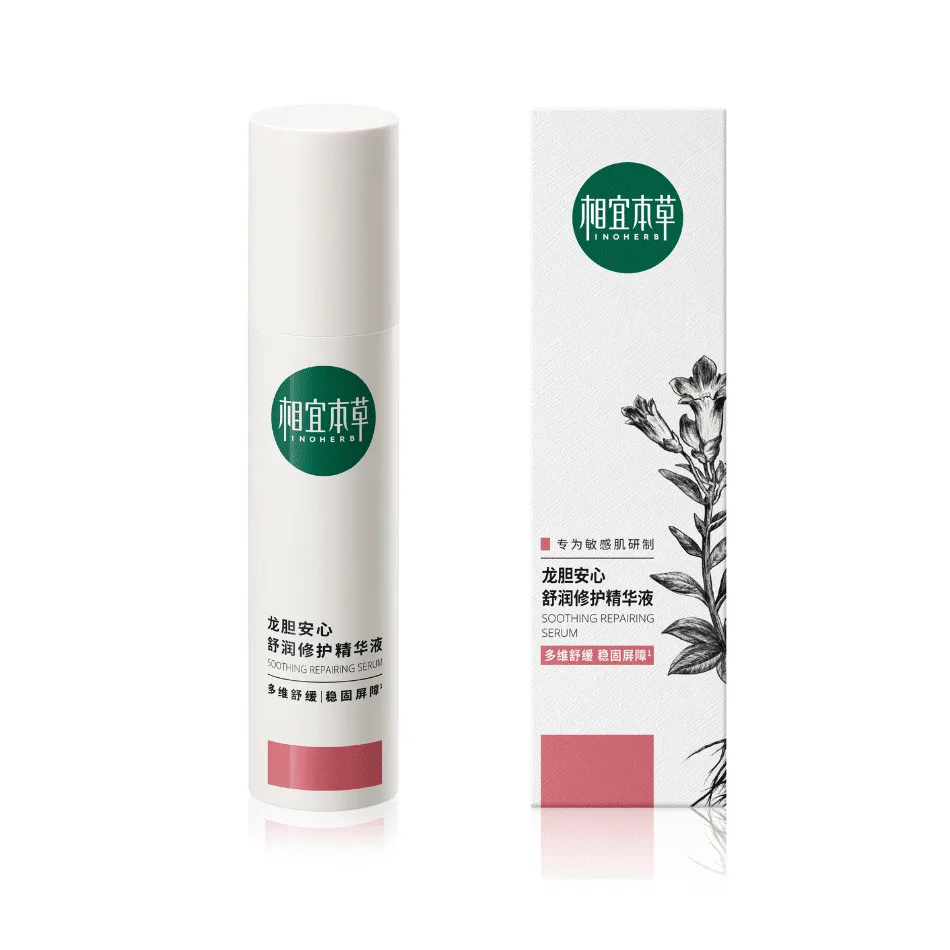 Lamellar Herbal Barrier Serum
Gentiana Soothing Repairing Serum
The best-formulated product Inoherb sells abroad: a fragrance-free lamellar barrier serum with panthenol, betaine, lecithin-structured squalane, plant sterols and a synthetic pseudoceramide, wearing a five-herb gentian signature that is more decoration than driver. Reactive, dry and barrier-stressed skin will feel the difference within days; the converted price is the main thing to negotiate with.
 Cellulite-Claim Jumbo Jar
Green Coffee Bean Oil Body Cream
A competent mineral-oil-and-glycerin body moisturizer wearing a cellulite claim it cannot support: the coffee seed oil is eleventh, nothing warms, and the taut feel is a collagen film drying on hydrated skin. Five thousand reviewers give it the lowest rating in the brand's range because they tested the promise. As a scented, tinted basic body cream for seventeen dollars it is fine; as a firming treatment it is not.
 German Pharmacy Classic
Anti-Dry Night Intensive Cream
A deeply nourishing pH-balanced night cream that layers three lipid classes for proper overnight barrier repair. It's rich without being greasy, calm without being boring, and priced fairly for what it actually does — a genuine German pharmacy workhorse for dry and sensitive skin.
 Summer Essential
After-Sun Repair Creamy Gel
A watery, cooling after-sun gel that does more than the average aloe slick — it pairs instant sensory relief with a genuine lipid complex to replenish the barrier sun strips away, anchored by Avène's soothing thermal water. Fragrance and mineral oil keep it from being a sensitive-skin perfectionist's pick, but the generous size and real soothing make it a summer staple.
 Thirsty-Skin Micellar Water
Hydrabio H2O Micellar Water
The micellar water that started the category, with a humectant upgrade for thirsty skin: the same lipid-mimicking single surfactant as Sensibio H2O, plus glycerin in second place and a sugar-and-niacinamide complex left behind on a no-rinse cleanse. It removes everyday makeup and sunscreen without stripping, costs very little per use across 500 mL, and is one of the best-documented cleansers you can buy. The fragrance is the one reason to choose its unscented pink sibling instead.
 Two-Phase Cica Rescue Mist
Panthecell Repair Cica Ampoule Mist
A gentle, fragrance-free two-phase mist that pairs a declared 30 percent centella extract and one percent panthenol with purified centella triterpenes and a light oil layer, so it soothes and hydrates without the drying effect of a watery spray. It suits sensitive and stressed skin well; oily and fungal-acne-prone skin should pass, and finding it in stock is getting harder.
 Oat Protectant for Face and Body
Stabilizing Repair Face + Body Serum
A fast, light, fragrance-free oat serum that does what the label can legally say: relieves itch and tightness within minutes, thanks to 1% colloidal oatmeal under the FDA monograph, a cooling agent and a squalane base. It is a genuinely useful thing to have for reactive faces and flaring hands. It is also $69 for 1.7 ounces of what is, at heart, a very well-dressed oat lotion, it needs a cream over it on dry skin, and the cooling tingle is wrong for an open flare. Buy it for the face and the trouble spots, not for the whole body.
 Japanese Anti-Pollen Skincare
Aller Screen Mist
A genuinely distinctive Japanese pharmacy product addressing a specific seasonal need — pollen and PM2.5 protection through Shiseido's patented electrostatic anti-adhesion mist technology. Earns its place for users with confirmed seasonal skin reactivity or in high-pollution urban environments; less essential for users without those specific concerns.
 Barrier-Trio Bargain
Cera Barrier Moisture Emulsion
A quietly overachieving ceramide emulsion that supplies the entire barrier-lipid trio in one lightweight step for around $17. The five ceramides, beta-sitosterol and free fatty acids make it a legitimate barrier-repair moisturizer that still wears well under sunscreen. The only real catch is a noticeable essential-oil fragrance that rules it out for the most reactive skin.
 Derm Clinic Calming Pick
A-CICA365 Blemish Calming Face Serum
Aestura's A-CICA365 Blemish Calming Serum treats breakout-prone skin from the calming side, pairing a gentle 2 percent niacinamide with an isolated CICA BPM complex of madecassoside, beta-glucan, and phytosterols. At 33 dollars for 40ml it's a clinically-positioned, fragrance-free soother that fades post-blemish marks and quiets redness without stripping. The alcohol denat is the only real asterisk, and the action is calming rather than dramatically clearing — but for reactive skin that harsh acne products worsen, it's a smart pick.
 Korean Derm Office Staple
A-Cica 365 Calming Cream
Aestura's A-Cica 365 Calming Cream is one of the best fragrance-free calming creams currently on the market — a thoughtfully formulated barrier-repair moisturizer with a confirmed 5% panthenol dose, isolated madecassoside, beta-glucan, and phytosterols, all delivered in a lightweight gel-cream that genuinely suits reactive skin. At its current price, it's a quietly excellent purchase that earns its top-seller status at Korean dermatology clinics.
 German Pharmacy Q10 Cream
Age Defense Q10 Cream
Sebamed pH 5.5 physiological Q10 anti-aging cream with Q10 antioxidant, panthenol + tocopheryl acetate vitamin pair, triple emollient pool (sweet almond + shea butter + squalane), phytosterols, and brand-signature pH 5.5 chemistry. Multiple emollient oils flag fungal-acne-prone routines; parfum + C12-15 alkyl benzoate limit sensitive routines.
 Niacinamide Day Moisturizer
Dress Lift Day Emulsion
A smartly built morning moisturizer that pairs a ministry-approved niacinamide wrinkle active with antioxidant ergothioneine and barrier-mimetic lipids, all in a finish light enough to vanish under sunscreen and makeup. Just don't mistake 'day' for sun protection — there's no SPF here. A small 60ml bottle at a premium price and a roster of essential oils are the real caveats.
 Glass-Gloss Lip Balm
Probioderm Collagen Volume Lip Balm
A pleasant, glossy pot balm that makes lips look fuller through shine and a light cooling tingle, not collagen, and keeps them soft with a lanolin-free occlusive base, plant oils and ceramides. It has two UV filters but no SPF, a little fragrance, and a $24 price for 15 ml that is hard to justify for a glossy balm.
 Quiet Acne Specialist
Lupeol Eggplant Extract Ampoule
A refreshingly single-minded acne ampoule that bets on lupeol, a triterpene pulled from eggplant, instead of the usual acids. Lightweight, fragrance-free and genuinely gentle, it calms active breakouts and supports oily skin without drying it out. Results are subtle and slow, and the evidence is still emerging — but as a low-irritation addition to a congestion-prone routine, it's a smart, unusual pick.
 Fragrance-Free Squalane Splurge
Superkind Bio-Shield Face Oil
The best face oil Tata Harper makes for sensitive skin, because it is the only one that smells of nothing: squalane first, sterol esters, bisabolol, centella and a wide omega seed-oil set, with no essential oils and a National Eczema Association seal. The postbiotic and adaptogen story is trace-level decoration, the oil is too light for very dry winter skin on its own, and $132 for 30 mL of mostly squalane is a price for the brand rather than the bottle. Gentle and good; costly for what it is.
 Lightweight Daily Hydrator
The Light Moisturiser
A genuinely weightless gel-cream that brings real barrier lipids and antioxidants to combination and oily skin, hydrating without a hint of grease. It's the smart lighter sibling to the brand's richer cream — let down only by the same self-contradictory fragrance choice in its standard version and a premium price, both softened by a fragrance-free option and a pump.
 Fragrance-Free Cica Repair Cream
Panthecell Repair Cica Cream
The gentle, fragrance-free standout in Bioheal BOH's lineup — a genuinely cica-rich barrier-repair cream built on a 75%+ centella base with 5% panthenol, barrier lipids and, unusually, a bonus peptide complex. It soothes redness, repairs a compromised barrier and adds subtle firming, all without fragrance. For sensitive, reactive or stressed skin, it's one of the more thoughtfully complete cica creams around.
 Luxury Fermentation Cream
Secret Cream
Su:m37's anchor moisturizer is a genuinely rich barrier cream — ceramide NP, shea, squalane, and phytosterols layered over the brand's long-fermented plant base — that earns its place on dry, mature skin in winter. The luxury price and jar-only richness are the catches, and the firming claims are gentler than the marketing suggests, but the formula itself is no empty flex.
 Retinal for the Retinoid-Shy
Firm Revival HydroRetinal Firming Serum
The retinoid Dieux took six years to make is a good one: 0.05 percent retinal in a hydrating gel with a real irritation-buffering system, stated doses where it counts, barrier lipids, no fragrance, a National Eczema Association seal and a 31-panelist instrumental study behind it, at $42. It is two months old, its algae booster is a plausible extra rather than a proven one, and its study has no vehicle arm; none of that changes the fact that this is one of the more thoughtfully built beginner retinals sold at the price. Buy it for the retinal, not the algae.
 Professional Skin Therapy Staple
Skin Smoothing Cream 2.0
Dermalogica's quietly upgraded its 35-year-old hero moisturizer into something genuinely modern. The 2.0 formula delivers the brand's promised 48-hour hydration through a clever saccharide isomerate plus dual-weight hyaluronic acid system, layered over the herbal Soothing Complex that's defined the line since the late 80s. It earns its place on the bathroom shelf — provided you can live with the fragrance components.
 Luxury K-Beauty Treatment Cream
Rejuvenating Treatment M.D. Cream
Amorepacific's Rejuvenating Treatment M.D. Cream combines dual lactobacillus postbiotic with shea butter, EGCG-bearing green tea, glutathione, hydrolyzed DNA, niacinamide, and phytosterols in a rich luxury K-beauty cream. At $110 for 50ml the pricing is challenging luxury territory. Sophisticated chemistry; brand premium reflects positioning more than cost-per-active value.
 Leave-On Lamellar Foam
HAS Lamellar Mask
An inventive leave-on foam that goes on last, sits for a few minutes, then presses into a glossy, cushioned film built from a lamellar lecithin-phytosterol structure, Lipidure, beta-glucan and hyaluronate. Dry and normal skin will love the finish, but orange peel oil, an unproven stem-cell extract and a steep Japanese price make it a luxury rather than a necessity.
 Celebrity Method Moisturizer
The Method: Nourish
The Method: Nourish is a competent daily anti-aging moisturizer — shea butter, plant oils, hexapeptide-48, and crosslinked hyaluronic acid in a cushioned, satin-finish cream. It hydrates well and feels pleasant. The trouble is the $85 price for 1.7 oz, which pays for the Beverly Hills Lancer name rather than a distinctive formula. Comparable peptide moisturizers deliver the same results for far less.
 Tmall Chart-Topping Rose Cream
Pink Diamond Firming Delicate Rose Cream
China's chart-topping rose cream is, once the space-rose story is set aside, a very well-made lipid moisturizer: plant sterols and a polyisobutene film that melt in and cushion dry skin, with a trace retinoid ester and carnosine for a slow nudge on texture. The anti-gravity lift and collagen-peptide claims are not on the ingredient list. Buy it for the comfort and the scent, not the promise.
 Award-Winning Clay Mask
Intense Recharge Mask
Epionce dermatologist-developed clay mask with substantive 14+ botanical active pool + kaolin clay base + glycerin humectant balance + potassium azeloyl diglycinate brightening + prebiotic + humectant pool + barrier-supportive phytosterol pair. Vegan + fragrance-free + alcohol-free formulation. Award-winning multi-pathway clay mask (Best Clay Mask 2024 Shape Beauty Awards + Best Brightening Mask 2025 NewBeauty Awards).
 Luxury Ferment Essence
Youth Power Advanced Essence
A prestige Japanese fermented essence built on a high 62% black-koji (Aspergillus) ferment delivered through a bioliposome system, placing it in the same celebrated category as the famous pitera essences. It leaves skin smoother, softer and subtly more radiant, with an elegant, lightweight feel. The catches are SK-II-level luxury pricing and a formula carrying alcohol, fragrance and a paraben.
 Sensitive-Skin Comfort Cream
Superkind Calming Crème
The best-loved product in Tata Harper's sensitive-skin line, and deservedly: a thick, pillowy, genuinely unscented cream of plant sterols, olivate esters, squalane and bisabolol that stops the sting and the tightness within minutes and cocoons dry, flushed skin through a winter. It carries no ceramide, its pepperberry and microalgae headliners are trace-level, its 87 percent figure is a survey, and $168 for 50 mL is the highest price in the barrier-cream class for what is a very good plain cream. Comfort, at a luxury tariff.
 Decorté Liposome Night Cream
Liposome Advanced Repair Cream
Decorté's signature multi-layer-liposome night cream — patented delivery technology, adenosine for clinically-supported wrinkle improvement, ectoin for cellular protection, and a thoughtful phytosterol complex for barrier support. The $130 price for 50g reflects the technical sophistication; the fragrance with multiple allergens is the main sensitive-skin flag.
 Department-Store Lip Indulgence
B.A Lip Bar Serum
Pola aimed its vascular research division at your lips and shipped a $58, unflavored, colorant-free bar whose sterol-ester film genuinely outclasses balm-aisle texture — for four months per bar, it conditions superbly and flatters lipstick. The science narrative is in-house theater, the price is a luxury tax, and the product underneath is honestly excellent at the modest job lip care can do.
The full phytosterols (plant sterols) guide
Cholesterol gets a bad reputation in wellness circles, but your skin's barrier genuinely depends on it — and phytosterols, the plant kingdom's close structural cousin to cholesterol, can step in to help repair what daily life and environmental stress wear down.
Derived from soy, rice bran, sunflower, and other plant sources, these lipid compounds are thought to slot into the stratum corneum's lamellar architecture, easing inflammation and reinforcing the barrier from within rather than just sitting on top of it. They're not a headline active yet, but that low profile is partly why formulators who think in terms of skin-lipid ratios tend to reach for them.
How it's regulated in the US
FDA does not classify ingredients — it classifies products, by what they are sold to do. The same molecule can be a drug active in one product and a cosmetic ingredient in the next, and only the claim on the label decides which. What follows is a statement about that legal standing, not about whether it works — the evidence question is answered separately above.
Cosmetic Phytosterols (Plant Sterols) is a cosmetic ingredient in the US: no OTC monograph covers it and it is not an active in any FDA-approved drug, so a product built around it is a cosmetic rather than a drug.
Human evidence for topical phytosterols is limited but credible rather than hypothetical. A 2008 study in the Journal of Cosmetic Science (PMID 18528589) reported that topical soybean phytosterols sped stratum corneum recovery after barrier disruption in human volunteers, measured via methyl-nicotinate-induced erythema. A 2016 paper (PMID 26201345) found that pairing phytosterols with niacinamide in optimized lecithin and solid-lipid-nanoparticle delivery systems improved percutaneous absorption and recovered roughly 95% of barrier integrity eight days after tape stripping. Preclinical work is more developed: in a 2023 study (PMID 37075671), beta-sitosterol attenuated psoriasiform inflammation in a mouse model, thinning epidermal hyperplasia and downregulating IL-6, TNF-alpha, and CXCL1. Cell-culture studies suggest phytosterols can upregulate hyaluronic acid synthesis and support keratinocyte differentiation, though these effects have not been confirmed on human skin in use. The CIR Expert Panel reviewed phytosterols and steryl alkanoates and judged the class safe as used in cosmetics. The honest read: a plausible, well-reasoned mechanism with early human validation, but not the large randomized-trial base that would earn a well-established rating.
How it works
The outer skin isn't just dead cells stacked like bricks — it's cells set in a precise lipid mortar made mostly of ceramides, cholesterol, and free fatty acids. When that ratio drifts from sun damage, harsh cleansers, cold air, or aging, water escapes and irritants slip in. Phytosterols are useful here because their shape closely mirrors cholesterol: a rigid four-ring steroid backbone with a small side-chain variation that doesn't stop them from intercalating into the same lipid bilayers. Once integrated, they appear to help restore the lateral packing density of stratum corneum lipids, slowing transepidermal water loss without forming an occlusive film on the surface. The anti-inflammatory side is a separate mechanism. Beta-sitosterol — usually the dominant fraction in cosmetic phytosterol blends — has been shown to dampen pro-inflammatory signaling through pathways including ERK, AKT, and STAT3 in keratinocytes and macrophages, the same cascade tied to the redness-and-itch loop of compromised or atopic skin. There are signs of deeper activity too: cell-culture studies indicate phytosterols can upregulate hyaluronic acid synthesis and nudge keratinocytes toward healthy differentiation, which over time might help organize the epidermis, though this remains lab-stage rather than proven on skin. A quieter antioxidant role — donating electrons to free radicals and shielding cell membranes from oxidative breakdown — rounds out the picture. In practice, blends of beta-sitosterol, campesterol, and stigmasterol are formulated at low total percentages, where the goal is integration into existing lipid structure rather than bulk.
Key benefits
- Speeds visible barrier recovery after disruption, with support from human-volunteer studies
- Helps slow transepidermal water loss by integrating into stratum corneum lipid layers
- Eases redness and itch via anti-inflammatory pathway activity (ERK, AKT, STAT3)
- May encourage hyaluronic acid synthesis in keratinocytes, based on cell-culture data
- Acts as a lipid-phase antioxidant that helps protect cell membranes from oxidation
- Well tolerated on atopic and sensitive skin without the drawbacks of topical steroids
Concentration & usage
Cosmetic formulas usually keep total phytosterol content low — commonly in the 0.5-2% range, rarely above 5% — and the CIR Panel assessed the class as safe at current use levels with no fixed regulatory cap in the EU. On an INCI list, look for Phytosterols (the blend), Beta-Sitosterol, Stigmasterol, Campesterol, or the esterified forms Phytosteryl Oleate and Phytosteryl Isostearate. Soy and rice bran are the most common cosmetic sources. No specific pH dependence has been established for topical activity. Delivery matters more than raw percentage here: lecithin-based and solid-lipid-nanoparticle systems have shown meaningfully better penetration than plain emulsions, so the vehicle a brand picks influences how much actually reaches the stratum corneum.
Who it's for & who should be cautious
Who it's for
Skin whose barrier is chronically under stress is the clearest fit — frequent cleansers, low-humidity climates, eczema-prone or sensitized complexions, and post-procedure recovery all qualify. Dry types wanting lipid replenishment that doesn't feel heavy will appreciate phytosterols tucked into emollient-rich moisturizers. Mature skin is another reasonable target, since natural cholesterol output declines with age and skews the ceramide-cholesterol-fatty-acid balance the barrier relies on.
Who should be cautious
There's no skin type that needs to steer clear of phytosterols on safety grounds — the CIR assessed the class as safe across normal use concentrations. The practical caveat is contextual: phytosterols often ride along with heavier plant oils or butters, and it's those carrier ingredients, not the sterols, that can feel congesting on very acne-prone skin, so judge the full formula. A confirmed plant-sterol allergy is rare but possible; if you react to soy-derived ingredients, check the source declaration and patch test before assuming you'll tolerate it.
Pairs with & conflicts
Myths & facts
Myth: Phytosterols are just a moisturizing filler — basically the same as any plant oil.
Reality: Most plant oils mainly sit on or near the surface as emollients. Phytosterols are structurally built to intercalate into the stratum corneum's lipid bilayers in cholesterol's place, and they carry anti-inflammatory pathway activity (ERK, STAT3) that emollient oils don't. That makes them an active barrier-support ingredient rather than passive occlusion.
Myth: If an ingredient is related to cholesterol, slathering it on must raise your blood cholesterol.
Reality: Topically applied phytosterols aren't absorbed into the bloodstream at meaningful levels, and the CIR safety review found no systemic concern at cosmetic concentrations. The familiar cholesterol-lowering effect of plant sterols comes from eating them at gram-level doses — a completely different route and dose from a 1-2% topical cream.
Myth: Phytosterols only do anything for dry or mature skin.
Reality: Dry and aging skin may show the most obvious payoff, but the anti-inflammatory action is relevant more broadly. Oily and breakout-prone skin frequently has a compromised barrier alongside excess sebum, and redness-prone sensitive skin can benefit from the cytokine-calming effect regardless of how hydrated it already is.
Frequently asked questions
If ceramides already repair the barrier, what do phytosterols add?
Ceramides are the largest lipid class in the stratum corneum, and topical ceramides directly top up that pool. Phytosterols stand in for cholesterol, a different but equally essential part of the same lamellar bilayer, and they bring anti-inflammatory activity that ceramides largely don't. The two work in complementary lanes, which is why barrier-repair products often pair them.
Is it fine to keep using a phytosterol cream while I'm actively breaking out?
Phytosterols themselves aren't comedogenic, and their calming activity may even take the edge off redness around breakouts. The real question is the rest of the formula — phytosterols often live in richer creams built on heavier emollients that can be a problem for oily, congestion-prone skin. Read the full INCI rather than writing off the ingredient itself.
Are phytosterols the same as the plant stem cells brands advertise?
No — they share a botanical origin and nothing else. Plant stem cells in cosmetics are extracts of undifferentiated plant tissue marketed for growth-factor-style effects, with thin topical evidence. Phytosterols are a defined class of sterol lipids with a documented structural role in both plant membranes and the human stratum corneum. The mechanisms and the strength of the evidence are quite different.
How soon might a phytosterol moisturizer show results?
Barrier improvement, seen as reduced transepidermal water loss, has been observed in human studies within about two to four weeks of consistent use. A softer, less tight feel can show up sooner — sometimes in the first few days — because the lipid-integration effect starts on application. Any anti-aging angle tied to collagen support would take longer and is less firmly established for topical use.
Can I use soy-derived phytosterols if I'm allergic to soy?
The proteins that trigger soy allergies are generally stripped out of refined phytosterol extracts, which are lipid-based rather than protein-based. Even so, sensitivity varies; with a confirmed soy allergy it's worth checking the source declaration and patch testing first. That caution applies most to less-refined plant-oil preparations that can carry trace proteins alongside the sterols.
Why do phytosterols usually appear near the end of an ingredient list?
They're typically used at low totals, often 0.5-2%, which places them in the back half of an INCI list ordered by descending concentration. That's consistent with the mechanism — the barrier doesn't need a large dose of a molecule that's integrating into existing lipid structure rather than building a whole new layer, so low placement doesn't mean it's doing nothing.
Sources
- https://pubmed.ncbi.nlm.nih.gov/18528589/
- https://pubmed.ncbi.nlm.nih.gov/26201345/
- https://pubmed.ncbi.nlm.nih.gov/37075671/
- https://www.cir-safety.org/sites/default/files/Phytos_122013_Final.pdf
- https://www.fortunejournals.com/articles/skin-improvement-effects-of-phytosterol-ester-derived-from-rice-bran.html