Malic Acid
Products with Malic Acid
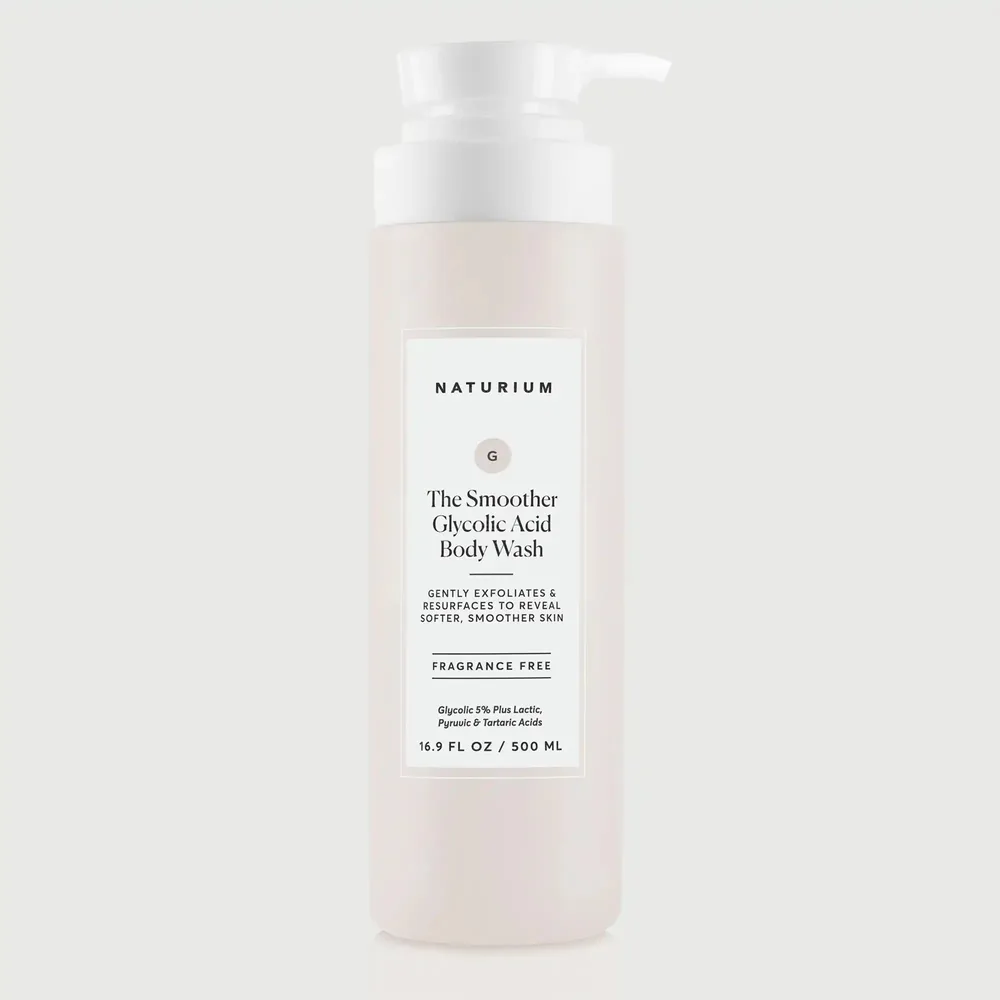 KP & Body Texture Hero
The Smoother Glycolic Acid Exfoliating Body Wash
The body wash that proved acid exfoliation belongs in the shower, not just on the vanity. At $17 for 16.9 ounces of 5% glycolic acid in a sulfate-free, fragrance-free formula, Naturium's The Smoother is the most effective and best-value body exfoliant available. A genuine game-changer for keratosis pilaris, body acne, and rough texture.
 Gentle Glow Toner
Hydrate & Glow Toner
A genuinely gentle AHA toner for the people usually told to avoid them: 2% lactic acid plus malic acid, heavily buffered with glycerin and a prebiotic, fragrance-free and alcohol-free. It smooths flaky, dull, dry skin while actually hydrating it. The trade-off is that it is mild — a feature for sensitive skin, a limitation if you want stronger exfoliation.
 K-Beauty BHA Foam Cleanser Value
Pore-Purifying Salicylic Acid Foaming Cleanser
Jumiso K-beauty salicylic acid foaming cleanser combining 0.5% salicylic acid + multi-component amino-acid surfactant pool + mineral clay pool + glycerin humectant balance + multi-fruit AHA pool + MSM. Vegan + fragrance-free + alcohol-free + oil-free + 16-ingredient minimalist formulation. Strong K-beauty value at $18 for 150ml.
 Non-Stripping Peeling Gel
Moisture-Rich Clarifying Peeling Gel
A genuinely clever peeling gel that fixes the category's biggest flaw — most leave skin tight and dry, but this one builds in a complete five-ceramide barrier complex, so it exfoliates and brightens while actually moisturizing. Gentle enough for frequent use, fairly priced, and satisfying to use. Just respect the fruit acids: daily sunscreen is non-negotiable, and very sensitive skin should still go slow.
 Gentle Glow Getter
Cleanser Concentrate
Cleanser Concentrate is a thoughtfully formulated gateway to chemical exfoliation — gentle enough for AHA beginners, effective enough to deliver visible brightening, and housed in packaging that makes you feel like you're doing something more elevated than just washing your face.
 Gen Z Glow Pad
Insta Swipe Lemon Honey AHA Pads
A friendly, well-priced glycolic and malic acid pad that delivers a genuine next-morning glow and lands in the sweet spot for Gen Z shoppers who want a clean-beauty acid without the aesthetic baggage of older toners. The inclusion of lemon peel oil is the one real misstep, and the jar packaging is less practical than the formula deserves.
 Budget Brightening Pick
Brightly Ever After Serum
A wildly cheap Indonesian brightening serum that pairs niacinamide with a vitamin C derivative and glutathione for gradual tone-evening. The core formula is more sensible than the 'whitening' branding suggests, but lavender water, an added colorant, and a tiny 15ml bottle keep it from punching above its budget tier.
 Targeted Spot Eraser
AGE Bright Spot Fader
A clever two-jobs-in-one spot gel: salicylic acid takes down the live breakout while hexylresorcinol and niacinamide fade the dark mark it leaves. The thinking is sound and the actives are credible, but essential oils raise the irritation risk and the product is now frustratingly hard to find.
 Gentle Papaya Phyto Mask
ImPHYTO AHA Mask
A gentle, fragrance-free, vegan papaya sheet mask on a compostable sheet that hydrates and refreshes without stinging. Its 'AHA' promise is thin, with malic acid at 100 ppb and papaya enzyme activity uncertain, so treat it as a soothing fruit mask rather than an exfoliant.
 Body-Tone Workhorse
Niacinamide 5% Face and Body Emulsion
A thoughtful extension of The Ordinary's most popular active into a format the body actually needs. 5% niacinamide is the right strength, 100 mL for $14 is the right price, and the lightweight emulsion format makes daily full-body use realistic. One of the few genuinely useful body-scale tone correctors at this price point.
 European Peel Innovation
Isdinceutics Night Peel
A thoughtfully formulated at-home AHA peel that gets the balance right between effective exfoliation and gentle hydration. The ampoule format ensures freshness and prevents overuse, making it one of the most fool-proof chemical exfoliants available — though the premium price means you're paying for European pharmaceutical elegance.
 The Undone Manicure
AHA Nail Sheer
As a sheer wash it is lovely — thin, self-levelling, 10-free, with conditioning lipids and silica in the film. As a treatment it has a chemistry problem: the three alpha hydroxy acids in the name are dissolved in a lacquer that dries to a solid film in under a minute, and acids cannot work without water.
 Gentle Exfoliating Cleanser
PITERA Facial Treatment Cleanser
A pleasant, gently exfoliating foaming cleanser whose real benefit is the mild willow-and-AHA refinement it gives as you wash — not the headline PITERA, which washes down the drain before it can do anything. It cleans without stripping and leaves skin smooth, but at $60 it's steep for a cleanser, especially one whose star ingredient is wasted in a rinse-off. Fine for devoted SK-II fans; everyone else can get the same gentle exfoliation for far less.
 Luxury Overnight Recovery
Pro-Collagen Oxygenating Night Cream
A genuinely luxurious overnight recovery cream with an excellent emollient base and an intriguing marine-peptide complex, but the $155 price, paraben inclusion, and multiple fragrance allergens make it harder to justify than its celebrated daytime sibling.
The full malic acid guide
Pulled from apples and other tart fruits, malic acid sits in an unusual spot within the alpha hydroxy acid family — it's a larger molecule than glycolic or lactic acid, so it crosses the skin's surface more slowly and tends to feel gentler than its better-known relatives.
That slower gradient is most of its appeal. You'll rarely see it headlining a product on its own; far more often it's a supporting act in multi-acid blends, where it helps round out the exfoliation and nudge the formula's pH into the active range rather than doing the heavy lifting solo.
How it's regulated in the US
FDA does not classify ingredients — it classifies products, by what they are sold to do. The same molecule can be a drug active in one product and a cosmetic ingredient in the next, and only the claim on the label decides which. What follows is a statement about that legal standing, not about whether it works — the evidence question is answered separately above.
Cosmetic Malic Acid is a cosmetic ingredient in the US: no OTC monograph covers it and it is not an active in any FDA-approved drug, so a product built around it is a cosmetic rather than a drug.
The AHA class as a whole is well-studied for surface exfoliation and texture refinement, but malic acid specifically has far less standalone clinical data than glycolic or lactic acid — most of its evidence rides on the class. A 2009 comparative study in the Journal of Cosmetic Dermatology (PMID 19245467) tested several AHAs at equimolar concentrations and found malic, citric, and hydroxybutyric acids less effective than lactic and glycolic, positioning them as better-suited supporting ingredients than primary actives. The broader AHA mechanism — loosening corneocyte cohesion to accelerate desquamation — is described in a 2018 review in Molecules (PMC6017965), with malic acid sharing those properties at a gentler pace. Its frequently-cited dual role as exfoliant plus humectant is biologically plausible but not well-quantified for malic acid in isolation from other acids. The Cosmetic Ingredient Review Expert Panel has assessed malic acid and sodium malate as safe in cosmetics at current use concentrations. The honest read: promising as part of multi-AHA systems, thinly evidenced as a standalone active.
How it works
The core action mirrors other alpha hydroxy acids: malic acid weakens the bonds holding corneocytes — the flattened dead cells of the outermost epidermis — so they shed more readily than they would unassisted. Faster surface turnover translates to smoother texture, a more even tone, and a clearer runway for other actives to absorb. What sets malic acid apart is bulk. Its molecular weight runs higher than glycolic acid (the smallest, deepest-penetrating AHA) and higher than lactic acid, so it diffuses through the stratum corneum at a more measured pace. In practice that slowness reads as tolerability: skin that flushes or stings under glycolic often handles malic acid more comfortably, which is why it turns up in formulas aimed at reactive complexions. Malic acid is also described as having humectant character, attracting and helping hold water at the surface — a secondary hydration effect that may soften the drying edge exfoliation can otherwise carry, though this dual behavior is hard to isolate from the rest of a blend. Concentration and pH govern whether any of this actually happens. In most leave-on products it appears around 1–5% at a pH roughly between 3 and 4.5, the window where free-acid exfoliation is meaningful; push the pH much above 5 and the exfoliating effect fades. Formulators lean on that same chemistry the other way too, using small amounts purely to buffer and hold multi-acid blends in their active range.
Key benefits
- Loosens dead surface cells with less sting than stronger AHAs like glycolic
- Often better tolerated by skin that reacts to glycolic or lactic acid
- Adds humectant character that can offset the drying edge of exfoliation
- Helps buffer and hold multi-acid blends in their active pH range
- Gradually smooths rough texture and evens tone with lower irritation risk
- Extends the molecular-weight range in blended AHA formulas
Concentration & usage
In leave-on products, meaningful exfoliation tends to land around 1–5% at a pH between roughly 3 and 4.5. Rinse-off formats like cleansers can carry more (up to about 10%) because contact time is short. On an INCI list, look for "Malic Acid" or "DL-Malic Acid": placement is the tell. Sitting near the bottom alongside preservatives and chelators, it's almost certainly there in trace amounts as a pH buffer, not an active exfoliant. Higher up the list, it's more likely contributing real exfoliation. Professional peel solutions can reach 20–40%, but those are clinic-only concentrations applied under supervision.
Who it's for & who should be cautious
Who it's for
If glycolic or lactic acid leaves you red, stinging, or flaking, malic acid is worth trying — it tends to deliver surface exfoliation without hitting the same irritation threshold for many people. Dry skin may also appreciate it, since the humectant character can add a little moisture back while texture gets refined. And if you already use a multi-acid exfoliant for uneven tone or roughness, there's a decent chance malic acid is quietly part of the blend you're benefiting from.
Who should be cautious
Skip it on a compromised barrier — active eczema flares, open or broken skin, raw post-procedure areas — where even a gentle acid can sting and slow healing. If you're already running a heavy exfoliation load (high-strength glycolic peels, therapeutic retinoids, frequent scrubs), adding malic acid mostly stacks acid without much extra payoff. Pregnancy messaging around AHAs is muddled, though low-concentration leave-on products (10% or less) are generally treated as low-risk; if you're unsure, ask your OB rather than trying to decode the INCI list yourself.
Pairs with & conflicts
Pairs well with: Glycolic Acid (AHA), Lactic Acid, Mandelic Acid, Tartaric Acid, Citric Acid, Gluconolactone (PHA), Hyaluronic Acid, Glycerin, Niacinamide (Vitamin B3), Panthenol (Pro-Vitamin B5), Ceramides
Use with care alongside: Retinol, Salicylic Acid (BHA), Benzoyl Peroxide, Vitamin C (L-Ascorbic Acid)
Myths & facts
Myth: Malic acid is purely a pH adjuster and doesn't really exfoliate.
Reality: It can do both, and the formula decides which. High enough on the INCI list with the pH in the active window (around 3 to 4.5), malic acid loosens corneocytes like any AHA. Used in trace amounts down near the preservatives, it's just buffering pH. Where it lands on the ingredient list is the giveaway.
Myth: A bigger molecule means it's too weak to bother with.
Reality: Larger molecular weight means slower penetration and a gentler feel, not zero effect. For reactive skin, that measured absorption is exactly the point — exfoliation without the acute sting glycolic can trigger. In blended formulas it also widens the range of acid molecule sizes at work, which is part of why multi-acid products read as smoother and more balanced.
Myth: Fruit-derived malic acid is safer than the 'synthetic' kind.
Reality: Malic acid from an apple and malic acid made in a lab are the same molecule, and your skin can't tell them apart. What governs safety is concentration, pH, and contact time, not origin. Marketing that leans on 'natural fruit acid' is selling a story, not a formulation advantage.
Frequently asked questions
Can malic acid stand in for glycolic acid in my routine?
It can if glycolic doesn't agree with your skin, but expect a trade-off: malic acid exfoliates more gently and slowly, so texture and fine-line results come on more gradually. For sensitive or reactive skin that slower pace is usually the upside. If you're chasing aggressive resurfacing, glycolic has the deeper track record.
How can I tell whether malic acid in a product is exfoliating or just adjusting pH?
Read its spot on the INCI list. In the upper third — above the preservatives and thickeners — there's likely enough of it that exfoliation is intended. Down at the very bottom near preservatives and chelating agents, it's almost certainly present in trace amounts for pH buffering only.
Is it okay to use malic acid every day?
At the 1–5% levels in most leave-on products, daily use is generally fine for skin that handles AHAs without visible irritation. But if you're also running retinoids, other AHAs, or a BHA in the same routine, doing all of them daily piles on cumulative acid — alternating days or splitting AM and PM is the safer rhythm.
Does malic acid do anything for dark spots?
Only indirectly. By speeding surface turnover, it helps the skin shed pigmented cells from post-inflammatory marks a bit faster than it would on its own. It isn't a dedicated brightener the way vitamin C, tranexamic acid, or niacinamide are — think of it as clearing the surface so targeted brighteners can reach their mark more efficiently.
Why does malic acid show up so often in body products and exfoliating cleansers?
Its gentleness suits body skin, and it doesn't need long contact time, which makes it a natural fit for rinse-off formats. The humectant side helps too — a wash or scrub built around it tends to leave skin feeling softer rather than tight and stripped, which is a real win in formats that rinse away in seconds.
Should I layer malic acid and retinol together?
Best kept apart. Both push cell turnover and raise sensitivity, so combining them at once invites redness, irritation, and barrier stress. The usual move is to put an AHA like malic acid in the morning under SPF and save retinol for night — keep them on opposite ends of the day.