Angelica
Products with Angelica
 Gentle Mineral Sunscreen
Mineral UV Sunscreen Mild Gel SPF 35
A genuinely gentle 100% mineral sunscreen from a brand better known for sweat-proof sport formulas. Fragrance-free, alcohol-free, and rated for babies and sensitive skin, it offers comfortable, low-irritation SPF 35 protection with a smoother finish than old-school mineral sunscreens. The SPF is slightly lower than the daily norm, but for delicate skin that is a fair, deliberate trade.
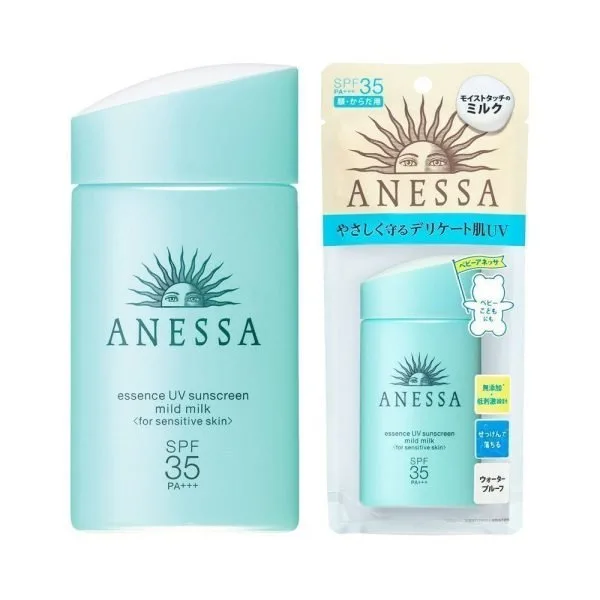 Sensitive-Skin Anessa SPF
Essence UV Sunscreen Mild Milk SPF 35
Anessa's sensitive-skin variant delivers SPF 35 / PA++++ mineral-focused protection with the signature Aqua Booster technology, in a fragrance-free, alcohol-free, additive-free formulation safe for adults, children, and babies. One of the best baby-safe Japanese sunscreens available.
 Souffle Milky Lotion
Sekkisei Essential Souffle
The Sekkisei line's milky-lotion moisturizer — a souffle-textured, oil-sealing emulsion that follows the iconic blue lotion, sealing in moisture with sesame oil and emollients and leaving skin silky. It's a pleasant, nourishing-yet-lightweight moisturizing step, milder than the alcohol-heavy lotion. But it still contains alcohol and fragrance, and the brightening is traditional rather than proven. A lovely souffle texture with the Sekkisei character; nourishing for normal-to-dry skin that tolerates the alcohol.
 Rose-Powered Hydration Staple
Rose Deep Hydration Face Cream
A genuinely pleasant gel-cream that earns its popularity through reliable hydration and an elegant texture. The dual-weight HA system and quadruple rose complex are well-conceived, but the fragrance allergens and a price that outpaces the ingredient innovation keep it from being a universal recommendation.
 J-Beauty UV Classic
Sekkisei Clear Wellness UV Defense Milk SPF 50+ PA++++
Sekkisei's modernized daily sunscreen gets the important things right: PA++++ UVA coverage, a weightless milk texture, and zero white cast. The alcohol base and signature herbal fragrance keep it off the sensitive-skin shortlist, but for normal-to-oily skin in a hot climate, it's one of the most wearable high-protection formulas in J-beauty.
 Heritage Brightening Emulsion
Sekkisei Supreme Moisturizer II N
A refined, silky brightening emulsion that pairs Sekkisei's four-decade herbal heritage with a genuine vitamin C derivative, leaving normal-to-oily skin soft, balanced, and gradually more even-toned. The signature scent and prestige ritual are a real draw. But it's a premium price for a formula carrying alcohol, fragrance, and a paraben — heritage and experience more than cutting-edge actives.
 Sekkisei Daily Workhorse
Sekkisei Treatment Cleansing Oil
The everyday partner to Sekkisei's flashier Brightening Cleansing Oil — same herbal heritage, lighter daily-driver formula, and a 300 ml refill size that lowers the per-use cost into reasonable territory. The fragrance and alcohol mean it's not for sensitive skin, but for everyone else in the Sekkisei orbit it's the version that actually gets used to the bottom.
 J-Beauty Sekkisei Heritage SPF
Sekkisei Herbal UV Defense Gel SPF 40
Kose's Sekkisei Herbal UV Defense Gel SPF 40 combines European-tier hybrid SPF filter framework with the brand's signature herbal complex (Job's Tears + angelica + melothria) plus niacinamide plus K-beauty soothing cast. J-beauty heritage SPF at 36-dollar moderate pricing — US import channel only.
 Mugwort Foam Cleanser
Pure Artemisia Mild Cleansing Foam
A satisfying mugwort foam cleanser that lathers richly and leaves skin thoroughly clean, with a meaningful dose of soothing artemisia and gentler secondary surfactants softening the wash. Just read the 'mild' with a grain of salt: it is built on a potassium-soap base that runs higher-pH, plus added fragrance, so it suits oily and combination skin far better than dry or sensitive.
 Shirojyun Premium Brightening Cleanser
Shirojyun Premium Whitening Face Wash
Hada Labo's Shirojyun Premium Whitening Face Wash layers arbutin, phytic acid, and an eight-extract Asian botanical brightening blend on an amino-acid surfactant base — a more ambitious formulation than most drugstore brightening cleansers attempt. The citrus essential oils and methylparaben hold the score back, and the cleanser only earns its line-name positioning as part of a complete Shirojyun Premium routine.
 Mugwort Calming Toner
Pure Artemisia Watery Calming Toner
A genuinely soothing mugwort toner that puts substance behind the calming claim: baby mugwort leaf water in place of plain water, plus copper tripeptide and an amino-acid NMF complex to settle and hydrate reactive skin. Broadly suitable and lightweight, it is a sensitive-skin favorite for good reason. The one self-inflicted flaw is added fragrance in a product meant to calm.
 Brightening J-Beauty Emulsion
Emulsion Excellent
The moisturizing-step sibling to Sekkisei's lotions, but smarter: a lightweight emulsion that places a stable vitamin C derivative high in the formula alongside dual vitamin E and the brand's broadest herbal complex. It hydrates and gradually evens tone with a satin finish, and with alcohol sitting low it's gentler than the namesake lotions — though fragrance still rules out very reactive skin.
 Dual-Active Prestige Brightening Serum
Melano Focus EV
One of the best-engineered prestige Japanese brightening serums available — dual Japan quasi-drug certified active chemistry (tranexamic acid + Potassium 4-Methoxysalicylate) anchored in 20+ years of HAKU brand heritage, with the broader Shiseido R&D infrastructure behind it. Genuine clinical credibility at prestige Japanese pricing.
 Iconic Alcohol-Forward Lotion
Sekkisei Lotion Mask
The iconic Sekkisei blue 'Lotion' that launched the line in 1985 — a cult brightening toner, used straight or as a cooling cotton 'lotion mask,' beloved for its fresh, cooling feel. But that feel comes from a deeply alcohol-forward astringent base (alcohol is the second ingredient, with witch hazel too), which is drying and dated by modern barrier-care standards, and the brightening is traditional rather than proven. A nostalgic heritage icon for resilient oily skin; a hard no for dry or sensitive skin.
 Hanbang Honey Sheet
Chogongjin Geumsul Jin Mask
A warm, milky, strongly scented hanbang sheet that leaves dry, mature skin soft and glossy for a day, with niacinamide at fourth doing the quiet modern work under a traditional cast of Korean angelica, cornus, bellflower, deer antler velvet and royal jelly. Rich and comforting for the right skin, wrong for oily or reactive faces, and best judged at the sale price the six-pack always seems to carry.
 Ginseng Oil Sheet
Chogongjin Sosaeng Jin Mask
The most generous and the most oil-rich of Missha's three Chogongjin sheets: 40 grams of a triglyceride-led essence with niacinamide at fifth, the line's fullest cast of Korean tonic herbs, and red ginseng and collagen listed after the fragrance. Dry, mature skin comes out bouncy and glossy for a day; oily and reactive skin should not apply. The firming is hydration, the scent is strong, and the six-pack is only worth it at the price it always seems to be.
 Luxury Ritual Toner
Abeille Royale Anti-Aging Fortifying Lotion
A beautifully crafted luxury toner that offers a genuinely indulgent skincare experience, but the simple ingredient list struggles to justify the $70 price on formulation merit alone. You're paying for the Guerlain ritual, not groundbreaking science.
 Japanese Heritage Brightening Toner
Sekkisei Lotion Excellent
Kose's richer variant of the iconic 1985 Sekkisei Lotion preserves the traditional Japanese botanical brightening complex while adding humectants for dry-skin tolerability. The 40-year brand heritage and quasi-drug regulatory pathway add genuine credibility, though the alcohol and fragrance content limit broader suitability. For heritage J-beauty enthusiasts, this represents authentic continuity with one of Japan's most enduring skincare traditions.
 Hanbang Glow Emulsion
Chogongjin Sulbon Jin Essence
A genuinely pleasant hanbang lotion-essence that hydrates well and lends skin a soft, even glow, with a modest niacinamide dose doing the real spot-fading work. The pearl-and-ginseng story is lovely and largely unproven, the fragrance rules it out for reactive skin, and at this price the brightening pace is leisurely.
 Cinnamon-Warming Exfoliating Lotion
Reset Clear N Exfoliating Lotion
Shiseido Benefique's signature wipe-off exfoliating lotion — cinnamon bark extract plus angelica and Rehmannia root chemistry in an alcohol-based wipe-off format that produces a distinctive warm sensation and visible texture improvement. Genuine traditional Asian medicine botanical formulation, with the alcohol and cinnamon load that limits sensitive-skin applicability.
 Latest-Generation HAKU Brightening
Melano Focus Z
The 2024 latest generation in HAKU's 20-year dual-active brightening serum lineage — same Japan quasi-drug certified W Anti-Melano Agent chemistry (tranexamic acid + 4MSK) as the predecessor EV, with Rosa multiflora extract addition and refined supporting chemistry. A marginal upgrade rather than a chemistry overhaul, with the same prestige Japanese pricing structure as the line's earlier iterations.
 The Original Blue Bottle
Medicated Sekkisei Lotion
The 1985 original that launched Sekkisei: a clarifying, herbal blue-bottle lotion built on soothing dipotassium glycyrrhizate and traditional botanicals rather than vitamin C. Oily and combination skin will appreciate its brisk, mattifying finish, but the alcohol, witch hazel, fragrance, and paraben trio make it a hard pass for dry or sensitive types.
 Premium Soap Foam
Sekkisei Supreme Cleansing Cream
The Supreme tier's foaming face wash — a potassium-soap base softened by a mild amino surfactant and glycerin, lathering into a dense foam that cleanses thoroughly to a fresh, matte finish. It's a decent cleanse, but a mildly-alkaline soap base with a touch of alcohol (less gentle than a modern pH-balanced cleanser), the herbal 'brightening' washes away in a rinse-off, and it's premium-priced for what a cleanser does. Fine for normal-to-oily skin; outclassed on gentleness and value.
 Premium Alcohol-Forward Lotion
Sekkisei Supreme Refining Lotion I
The Supreme (premium anti-aging tier) version of the iconic Sekkisei lotion — with fancier herbal extracts and elevated packaging, but, tellingly, the same alcohol-forward astringent base (alcohol is the second ingredient, plus witch hazel). So the premium tier charges more for essentially the same drying, dated chemistry as the regular blue lotion, with traditional rather than proven brightening. The 'I' is the lighter version. A luxurious-feeling but poor-value astringent toner; fine for resilient oily skin, a skip for dry or sensitive skin.
 Cream Sheet For Dry Winters
Chogongjin Youngan Jin Mask
A night cream applied by cloth: a beeswax-and-ester emulsion coated onto a sheet, with niacinamide at eighth, the Chogongjin herbs mid-list, and black ginseng and a peptide too far down to do the wrinkle work the copy describes. Dry, mature skin in winter will find it genuinely nourishing for a day; everyone else will find it heavy and strongly scented. Buy it for the richness, at the price the six-pack actually sells for.
 J-Beauty Brightening Icon
Lotion Excellent
A decades-old J-beauty brightening lotion in its richer 'Excellent' form, built on a stable vitamin C derivative and a heritage herbal complex. It brightens dullness slowly and feels luxurious, but the alcohol-forward base and fragrance limit it to non-sensitive skin, and $68 is paying partly for legacy and ritual.
 Heritage Aromatherapy Oil
Aromessence Angelique Nourishing Oil Serum
Aromessence Angelique is Decleor at its most traditional: a pure plant-and-essential-oil concentrate that genuinely nourishes dry skin and turns a nightly step into an aromatherapy ritual. It's also a small, expensive bottle with no targeted actives and a heavy essential-oil load, which makes it a sensory indulgence for dry-skinned aromatherapy fans rather than a results-driven serum.
 Richer Vitamin C Toner
Sekkisei Supreme Refining Lotion II
The richer, more-moisturizing version of the Supreme toner (for drier skin than the lighter 'I'), and the better of the two — it adds a genuine vitamin C brightener and more humectants, so it's both more hydrating and more effective on tone. But it keeps the line's signature alcohol-forward base (alcohol second, plus witch hazel), so even the better Supreme toner isn't gentle, and it's premium-priced. The Sekkisei toner to choose if you want one — with the alcohol caveat intact.
The full angelica guide
Long a fixture in East Asian herbal medicine, angelica has more recently drawn attention from cosmetic chemists looking at what its root compounds actually do on skin cells.
One wrinkle worth knowing upfront: "angelica" is a genus, not a single plant. The species you'll see on INCI lists — sinensis, dahurica, archangelica — carry different active profiles, so what an angelica extract is likely to do depends heavily on which one made it into the formula. The early cell-model data is interesting, but it's still early data, not a track record of clinical results.
How it's regulated in the US
FDA does not classify ingredients — it classifies products, by what they are sold to do. The same molecule can be a drug active in one product and a cosmetic ingredient in the next, and only the claim on the label decides which. What follows is a statement about that legal standing, not about whether it works — the evidence question is answered separately above.
Cosmetic Angelica is a cosmetic ingredient in the US: no OTC monograph covers it and it is not an active in any FDA-approved drug, so a product built around it is a cosmetic rather than a drug.
The evidence sits firmly in the emerging tier: most of it comes from in-vitro and animal studies rather than human trials. A 2026 cell-model study in Frontiers in Pharmacology tested an A. sinensis extract standardized to 1% ligustilide and reported reduced reactive oxygen species in keratinocytes and fibroblasts, attenuated UVB-induced cellular senescence, lower LPS-induced NF-κB nuclear localization, an increased COL1A1 signal in fibroblasts, and inhibition of Staphylococcus species and partial inhibition of C. acnes. Separately, furocoumarins from A. dahurica (imperatorin, isoimperatorin) were identified in a 2006 study as candidate skin-whitening agents that suppress tyrosinase synthesis in B16 melanoma cells. Review literature on A. sinensis documents anti-inflammatory activity for ferulic acid and Z-ligustilide via TNF-α and NF-κB pathways. What's missing is human evidence: no large clinical trials confirm cosmetic benefit at the trace concentrations typically used in finished products, so the picture is promising but unproven.
How it works
Angelica's skin activity traces to two interacting compound families — phthalide lactones (notably Z-ligustilide) and phenolic acids (chiefly ferulic acid) — plus furocoumarins (imperatorin, isoimperatorin, bergapten, byakangelicin) that are especially prominent in A. dahurica. Z-ligustilide has been shown in cell studies to dampen TNF-α and NF-κB activity, the inflammatory signaling that feeds chronic low-grade skin inflammation. Ferulic acid contributes UV-absorbing antioxidant support, mopping up free radicals from UVA exposure and helping neutralize hydrogen peroxide before it oxidizes proteins and lipids. In the senescence work, A. sinensis extract appeared to blunt UVB-induced cell-cycle arrest — one route by which UV damage accumulates into visible aging over time. The 2026 study also reported a bump in COL1A1 gene expression in cultured fibroblasts, which hints at a downstream effect on collagen — though that signal lives in a petri dish, not yet in human skin biopsies. For tone, the A. dahurica furocoumarins suppress the production of tyrosinase rather than blocking the enzyme already present, a different angle than hydroquinone or kojic acid. One caveat shapes the whole picture: those same furocoumarins can be photosensitizing under UVA at higher concentrations, so formulation form and dilution genuinely matter — particularly with essential-oil preparations.
Key benefits
- Attenuated UVB-induced cellular senescence in keratinocyte and fibroblast cell models
- Reduced reactive oxygen species via ferulic acid and ligustilide antioxidant activity
- Lowered NF-kB-mediated inflammatory signaling in cultured skin cells
- Suppressed tyrosinase synthesis in melanocyte assays, a brightening route specific to A. dahurica
- Increased COL1A1 (type I collagen) gene expression in fibroblast culture
- Inhibited Staphylococcus species with partial activity against C. acnes
Concentration & usage
Cosmetic use levels are typically low — root extracts often sit below 1% of the finished formula in both rinse-off and leave-on products. Note that the 2026 study's "1% ligustilide" refers to standardization of the extract itself, not 1% of the product. On an INCI list, the forms to look for are Angelica Polymorpha Sinensis Root Extract, Angelica Dahurica Root Extract, or Angelica Archangelica Root Extract. With angelica-derived essential oils, furocoumarin content and dilution become the key safety variables, and IFRA caps usage levels to limit phototoxicity. No human clinical trials have established an "effective topical concentration" range, so there's no benchmark to hold a product to. Formulas using angelica as a supporting botanical at trace levels are well within accepted norms; any product building its entire claim around angelica deserves a harder look at the evidence behind it.
Who it's for & who should be cautious
Who it's for
Skin contending with dullness, early photoaging, or mild barrier sensitivity may find angelica a reasonable add-on, especially in products that pair it with better-validated actives rather than leaning on it alone. It slots comfortably into nighttime toners and serums, where the furocoumarin phototoxicity question is mostly moot. Anyone drawn to formulations rooted in Traditional Chinese Medicine — A. dahurica in particular has a long history in K-beauty and J-beauty — will run into it often, and at standard cosmetic concentrations it's generally well tolerated.
Who should be cautious
People with a known allergy to plants in the Apiaceae (carrot/parsley) family — celery, parsnip, dill — should patch test, since cross-reactivity is plausible. The bigger flag is daytime use of high-concentration angelica essential oil on exposed skin: its furocoumarins react with UVA and can trigger irritation and hyperpigmentation. Diluted extracts in finished formulas are far lower risk, but it's worth keeping in mind. Pregnant individuals should note that A. sinensis (dong quai) has a traditional reputation as a uterine stimulant and is commonly advised against during pregnancy; checking with a healthcare provider is the safest move.
Pairs with & conflicts
Myths & facts
Myth: Angelica in skincare is just dong quai repackaged and doesn't do anything topically
Reality: Internal and topical pharmacology aren't the same thing, but the anti-inflammatory and antioxidant compounds in A. sinensis (ferulic acid, Z-ligustilide) do act on skin cells in culture. The 2026 cell-model study reported measurable drops in reactive oxygen species and NF-kB activity in keratinocytes and fibroblasts — a real bioactive signal, even if it's not yet backed by human results.
Myth: All angelica is phototoxic and should never be worn during the day
Reality: Phototoxicity risk is tied mainly to concentrated furocoumarins, especially in undiluted essential oils. Standardized root extracts in finished formulas — the usual cosmetic form — appear far below the threshold seen in clinical phototoxicity reactions. High-furocoumarin preparations are a genuine concern before sun exposure; a trace root extract in a serum generally is not.
Myth: Angelica is purely a brightening ingredient
Reality: Tyrosinase suppression is one documented activity, and it's specific to A. dahurica. The wider genus shows anti-inflammatory, antioxidant, anti-senescent, and antimicrobial signals in cell studies that go well beyond pigment. The brightening framing tends to dominate mostly because it's the easiest angle to market.
Frequently asked questions
Does it matter whether a product uses Angelica sinensis or Angelica dahurica?
It does. Angelica sinensis (dong quai) is the form behind most of the antioxidant and anti-senescence research, with Z-ligustilide and ferulic acid as its main actives. Angelica dahurica is the one tied to brightening, via furocoumarins like imperatorin that suppress tyrosinase synthesis. Many labels don't specify the species, so it's worth reading the full INCI name.
Can I use an angelica extract in my morning routine?
For most leave-on products with diluted angelica root extract, daytime use is generally fine — and broad-spectrum sunscreen afterward is good practice either way. The phototoxicity concern applies far more to undiluted essential oils and very high-concentration preparations than to standard cosmetic formulas. If you're unsure, the brand's own usage instructions are the best guide.
Why does angelica turn up so often in K-beauty and J-beauty toners?
Angelica dahurica has centuries of documented use in East Asian topical preparations for brightening and refining skin, appearing in classical multi-herb whitening formulas. Modern K-beauty and J-beauty brands lean on that heritage while increasingly combining it with evidence-backed actives, which is why you'll often see it sitting next to niacinamide or centella on an ingredient list.
Will an angelica extract actually build collagen?
A 2026 in-vitro study found that A. sinensis extract raised COL1A1 expression — the gene for type I collagen — in cultured fibroblasts. That's a real signal, but it's a cell-culture result, not a clinical trial measuring collagen in actual skin. Promising enough to take seriously, not strong enough to call proven collagen building.
Is angelica extract safe to use during pregnancy?
Angelica sinensis (dong quai) has a long history as a uterine stimulant in traditional medicine and is commonly advised against in pregnancy. For topical cosmetic use, where absorption through intact skin is limited, the risk is less clear — but as a precaution, products prominently featuring A. sinensis are often skipped during pregnancy. A. archangelica and A. dahurica don't carry the same flag, though checking with a healthcare provider is always reasonable.
What does standardized to 1% ligustilide mean on an angelica product?
Ligustilide is a primary bioactive phthalide in Angelica sinensis, and standardization means the extract is processed so that 1% of its content is confirmed ligustilide — keeping potency consistent batch to batch. Unstandardized botanical extracts can swing widely in active content depending on growing and processing conditions. The 2026 Frontiers study used a 1%-ligustilide standardized extract, which is why that particular form has the strongest data behind it.
Sources
- https://www.frontiersin.org/journals/pharmacology/articles/10.3389/fphar.2026.1779635/full
- https://pubmed.ncbi.nlm.nih.gov/16676120/
- https://pmc.ncbi.nlm.nih.gov/articles/PMC9283917/
- https://pmc.ncbi.nlm.nih.gov/articles/PMC3170324/
- https://www.paulaschoice.com/ingredient-dictionary/ingredient-angelica-polymorpha-sinensis-root-extract.html