What 'Fungal-Acne Safe' Claims Are Actually Worth
A real mechanism, a 1976 culture experiment, a community spreadsheet and no regulator anywhere — here is exactly how much weight that badge on the bottle can carry.
Read the preview
From the DermApproved blog, in How We Rate: the fungal-acne-safe badge. Nobody regulates that phrase, and the biochemistry behind it comes from a nineteen-seventies culture experiment on a single yeast — extrapolated to products nobody has tested. The mechanism is real. The badge is a guess in a lab coat, and one variable changes the answer completely. For the full breakdown, visit dermapproved.com/blog.
The mechanism is not the marketing
Start with what is solidly established, because it is genuinely interesting. When the Malassezia globosa genome was sequenced and published in PNAS in 2007, the researchers found something that explained decades of frustrating laboratory work: the organism appears to lack a fatty acid synthase gene entirely. It cannot build its own fatty acids. What it has instead is an unusual arsenal of secreted hydrolases — lipases, phospholipases, aspartyl proteases, acid sphingomyelinases — for harvesting lipids from its host. This is a yeast that has outsourced its metabolism to your skin.
That is a real dependency and it does have a real consequence: supply the right lipids and you support growth. It is why the concept behind the badge is not nonsense, and why dismissing the whole category as internet folklore is lazy.
What does not follow is the badge itself. No regulator defines 'fungal-acne safe' or 'Malassezia-safe'. There is no threshold, no test protocol, no body that audits the claim. A brand can print it because its formulator ran an ingredient list against a spreadsheet found online, or because the marketing team liked how it read. The phrase occupies the same category as 'non-comedogenic': mechanistically motivated, entirely self-certified. The difference is that the fungal-acne claim is newer, so fewer people have learned to discount it.
Where the chain-length rule actually comes from
Almost every safe-list on the internet rests, whether it says so or not, on a single paper from 1976.
Published in the Journal of Investigative Dermatology, it examined the growth requirements of Pityrosporum orbiculare — an older name for what we now call Malassezia — isolated from tinea versicolor lesions. The finding was clean: the yeast grew in vitro only if fatty acids from the C12 to C24 series were added to the culture medium. Almost all saturated and unsaturated fatty acids in that window supported growth, with two named exceptions that did not: elaidic acid and nervonic acid. Glucose and asparagine stimulated growth; exogenous vitamins made no difference.
That is the entire empirical foundation of the modern rule that ingredients metabolisable in roughly the C11–C24 range should be avoided. It is good work and it is doing an enormous amount of load-bearing. Three things are worth holding in mind about it. It was culture medium, not skin. It was one species, and the genus has since been split into many with different lipid preferences. And it tested fatty acids directly, not the esters, polysorbates and triglycerides that safe-lists now flag by inference — the assumption being that skin lipases will cleave them back into feedable fragments, which is plausible and largely untested at the concentrations products actually use.
The exceptions matter too, and they are the tell that this is real biochemistry rather than a blanket rule. Two fatty acids inside the supposedly dangerous window did not support growth. Chain length is a strong predictor, not a law.
What we compute, and how confident we say we are
Because the badge is unauditable, we do not read it. We derive the flag from the ingredient list ourselves, and we are explicit about the evidence grade behind it.
The check runs three families. Polysorbates and fatty esters — the polysorbate series, isopropyl myristate and palmitate, glyceryl and glycol stearate, PEG-100 stearate, sorbitan esters, myristyl myristate, decyl oleate, oleyl alcohol, the polyglyceryls. Free fatty acids — lauric, myristic, palmitic, stearic, oleic, linoleic, undecylenic. And plant oils, where the honest note in our own rules is that nearly all of them fall in the feeding range: olive, coconut, jojoba, argan, sweet almond, sunflower, avocado, shea, grapeseed, rosehip.
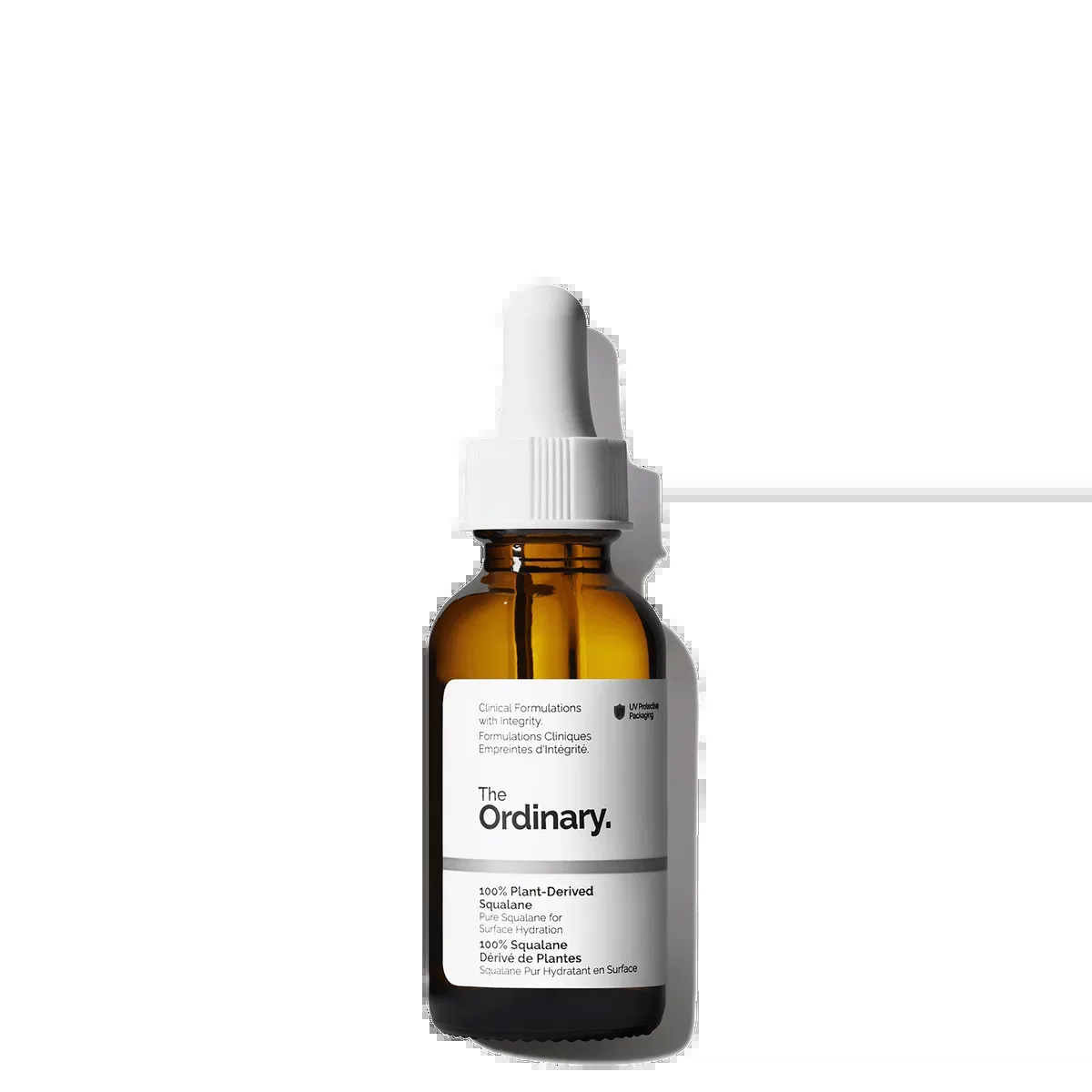
The deliberate silences are as important as the flags, so we record them explicitly rather than letting absence look like an oversight. Squalane, caprylic/capric triglyceride, mineral oil, petrolatum, dimethicone and cyclomethicone, propylene and butylene glycol, glycerin, sodium hyaluronate, zinc oxide and titanium dioxide all sit outside the metabolisable window. This is why The Ordinary 100% Plant-Derived Squalane passes despite being an oil — squalane is a hydrocarbon, not a fatty acid, and the distinction is chemical rather than semantic.
We also grade our own certainty. The ingredient families above are community-derived, assembled by the folliculitis community from curated lists and extrapolated from the culture literature. They were not tested ingredient-by-ingredient in vivo, because nobody has run that study. We record that provenance alongside the flag rather than presenting an inference as a measurement — the same discipline we apply to comedogenicity ratings, which descend from a rabbit-ear assay and are surfaced as a weak labelled signal rather than a verdict. A rating system that hides the grade of its own evidence is not more trustworthy for hiding it. The fungal-acne-checker runs the identical logic on any list you paste, including products we do not carry.
Contact time is the variable everyone forgets
The single most common misuse of a safe-list is applying it to something that rinses off.
A leave-on product sits on skin for hours, in a warm occluded environment, with its lipids available the entire time. A cleanser is on the face for well under a minute and then removed with water and surfactant. Those are not the same exposure, and treating them as equivalent produces the familiar spiral in which someone rebuilds their entire routine, cannot find a compliant cleanser, and concludes the condition is untreatable.
La Roche-Posay Toleriane Hydrating Gentle Cleanser fails the ingredient check and is a perfectly reasonable cleanser for someone with Malassezia folliculitis, because contact time makes the flagged ingredients close to irrelevant. If you prefer to pass anyway, CeraVe Acne Foaming Cream Cleanser and Bioderma Sensibio H2O Micellar Water both clear it — but choose them for how they feel, not because a compliant cleanser is doing meaningful work.
The same reasoning cuts the other way for moisturisers, sunscreens and anything worn overnight, where a flagged ingredient genuinely has hours of contact. That is where the check earns its keep. It is also why an excellent product can be the wrong product here: CeraVe Moisturizing Cream is one of the better barrier formulas available and it does not pass, which is a trade-off to make knowingly rather than a defect. When the check matters, Vanicream Daily Facial Moisturizer covers the same job while clearing the list.
Where the community lists are right, and where they overreach
They are right about the direction of travel. Plant oils really are mostly in the feeding range. Polysorbates and fatty esters really are plausible substrates once skin lipases get at them. People really do report improvement on stripped-back routines, and the mechanism gives a coherent reason why.
The overreach is precision. A binary pass/fail implies a threshold nobody has established. Whether a fatty ester at the fraction of a percent it occupies in a finished emulsion delivers enough metabolisable lipid to matter — against the sebum your own skin produces continuously, which is the yeast's actual food supply — is not a question the culture literature answers. Some flagged ingredients are almost certainly irrelevant at in-product levels. Some unflagged ones may not be. The list is a screening heuristic being read as a verdict.
The deeper overreach is treating avoidance as treatment. Malassezia folliculitis is a fungal overgrowth, and removing dietary substrate from the outside does not clear an established one. An antifungal does. Nizoral Anti-Dandruff Shampoo used as a short-contact face mask is the standard low-cost first move, and oral options exist for cases that do not respond. The fungal acne pathway sets out the escalation properly, and the fungal-acne routine treats the safe-list as a maintenance measure after treatment rather than as the treatment itself.
It is also worth confirming the diagnosis before rebuilding a routine around it. Malassezia folliculitis is uniform, itchy, monomorphic papules — no comedones — often on the chest, back and hairline. If there are blackheads, it is not this, and the acne pathway is the right document. The Ordinary Niacinamide 10% + Zinc 1% and Differin Adapalene Gel 0.1% both clear the check and are genuinely useful when the two conditions coexist, which they frequently do.
How to use the badge without being governed by it
Four rules that survive the uncertainty above.
Ignore the badge, read the list. The claim is self-certified and the ingredient list is not. Paste it into the fungal-acne-checker or scan it yourself for the three families; the ingredient-decoder will name anything you do not recognise.
Weight by contact time. Apply the check strictly to leave-on products and loosely to anything you rinse. This alone makes a compliant routine achievable instead of an ordeal.
Treat first, then maintain. Nothing on a safe-list is antifungal. Clear the overgrowth with something that actually kills it, then use ingredient screening to reduce the chance of it re-establishing.
Hold the whole framework loosely. If a flagged product has never caused you a problem, the flag is describing a population-level plausibility, not your face. And if a fully compliant routine has changed nothing in six weeks, that is strong evidence the diagnosis is wrong — which is a far more useful conclusion than assuming a hidden ingredient somewhere is still feeding something.
Products mentioned
Independently reviewed and scored — the real products behind this piece.


- Therapy guide Fungal acne The escalation ladder a safe-list cannot substitute for
- Therapy guide Acne The right document if there are comedones
- Routine Fungal Acne-Safe Skincare Routine Ingredient screening as maintenance after treatment
- Ingredient Squalane The canonical example of an oil outside the metabolisable window
- Ingredient Fatty Acids The class the whole chain-length rule is built on
References
- Dandruff-associated Malassezia genomes reveal convergent and divergent virulence traits shared with plant and human fungal pathogens — Proceedings of the National Academy of Sciences, 2007
- Growth requirements and lipid metabolism of Pityrosporum orbiculare — Journal of Investigative Dermatology, 1976
- Genus-Wide Comparative Genomics of Malassezia Delineates Its Phylogeny, Physiology, and Niche Adaptation on Human Skin — PLoS Genetics, 2015
- Diverse Colonisation and Disease Associations of the Human Commensal Malassezia: Our Body's Secret Tenant — Mycoses, 2025
Every cited link is verified to resolve to the paper named. Where a source could not be independently confirmed, it is listed without a link rather than pointing you somewhere wrong.
Frequently asked
Is 'fungal-acne safe' a regulated claim?
No. There is no defining body, no threshold and no test protocol behind it. Any brand can print it, and many do so after running their list against a spreadsheet found online. That is why we derive the flag from the ingredient list rather than reading the front of the bottle.
Where does the C12–C24 rule come from?
A 1976 study of Pityrosporum orbiculare found it grew in culture only when fatty acids in that series were supplied, with elaidic and nervonic acids as exceptions that did not support growth. It is genuine published work, applied well beyond the culture-dish conditions it was generated in.
Does a cleanser need to be Malassezia-safe?
Rarely. Contact time is under a minute and then it is rinsed away with surfactant, so flagged ingredients have little opportunity to matter. Applying the check strictly to leave-on products and loosely to rinse-offs is what makes a compliant routine practical rather than impossible.
Will avoiding the flagged ingredients clear my fungal acne?
Not on its own. Nothing on a safe-list is antifungal, and your own sebum is the yeast's main food supply regardless of what you apply. Clear an established overgrowth with an antifungal first, then use ingredient screening as maintenance.
Why do you flag squalane's neighbours but not squalane?
Squalane is a saturated hydrocarbon rather than a fatty acid or an ester of one, so it sits outside the metabolisable range. We record it and other deliberate exclusions — mineral oil, petrolatum, silicones, caprylic/capric triglyceride — explicitly, so the absence of a flag reads as a decision rather than an omission.
How much should I trust your fungal-acne flag?
As a screening heuristic with a stated evidence grade. The ingredient families are community-derived and extrapolated from culture data, which we label rather than obscure. It is a well-reasoned prediction about plausible substrates, not a measurement of what happens on your skin.