Reapplying Sunscreen Over Makeup: Every Option, Ranked by Honesty
At one o'clock the morning's protection has degraded and there is a full face on top of it. The available answers run from genuinely useful to ritual with a label, and the ranking is not the one the marketing suggests.
Read the preview
From the DermApproved blog, in Sun Protection: every product sold for reapplying sunscreen over makeup hits the same wall. None deliver anything close to the thickness their SPF was measured at. So the honest ranking is not the one on the shelf — and the two options that beat all of them are free. For the full breakdown, visit dermapproved.com/blog.
What reapplication is actually for
The two-hour rule gets recited as though UV filters have a shelf life once applied. Mostly they do not. Modern photostable filters and stabilised avobenzone systems do not simply stop working after 120 minutes on the skin.
What degrades is the film. Sweat carries product off. Sebum migrates through it. Clothing, straps, phone screens and hands rub it away in patches. Towelling removes it wholesale. The layer that was continuous at eight in the morning is discontinuous by lunchtime, and a discontinuous layer protects unevenly in a way no label figure describes.
That reframing matters because it tells you when reapplication is genuinely urgent and when it is close to ceremonial. A person who has been outdoors, sweating, in and out of water, has a film that has been substantially removed. A person who applied at eight, walked ten minutes to an office and has not touched their face since has a film that is largely intact.
So the honest first question is not which product to use. It is whether the layer you are worried about has actually been disturbed.
The benchmark every option fails
Whatever you reach for, judge it against one number.
SPF is measured at an application density of 2 milligrams per square centimetre — a layer thick enough to be visible before it is worked in, roughly a quarter to a third of a teaspoon for a face. That density is what generated the figure printed on whichever product you are about to use.
Nothing in the reapplication category comes close. A powder dusted over a made-up face, a mist held at arm's length, a few taps of a cushion — all deliver a small fraction of test density, and the SPF on those containers was generated at the full one. This is not a scandal so much as a category-wide structural fact, and the products are not lying; they were tested the way every sunscreen is tested.
The consequence is compounded by how protection scales. Delivered SPF falls faster than the layer thins — in vivo work found the relationship following exponential growth, with protection dropping as the square root at half density and further at a quarter. So a light top-up does not deliver a proportional slice of the labelled figure. It delivers real but modest and essentially unquantifiable protection.
Which is exactly why the ranking below is by honesty rather than by SPF. Run your own numbers once with the Sunscreen Amount calculator and the whole category becomes easier to think about.
The ranking
Best: remove the makeup and reapply properly. Unglamorous, unpopular, and the only option that reaches test density. Micellar water on a pad, then a full layer. If you are spending a day outdoors, this is the answer, and every product below is a compromise you are making for social convenience.
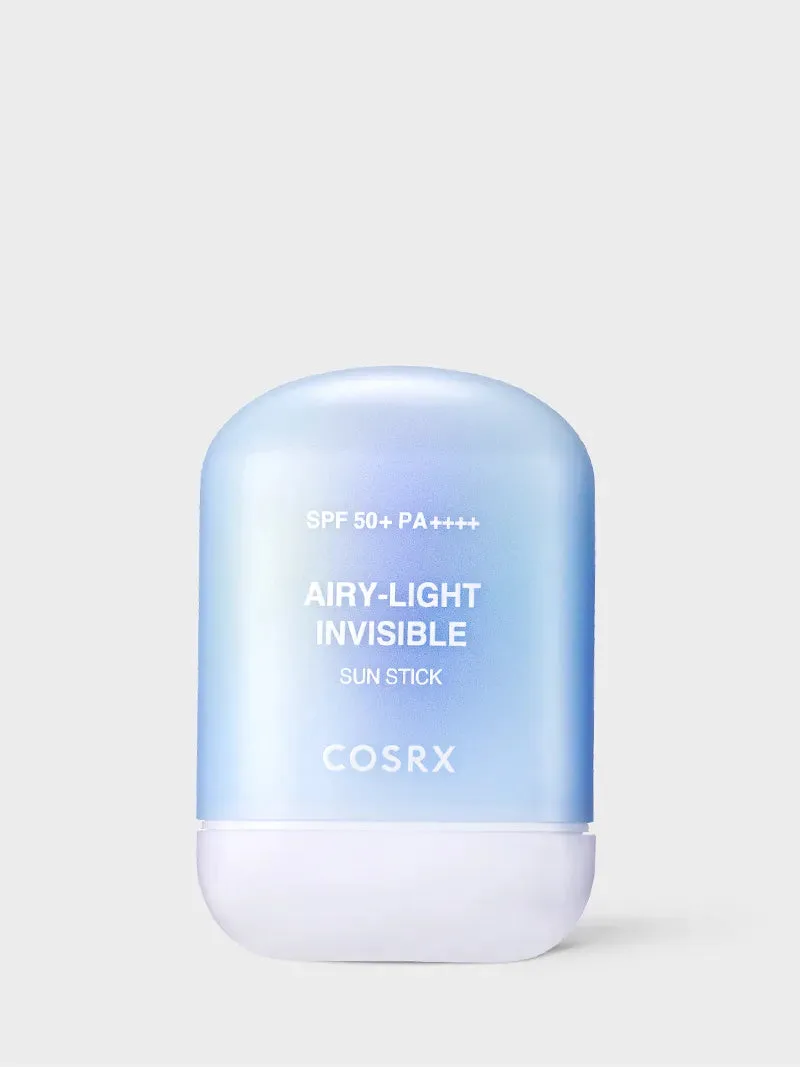
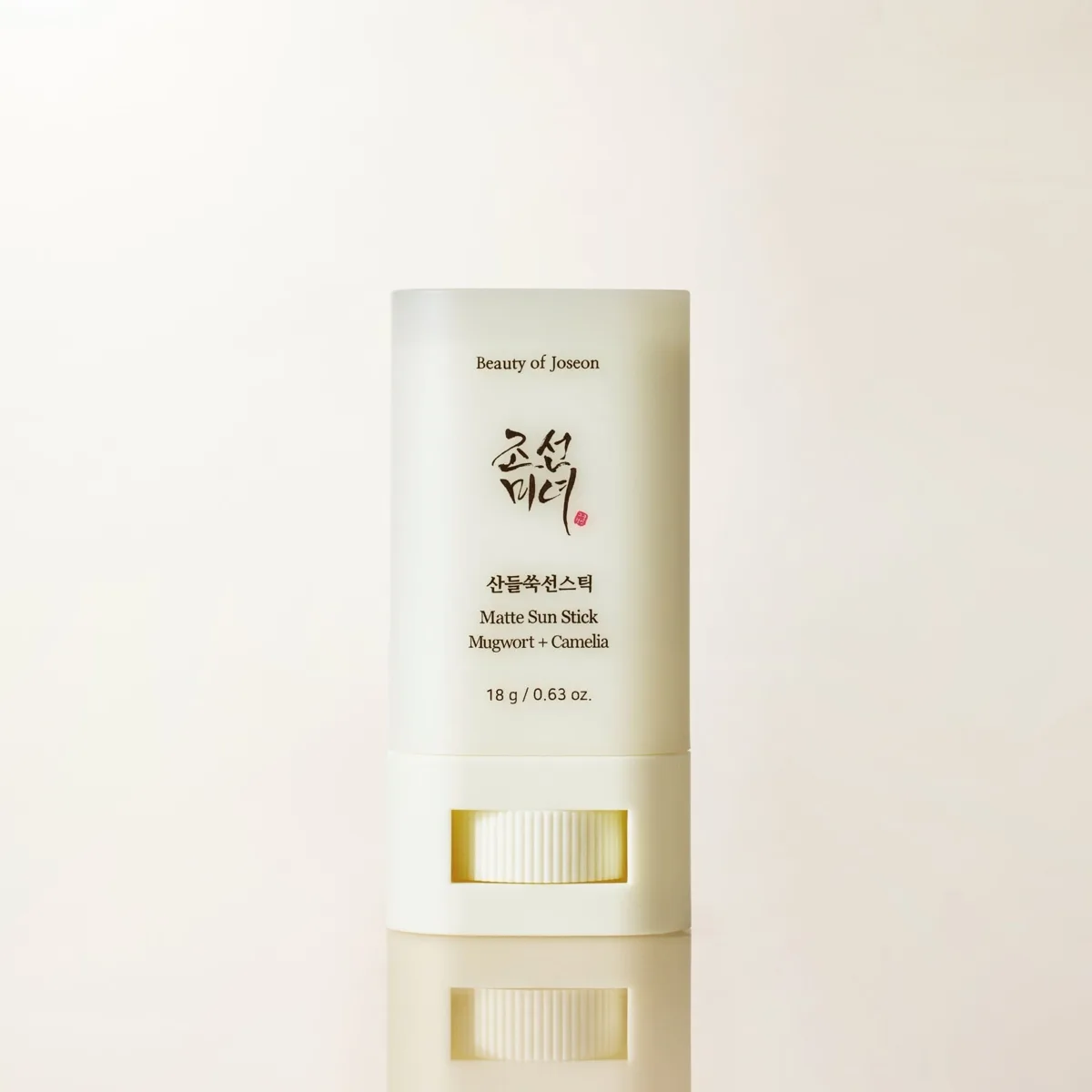
Very good, if you will do it: a sunscreen stick, pressed rather than swiped. A stick can deliver a genuinely substantial layer if you pass it back and forth over the same area until there is visible product, then press it in with fingertips rather than rubbing. It disturbs makeup less than a lotion and more than a mist. COSRX Airy-Light Invisible Sun Stick and Beauty of Joseon Matte Sun Stick are both usable this way, and this is the highest-dose option that survives a working day. Sticks are also the best answer for the sites everyone forgets — ears, hairline, the back of the neck — where there is no makeup to protect anyway.
Good: a cushion compact. A saturated sponge deposits more liquid than any powder or mist, taps on without disturbing what is underneath, and is the only format designed for exactly this moment. An untinted sun cushion like ROUND LAB Birch Juice Moisturizing Uvlock Sun Cushion sidesteps shade matching entirely; tinted versions such as Laneige Neo Cushion Matte double as touch-up base. One caveat worth taking seriously: testing of used cosmetics found sponge applicators carrying bacterial loads orders of magnitude above every other product category, so wash or replace the puff and never share the compact.
Mediocre: SPF mists and setting sprays. Coverage is uneven, a great deal of product misses the face entirely, and there is no visual feedback telling you whether you achieved anything. Supergoop! RE:SETTING Refreshing Mist and Kate Somerville UncompliKated SPF 50 Setting Spray are pleasant products; as sun protection they are a top-up on a top-up. If you use one, hold it close and mist to the point of visible dampness rather than a passing spritz.
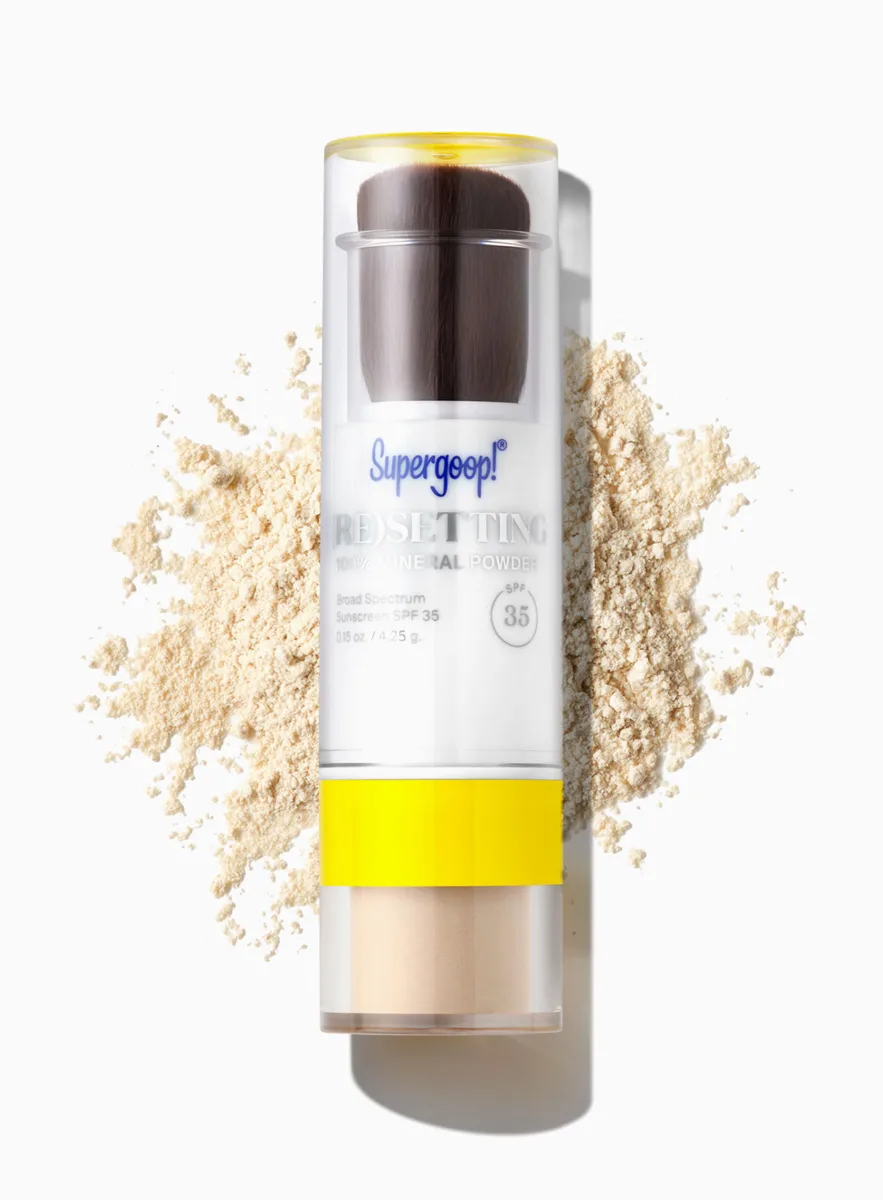
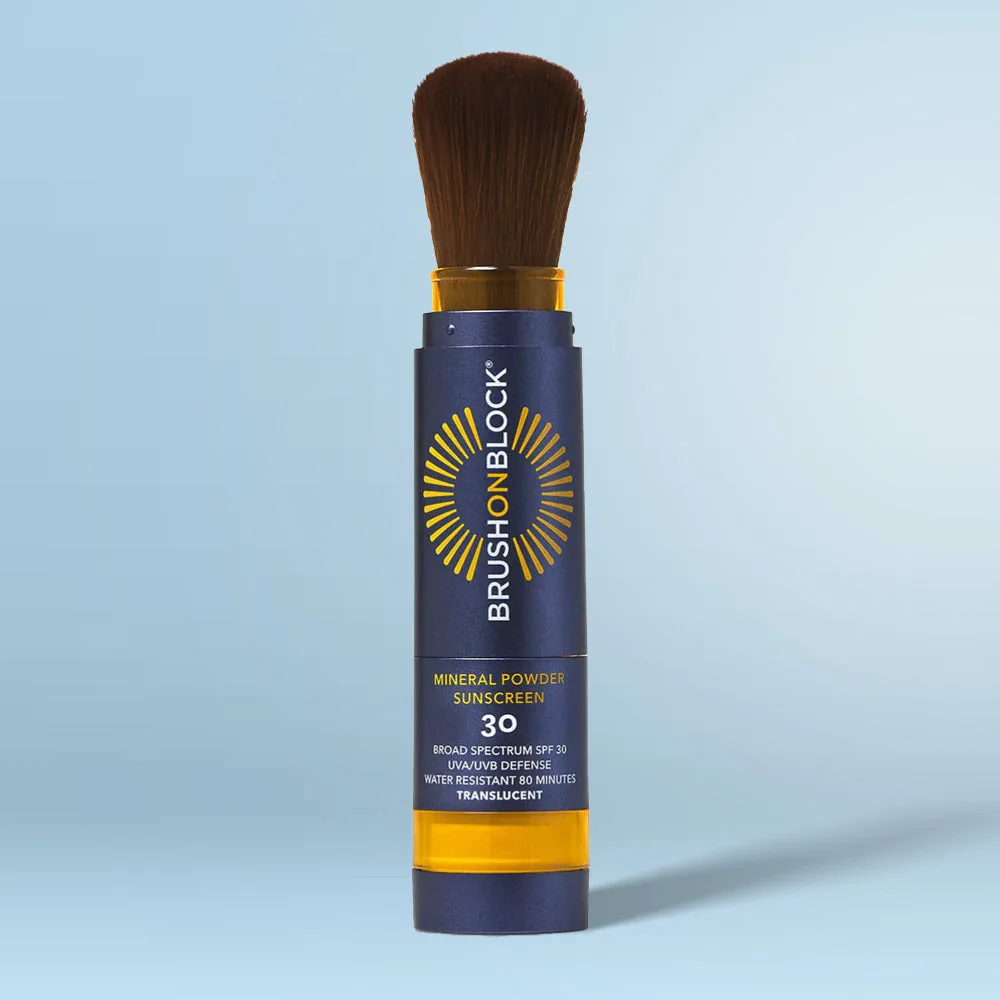
Weakest: SPF powders. No dusting motion reaches meaningful density, and the format's real appeal is that it addresses shine — a cosmetic problem — while carrying a number that implies it addresses UV. Supergoop! (Re)setting 100% Mineral Powder and Brush On Block Mineral Sunscreen Powder are decent at what they physically do. As the sole midday intervention they are close to ritual, and the risk is not the product — it is the confidence it produces.
The two answers that beat all of them
Both of the genuinely superior options are free, and neither is a product.
Shade. Moving out of direct sun reduces exposure by more than any partial reapplication achieves, immediately and reliably, with no dose problem whatsoever. Eating lunch inside or under an awning outperforms every item in the previous section combined. This sounds glib and it is arithmetically correct.
A hat with a brim. A wide brim shades the face, ears and neck continuously for as long as it is on your head, needs no reapplication, and cannot be under-dosed. It also protects the sites people most reliably miss with any product. The reason hats lose to powders in practice is entirely social, and it is worth being honest that the social objection is the real constraint rather than the efficacy one.
Timing is the third free lever. Ultraviolet intensity peaks in the middle of the day, so shifting an outdoor walk or a run by ninety minutes changes exposure more than any top-up. The Sun Safety tool covers what the index actually means for a given day and skin type, which is more useful than a fixed rule.
The honest hierarchy, then, runs: shade and timing, then a hat, then removing makeup and reapplying properly, then a stick or cushion, then a mist, then a powder. Most published advice inverts the top and bottom of that list because only the bottom half is purchasable.
Do you actually need to reapply?
For a large number of people the answer is no, and saying so is not permission to be careless — it is a way of spending your effort where it matters.
If you applied a full layer in the morning, commuted briefly, and have spent the day indoors away from a window without sweating or touching your face, the film is largely intact and a midday top-up adds little. The morning application was the intervention.
The complication is glass. Standard window glass blocks the great majority of UVB but transmits a substantial proportion of UVA, which is the wavelength range associated with photoageing and which penetrates more deeply. So a desk beside a sunny window is a genuine ongoing exposure, and it is the reason the blanket answer for office workers is neither "you need to reapply every two hours" nor "you are indoors, forget it." It depends on how much daylight actually reaches your face.
The practical version:
Outdoors for any sustained period, sweating, swimming or towelling — reapply properly, and remove makeup to do it if the exposure is significant. Two hours is a reasonable interval, and after water it is immediate.
Indoors, seated near a bright window — one genuine top-up in the middle of the day is worth doing, and a stick or cushion is a reasonable way to do it.
Indoors, away from windows — the morning layer is doing its job. Spend the energy on applying enough of it tomorrow morning instead, from something you actually enjoy using. Our fragrance-free sunscreen list and the oil-free list both exist because texture drives compliance, and compliance drives dose — which remains the only variable in this entire subject that reliably changes outcomes.
Products mentioned
Independently reviewed and scored — the real products behind this piece.


References
- The relation between sun protection factor and amount of suncreen applied in vivo — British Journal of Dermatology, 2007
- Sunburn protection as a function of sunscreen application thickness differs between high and low SPFs — Photodermatology, Photoimmunology & Photomedicine, 2012
- Microbiological study of used cosmetic products: highlighting possible impact on consumer health — Journal of Applied Microbiology, 2020
Every cited link is verified to resolve to the paper named. Where a source could not be independently confirmed, it is listed without a link rather than pointing you somewhere wrong.
Frequently asked
Do SPF powders actually work?
They deliver something, but nowhere near their labelled figure. SPF is measured at a density no dusting motion can achieve, and delivered protection falls faster than the layer thins. A powder is reasonable as a small top-up over a proper morning application and unreasonable as the whole midday plan. Its genuine strength is shine control, which is a cosmetic benefit wearing a sun-protection number.
What is the best way to reapply without ruining my makeup?
A sunscreen stick applied with several passes over the same area and then pressed in with fingertips gets closest to a real dose while disturbing the least. A cushion compact is the next best, since a saturated sponge deposits more product than any mist or powder and taps rather than rubs. Both are compromises against removing the makeup and applying properly, which is the only option that reaches test density.
Do I need to reapply if I work indoors?
It depends on your desk. Standard window glass blocks most UVB but transmits a substantial share of UVA, so a seat beside a bright window is genuine ongoing exposure and one midday top-up is worthwhile. Away from windows, with no sweating and no face-touching, the morning layer remains largely intact and the top-up adds little. Put the effort into a fuller morning application instead.
Why two hours? Do the filters stop working?
Mostly they do not — modern photostable systems keep absorbing. What fails is the film's continuity: sweat, sebum, friction from clothing and hands, and towelling all remove product in patches, and a patchy layer protects unevenly. That is why the interval matters far more when you are active or in water, and far less when you have been sitting still indoors.
Is there anything better than reapplying?
Yes, two things, and neither is a product. Moving into shade reduces exposure immediately and completely reliably, with no dose problem at all. A wide-brimmed hat protects the face, ears and neck continuously and cannot be under-applied. Shifting outdoor activity away from the middle of the day is the third. All three outperform any partial top-up, and all three are free.