A 30g Tube for a Whole-Body Rash Has Already Failed, and You Can See It at the Counter
Four fields on a prescription label decide whether a treatment can possibly work — strength, vehicle, quantity and refills — and patients are almost never walked through any of them.
Read the preview
From the DermApproved blog, in Prescription Skincare: the strongest steroid on the shelf carries the smallest percentage on its label. Point-oh-five is superpotent; one percent is the weakest class there is. So the number patients use to judge strength ranks them almost exactly backwards — and that's the least expensive of four mistakes visible on the tube. For the full breakdown, visit dermapproved.com/blog.
The label is the treatment plan, compressed
A prescription label is a dense little document that nobody teaches you to read. It carries a molecule, a number, a base, a quantity and a refill count, and between them those five things determine whether the treatment you were given has any chance of doing what it was prescribed for.
The consultation rarely covers them. Time is short, the diagnosis takes most of it, and the dispensing detail is treated as administrative — a matter for the pharmacy rather than for the patient. So people leave with a tube, apply it as instructed, and return weeks later to report that it did not work. Sometimes that is true and the drug was wrong. Often the drug was right and something about how it was dispensed made success unavailable.
The useful thing about all four failure modes below is that they are visible before you leave the counter, when the prescription can still be changed with a phone call rather than a repeat appointment six weeks later.
Strength: the percentage is not the potency
This is the most consistently misread number in dermatology, and the misreading is entirely reasonable — larger numbers usually mean stronger things.
Topical corticosteroids are ranked by measured anti-inflammatory activity, not by concentration. The US system runs from class I, superpotent, to class VII, least potent. Clobetasol propionate at 0.05% is class I. Hydrocortisone at 1% and 2.5% is class VII. The most potent preparation on the shelf carries the smallest percentage, and a patient comparing the two numbers would confidently reach the opposite conclusion about which is more likely to thin their skin.
So the number to ask about is not the percentage but the class, and specifically what class you have been given for the site you are treating. That question matters most where potency and site interact badly — face, eyelids, genitals and skin folds, where thin skin and natural occlusion drive absorption up. Our answers on what strength of steroid you are likely to be given and the real risks of topical steroids cover what the classes mean in practice, and the second is worth reading by anyone who has been made frightened enough of steroids to under-use one.
The corollary is that a plain over-the-counter option like Vanicream HC 1% Hydrocortisone Anti-Itch Cream sits at the bottom of that scale. That makes it appropriate for mild, small-area problems and genuinely inadequate for the ones a clinician has decided need a prescription — which is why substituting it for a prescribed course is not a cautious decision, it is a different and weaker one.
Vehicle: the base is part of the dose
The second field is the one people treat as a preference and clinicians treat as a variable, and the clinicians are right.
The same molecule at the same percentage behaves differently depending on what it is suspended in. Ointments are the most potent presentation because they are occlusive — they trap water at the surface, hydrate the stratum corneum and drive penetration. Creams deliver less and are more cosmetically acceptable, which is a real consideration when adherence is the binding constraint. Lotions, gels, foams and solutions exist mainly to reach hair-bearing skin and to be tolerable on large areas or greasy-averse patients.
That is why a substitution that looks trivial at the counter is not. Being handed a cream where an ointment was written is not a like-for-like swap; it is a reduction in delivered dose that nobody recorded as a change of plan. Equally, an ointment prescribed for a scalp or a bearded area is a prescription that will be abandoned within a week — the right vehicle for a site is the one that both penetrates and gets used.
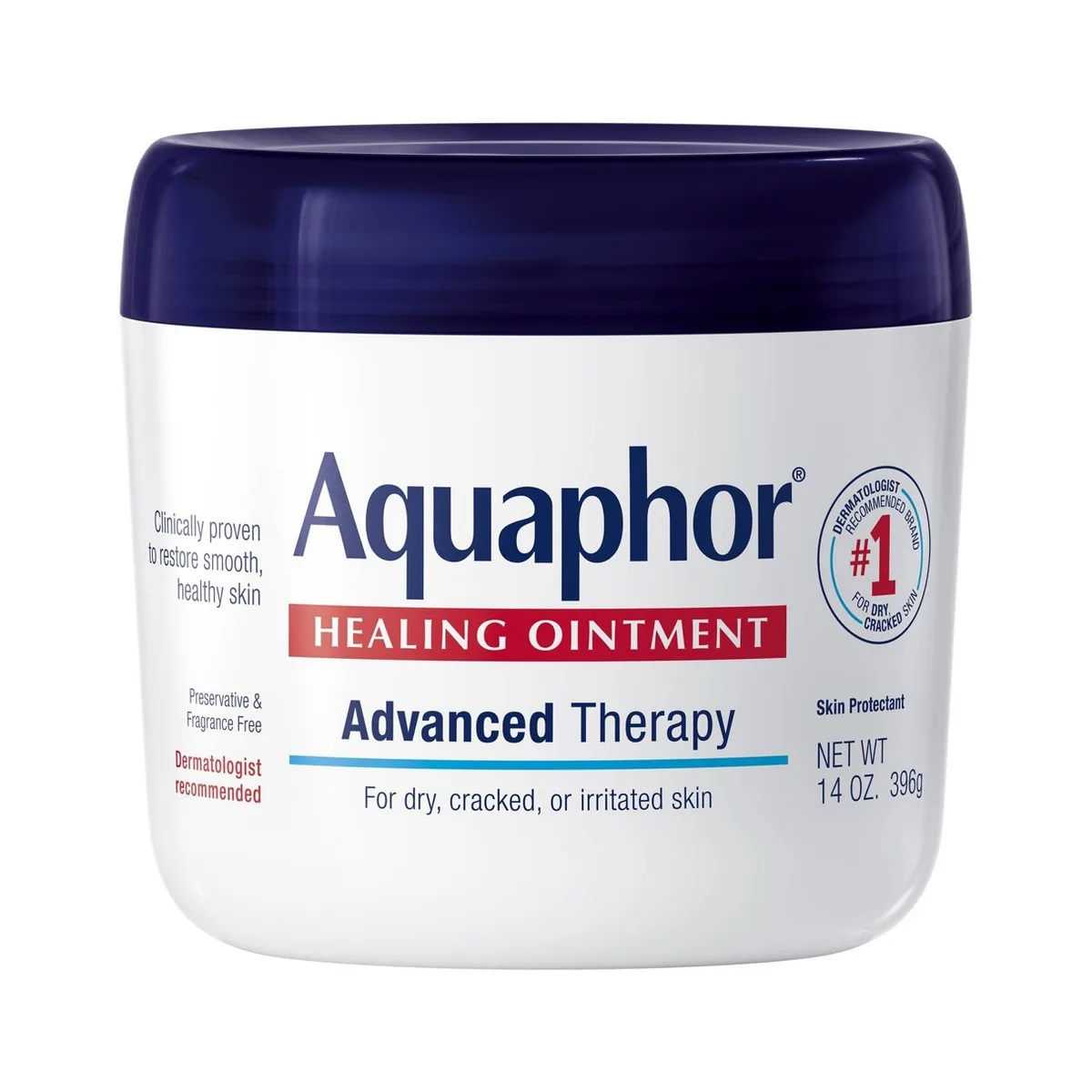
Site matters more than most people realise on its own. Penetration varies enormously across the body, differing by something like 300-fold between the thinnest and thickest regions, and inflamed skin absorbs several times more than intact skin — figures in the range of two to ten times. A regimen that is safe on a shin can be a genuine atrophy risk on an eyelid at the same class and the same percentage. Whatever the prescription, plain emollient underneath and around it does the supporting work: CeraVe Moisturizing Cream on the body, La Roche-Posay Lipikar Eczema Cream where the skin is inflamed, and Aquaphor Healing Ointment or Vaseline Original Healing Jelly where occlusion is wanted overnight.
Quantity: do the arithmetic before you leave
This is the field that fails silently and the one with an actual calculation behind it.
Dermatology has a standard unit for how much topical to apply: the fingertip unit, the ribbon squeezed from a standard nozzle across the last segment of an adult index finger. The original measurements are precise. One fingertip unit covers about 286 cm² of skin, with a small difference between men and women. Applying it region by region takes roughly 2.5 units for the face and neck, 6.7 for the front of the trunk, 6.8 for the back, 3.3 per arm-and-forearm, 1.2 per hand, 5.8 per leg-and-thigh and 1.8 per foot. A companion paper gives the conversion in the simplest possible form: four hand areas equal two fingertip units equal one gram.
Run those numbers for a whole adult body and one single application comes to somewhere around forty fingertip units — about twenty grams. Twice daily for a week is therefore in the region of 280 g. Against that, a 30 g tube is roughly a single day and a half of whole-body treatment. If your prescription is for widespread disease and the tube is small, the course you were told to run cannot be run, and no amount of diligence will fix it.
The reason this matters beyond arithmetic is that under-dosing looks identical to treatment failure from the outside. A patient who eked a 30 g tube across two weeks of widespread eczema will be recorded as not responding to that steroid, and the next decision — a stronger class, a different drug, a systemic agent — is made on a false premise. Working out the quantity before you start is worth more than almost any other preparation, and the FTU Calculator and BSA Calculator between them turn 'the affected area' into a number of grams you can hold against the tube in your hand.
Refills: the field that encodes the plan
The last field is the one patients almost never interrogate, and it carries information about what the prescriber expects to happen.
No refills usually means the drug is intended for a defined burst with a review at the end — either because the class is potent enough that unsupervised long-term use is undesirable, or because the diagnosis is provisional and the response to treatment is itself the diagnostic test. Several refills usually means a chronic condition where you are expected to run maintenance and only come back if things change. Those are different plans, and treating one as the other is how people end up either running out mid-course or continuing a potent steroid for months without anyone looking at the skin.
Duration guidance follows the same logic: high-potency steroids are generally not intended to run beyond about two weeks before tapering, and overall courses are usually held inside two to four weeks. If the refill count implies a longer run than that, it is worth asking what the maintenance plan is — proactive twice-weekly dosing, a step down to a lower class, or a steroid-sparing agent. Our answer on how long a steroid cream can safely be used covers the general shape.
This is also where prescription and over-the-counter blur in ways worth understanding. Some genuinely useful actives moved across that line — an adapalene like Differin Adapalene Gel 0.1% is a prescription-grade retinoid you can now buy — while others moved the other way, which is the subject of why hydroquinone is prescription now. And knowing when you have earned a prescription in the first place is its own question, covered for the scalp in when you need a prescription and for fungal problems in whether prescription ketoconazole is stronger.
What to ask before you walk out
Four questions, asked at the counter, cover everything above. What class is this steroid, and is that class right for where I am putting it? Is this the vehicle that was written, and if it was substituted, does the prescriber know? How many grams do I need for my affected area over the intended course, and is this tube that? And is this a defined course with a review, or a maintenance supply?
The reason to ask them there rather than later is entirely practical. A pharmacist can resolve a vehicle substitution or a quantity shortfall the same day. Six weeks later, the same problem has become a failed treatment in your record, and the conversation is about escalating rather than about dispensing.
It is also worth arriving prepared, because the appointment where this gets decided is short. The Derm Visit Prep tool builds the one-page brief — timeline, every product in use, and the questions worth asking — which is the difference between a consultation spent reconstructing history and one spent deciding what to do. From there, the eczema pathway and the psoriasis pathway set out what escalation looks like, and both make the same assumption this post has been arguing for: that the previous tier was actually run. A tube too small to cover the affected area is not a tier that was run. It is a tier that was written down.
Products mentioned
Independently reviewed and scored — the real products behind this piece.




- Therapy guide Eczema Escalation logic that assumes the previous tier was actually run.
- Therapy guide Psoriasis The same assumption, in a condition where quantity failures are especially common.
- Ingredient Petrolatum (Petroleum Jelly) The occlusive base that explains why ointments deliver more than creams.
- Ingredient Adapalene A prescription-grade retinoid now available without one.
- Question What strength of steroid cream will I be given? What the potency classes mean when they are actually prescribed.
- Question What are the actual risks of topical steroids? Worth reading by anyone frightened into under-using a prescription.
- Question How long can I safely use a steroid cream? The duration question the refill count implies but never states.
- Question Why can I not buy hydroquinone over the counter any more? An active that moved the other way across the prescription line.
- Question When have I earned a prescription? How to tell when over-the-counter options have genuinely been exhausted.
- Question Is prescription ketoconazole meaningfully stronger? The same strength-versus-availability question in the antifungal lane.
References
- The finger-tip unit--a new practical measure — Clinical and Experimental Dermatology, 1991
- The rule of hand: 4 hand areas = 2 FTU = 1 g — Archives of Dermatology, 1992
- Topical Corticosteroids — StatPearls, NCBI Bookshelf, 2025
- Relative Potency of Topical Corticosteroid Preparations — Indian Journal of Dermatology, Venereology and Leprology, 1985
Every cited link is verified to resolve to the paper named. Where a source could not be independently confirmed, it is listed without a link rather than pointing you somewhere wrong.
Frequently asked
Is a higher percentage a stronger steroid?
No, and this is the most common misreading on any dermatology label. Potency is ranked by measured anti-inflammatory activity across seven classes, not by concentration. Clobetasol propionate at 0.05% is superpotent class I; hydrocortisone at 1% and 2.5% is class VII. Ask which class you have, not what the percentage is.
Does it matter if the pharmacy gives me a cream instead of an ointment?
Yes. Ointments occlude and therefore deliver more of the same molecule at the same concentration than creams do, so the substitution quietly lowers your dose. It can be the right call for a hair-bearing site or for adherence, but it should be a decision someone made rather than one that happened at the counter.
How do I know whether my tube is big enough?
Work it out in fingertip units. One unit covers about 286 cm², and two units equal one gram — so a whole-body adult application is roughly forty units, or about 20 g. Multiply by applications per day and days of course. Widespread disease treated twice daily for a week needs an amount that a small tube cannot supply.
Why does the same steroid seem stronger on my face than my legs?
Because absorption varies enormously by site — on the order of 300-fold between the thinnest and thickest skin — and inflamed skin takes up several times more than intact skin. That is why potency choice is site-specific and why face, eyelids, genitals and folds are treated with lower classes for shorter periods.
What do refills tell me?
They encode the intended plan. No refills usually signals a defined course with a review at the end, often because the response is itself diagnostic. Multiple refills usually signals maintenance for a chronic condition. If the supply implies a longer run than typical duration guidance allows, ask what the maintenance strategy is.