'Preservative-Free' Is a Warning Label, Not a Selling Point
An unpreserved water-based cream is a warm, wet, nutrient-rich box — which is to say, a petri dish. The real question was never whether to preserve, but which preservative, and the fear got that exactly backwards.
Read the preview
From the DermApproved blog, in Ingredient Science: preservatives — and why the fear of them is aimed at exactly the wrong target. Picture your water-based moisturizer the way a microbe does. Warm. Wet. Full of food. Reopened every single night with fingers that have touched your phone, your face, the door. Now imagine there's nothing in there to stop the party. That, quietly, is what the words 'preservative-free' actually buy you — a petri dish with a pretty label. But here's the twist that should make the whole clean-beauty aisle squirm. The one molecule everyone spent a decade scrubbing from their shelves? It turns out to be among the least likely things in skincare to ever bother your skin. And the trendy, natural-friendly ingredient that rushed in to replace it went on to set off a genuine, documented allergy epidemic. So there's a preservative worth knowing by name before it finds you — and there's a reassuring little phrase on the front of the bottle that's secretly a warning. Which is which, and how to read a label like a grown-up — at dermapproved.com/blog.
The scariest word on the label is the one that's missing
Walk the skincare aisle and you'll see 'preservative-free' printed like a virtue, right next to 'clean' and 'free-from.' It's meant to reassure. It should do the opposite. A water-based moisturizer is, from a microbe's point of view, an ideal habitat: warm, wet, full of nutrients, and reopened daily with fingers that have touched everything. Leave the preservative out and you haven't made it purer. You've built a petri dish and put it on your bathroom shelf.
This is the inversion at the heart of the whole preservative panic. The marketing frames preservatives as a contaminant to be removed, when they are the thing standing between your cream and a bloom of bacteria and mold. The honest question was never whether a product should be preserved — for anything with water in it, that's settled microbiology — but which preservative does the job with the least downside. Somewhere in the 'free-from' era, we lost that question and replaced it with a reflex. Getting it back is the point of this piece, because the reflex has led a lot of people to fear exactly the wrong molecules.
Why water is the problem
Microbes need water to grow, and most of what you smooth onto your face — lotions, serums, gel-creams, essences — is mostly water. A 2009 review in Contact Dermatitis on contamination versus preservation put it plainly: cosmetics with high water content are at risk of being contaminated by micro-organisms that can spoil the product or endanger the user, with Staphylococcus aureus and Pseudomonas aeruginosa among the frequent offenders. Pseudomonas in particular loves a wet cosmetic, and it's no trivial houseguest — on compromised or eczema-prone skin, or near the eyes, a contaminated product is a genuine infection route, not a theoretical one.
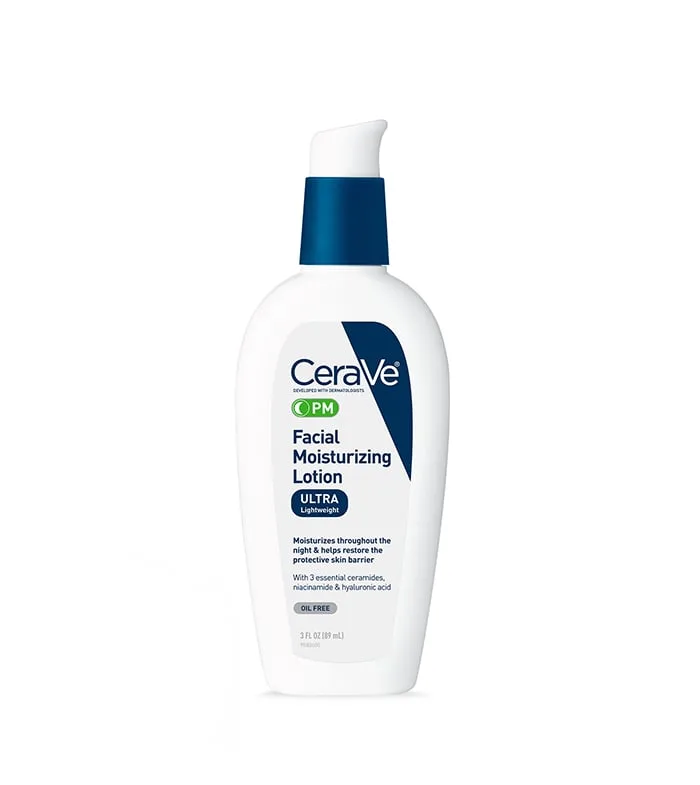
This is exactly why the products people trust most for barrier repair are carefully preserved. A water-rich, humectant-loaded serum like The Ordinary Hyaluronic Acid 2% + B5 has to be protected, because a hyaluronic acid solution is essentially sugar-water from a microbe's perspective. The same goes for a nightly staple like CeraVe PM Facial Moisturizing Lotion: the emulsion that makes it feel light and absorb fast is a water-oil system that would spoil within weeks unpreserved. The preservative isn't the compromise in these formulas. It's the reason they're safe to use for the months it takes to finish the bottle. If you want to see what's actually guarding a product, run its ingredient list through our ingredient-decoder — the preservative system is usually near the end of the INCI, quietly doing the most important job on the label.
The paraben panic, and what the evidence actually says
No preservative has been feared like parabens. They became the villain of the 'clean beauty' story on the strength of a single association: parabens can weakly mimic estrogen, and estrogen is tied to breast cancer, so the mental math wrote itself. But the mental math skipped the part where 'weakly' is doing enormous work. The estrogenic potency of parabens is on the order of tens of thousands of times weaker than the body's own estradiol — a difference so large it changes the kind of thing you're talking about, not just the amount.
On the allergy front, the record is almost the opposite of their reputation. In 2019 the American Contact Dermatitis Society named parabens the 'Non-Allergen of the Year,' a deliberately pointed title meant to highlight how rarely they actually cause allergic contact dermatitis despite decades of ubiquitous use. A 2020 safety review in the Journal of Applied Toxicology concluded that normal use of individual paraben-containing cosmetics does not pose a hazard to human health, while sensibly noting that piling on many paraben-preserved products at once is the scenario worth watching. That's the real shape of the risk: a well-studied, low-allergy, effective preservative with a theoretical cumulative-exposure caveat — not a toxin. It's why plenty of dermatologist-favorite formulas, including a barrier classic like CeraVe Moisturizing Cream, have long used parabens without incident.
The replacement that actually caused an epidemic
Here's the irony the 'paraben-free' label never mentions. When brands rushed to strip parabens out, they had to put something else in — and one of the popular substitutes, methylisothiazolinone, went on to cause a genuine allergy epidemic. Approved for broader cosmetic use in the mid-2000s, MI spread quickly into leave-on creams and wipes, and contact allergy rates climbed with it. A 2011 review in the British Journal of Dermatology flagged the early signal and warned it could be the first sign of an epidemic of MI contact allergy. It was.
The numbers that followed were striking. A 2023 analysis in JAMA Dermatology tracking methylchloroisothiazolinone/methylisothiazolinone allergy found European positivity peaking around 7.6% before regulation pulled it back down, while North American rates kept climbing — MI alone reaching roughly 15% in the latest period studied. Read those two stories together and the lesson is uncomfortable for the fear cycle: consumers were steered away from a preservative that almost never causes allergy and toward ones that, in some cases, caused it at epidemic scale. 'Free-from' is only an improvement if the replacement is better, and here it frequently wasn't.
How to read a preservative system like an adult
None of this means every preservative is equally benign or that you should ignore the topic — it means you should engage with it on its actual terms. Phenoxyethanol, one of the most common modern preservatives, is a well-tolerated workhorse with a long safety record and a low allergy rate; seeing it on an INCI list is reassuring, not alarming. Blends that pair a couple of gentle preservatives at low concentrations are often the sign of a thoughtfully formulated product, because effective preservation is achievable well below regulatory limits — and over-preserving is its own small risk, since sensitization is dose-dependent.
The smarter framing is 'enough, and well-chosen,' not 'none.' If a product genuinely carries no preservative, ask how it stays sterile — the legitimate answers involve packaging, not wishful thinking. Truly preservative-free products tend to be anhydrous (no water for microbes to exploit), single-use, or sealed in airless or sterile formats. A pressurized, sterile format like Avène Thermal Spring Water Spray can skip preservatives precisely because the can never lets contaminated air back in — that's preservative-free done right, engineered rather than merely claimed. A jar of water-based cream that boasts 'no preservatives' and expects you to dip fingers into it for three months is preservative-free done dangerously. Our shelf-life tool can help you gauge how long an opened product realistically stays safe, which matters far more than whether the label flatters your fears.
The verdict, minus the fear
Preservatives are one of the quiet triumphs of cosmetic science: they let a product survive months of daily, finger-in-the-jar use without turning into a health hazard, usually at concentrations too low to bother most skin. The 'preservative-free' badge inverts that reality, dressing a real risk up as a virtue and, in the paraben era, steering people toward substitutes that were sometimes worse.
So buy for the formula, not the 'free-from' list. A well-preserved, water-based product from a brand that understands microbiology is safer than an unpreserved one that flatters your instincts. If you have a diagnosed preservative allergy — MI being the one worth knowing about — that's a specific, real reason to read labels carefully, and a dermatologist can patch-test to pin it down. For everyone else, the preservative isn't the thing to fear on the label. Its absence is.
Products mentioned
Independently reviewed and scored — the real products behind this piece.


References
- Contamination versus preservation of cosmetics: a review on legislation, usage, infections, and contact allergy — Contact Dermatitis, 2009
- Review of the safety of application of cosmetic products containing parabens — Journal of Applied Toxicology, 2020
- Methylisothiazolinone contact allergy: a review — British Journal of Dermatology, 2011
- Trends in the Prevalence of Methylchloroisothiazolinone/Methylisothiazolinone Contact Allergy in North America and Europe — JAMA Dermatology, 2023
- Parabens (Non-Allergen of the Year) — Dermatitis, 2019
Every cited link is verified to resolve to the paper named. Where a source could not be independently confirmed, it is listed without a link rather than pointing you somewhere wrong.
Frequently asked
Is a 'preservative-free' moisturizer actually safer?
Usually the opposite. Any moisturizer with water in it needs a preservative to stop bacteria and mold from growing during months of daily use. A water-based product that genuinely has no preservative and comes in a jar you dip into is a contamination risk. The exceptions are anhydrous, single-use, or sterile/airless-packaged products, which stay safe by design rather than by leaving the preservative out.
Are parabens in skincare dangerous?
The evidence says no at the concentrations used in cosmetics. Parabens were named the American Contact Dermatitis Society's Non-Allergen of the Year in 2019 for their very low allergy rate, and their estrogen-mimicking activity is thousands of times weaker than the body's own hormones. Reviews conclude that normal use of paraben-preserved products doesn't pose a health hazard, with cumulative use of many products at once being the only scenario worth mild caution.
Which skincare preservative is most likely to cause a reaction?
Methylisothiazolinone, or MI, is the standout. After it replaced parabens in many products in the mid-2000s, contact allergy rates rose sharply enough to be called an epidemic, with positivity reaching high single digits and beyond in patch-test populations. If you react to skincare, MI is one of the first preservatives worth asking a dermatologist to patch-test.
Is phenoxyethanol a safe preservative?
Yes — phenoxyethanol is one of the most common modern preservatives precisely because it's effective, well-studied, and has a low rate of allergic reactions. Seeing it near the end of an ingredient list is a sign the product is sensibly protected, not a red flag. As with any preservative, formulators use it at low concentrations, since effective preservation doesn't require high amounts.
How do I know if a product's preservative system is well-formulated?
Look for a low-concentration blend of well-tolerated preservatives like phenoxyethanol rather than either nothing at all or a heavy single dose. Effective preservation is achievable well below legal limits, and over-preserving slightly raises allergy risk, so a light, thoughtful system is ideal. If a water-based product claims zero preservatives, check whether its packaging is airless or sterile — that's the only way that claim is safe.