Concentration Isn't Potency: pH, Vehicle, and Why 10% Can Underperform 5%
The percentage on the front of the bottle is the number readers most want us to rank on, and the one number our scoring system deliberately refuses to treat as a measure of strength.
Read the preview
From the DermApproved blog, in How We Rate: the percentage on the bottle is the number everyone wants us to rank on, and the one we refuse to read as strength. Only free acid works, and pH decides how much exists — so the weaker-looking bottle can out-exfoliate the stronger. And that is only the first of three mechanisms. For the full breakdown, visit dermapproved.com/blog.
The number people ask us to rank on
The most common request we get about scoring is some version of: rank these by strength, and use the percentage.
It is a reasonable instinct. Percentage is the one quantitative fact almost every brand discloses, it appears in large type, and comparing two numbers is easy. It is also, on its own, close to uninformative — and the reasons are chemical rather than philosophical.
Our methodology states the position directly in its governing principles: score risk, not hazard, with dose and concentration mandatory, and an unknown concentration lowering confidence rather than pretending. Alongside it sits the companion rule — respect formulation context, because vehicle, pH, and rinse-off versus leave-on change what an ingredient does.
What follows is why those two rules exist, and what they translate into when the engine actually runs. Three mechanisms sit between a printed percentage and a delivered dose. Any one of them can be worth more than the number itself.
Free acid: the arithmetic the label leaves out
An alpha hydroxy acid only exfoliates in its undissociated, protonated form. The salt does not do the job. So the operative quantity is not how much acid is in the bottle but what fraction of it is currently free acid — and that fraction is set by the gap between the formula's pH and the acid's pKa.
Glycolic acid has a pKa of 3.83. At a formulation pH equal to that pKa, about half the acid is free. Move the pH up to 4.5 and the free fraction falls to roughly 18%. Move it down toward 3.5 and it rises past two thirds. The total percentage never changed; the working dose changed by a factor of three.
Run that against the regulatory boundary and the consequence becomes concrete. The Cosmetic Ingredient Review Expert Panel concluded that glycolic and lactic acid are safe in consumer cosmetics at concentrations of 10% or less with a final pH of 3.5 or greater, and the FDA's 2005 labelling guidance for AHA cosmetics sits on that assessment. Two products can both comply — one at 10% and pH 4.5, one at 5% and pH 3.6 — and the lower-percentage product can deliver more free acid than the higher one.
Salicylic acid plays by the same rule with different constants: a pKa near 2.97 means that across the pH range cosmetics actually ship in, a large share is already dissociated. Its lipophilicity, not its free-acid fraction, is what carries it into a sebaceous follicle. Comparing acids across classes by percentage is not a rough approximation. It is a category error.
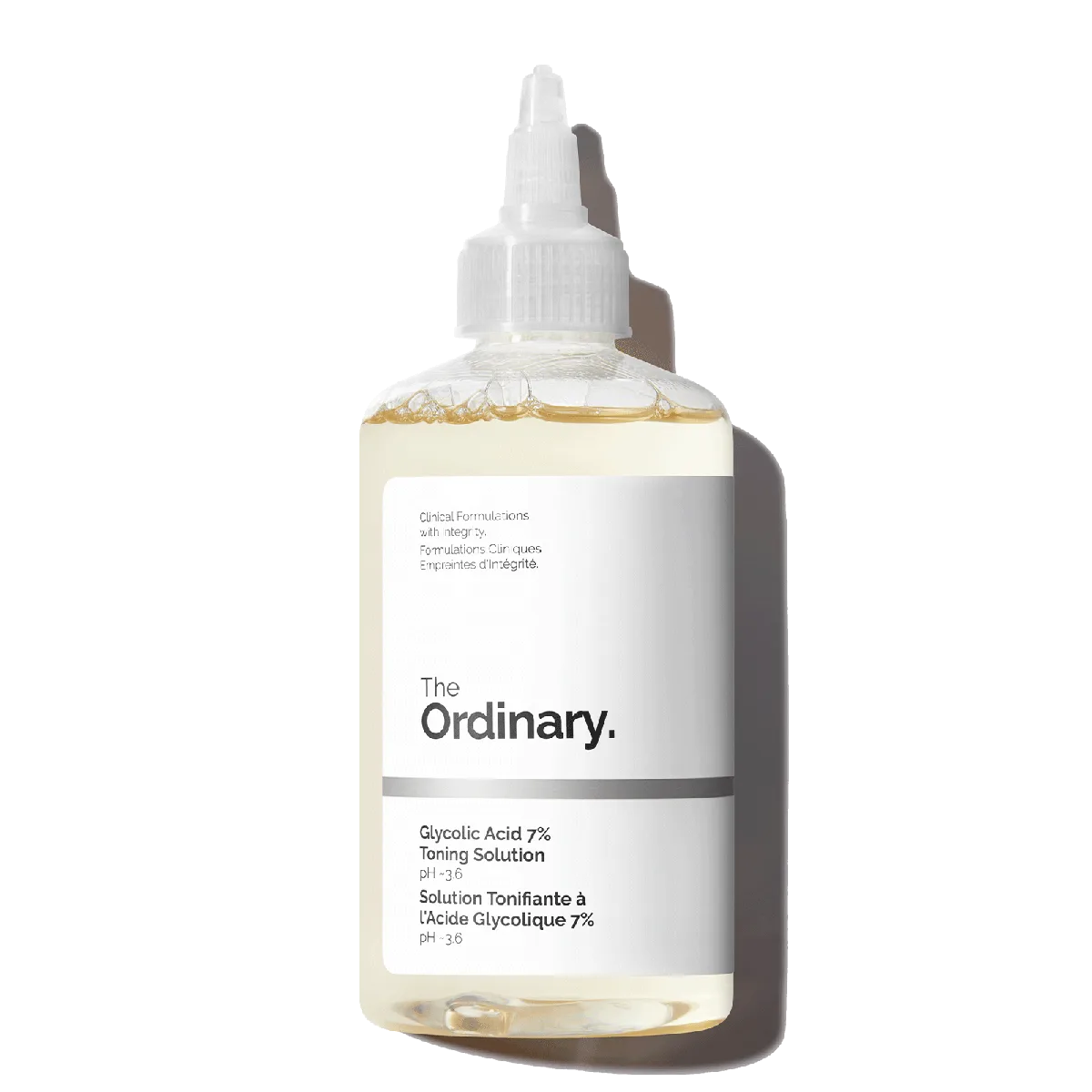
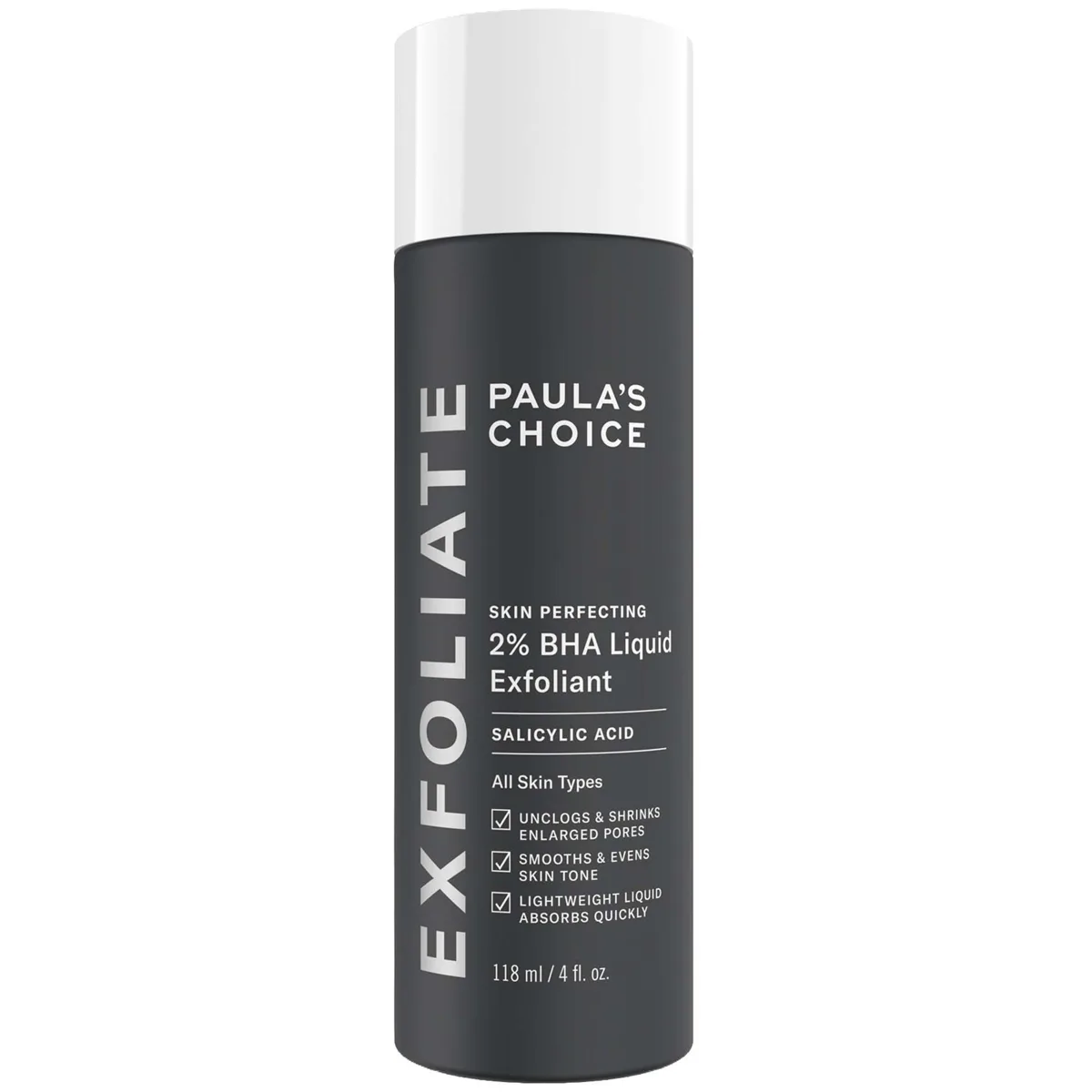
Which is why two glycolic acid leave-ons carrying near-identical headline figures — The Ordinary Glycolic Acid Toning Solution and COSRX AHA Whitehead Power Liquid — can present quite different working doses, and why a BHA exfoliant such as Paula's Choice BHA Liquid Exfoliant cannot be ranked against either by percentage at all.
Vehicle: the same percentage is not the same dose
Even holding free acid constant, what reaches living tissue depends on the base it arrived in.
The classical formulation of the problem, laid out in Pharmaceutical Research in 1990, is that flux into skin is governed by three variables: the concentration of the drug in the vehicle, the partition coefficient of the drug between stratum corneum and vehicle, and the diffusion coefficient within the stratum corneum. Concentration is one term of three, and it is the only one printed on the box. The vehicle sets the other two.
This is measurable rather than theoretical. Work published in Toxicology and Industrial Health in 2017 examined ethanol, isopropyl alcohol and isopropyl myristate as vehicles for model compounds through human stratum corneum and found significant vehicle effects on both absorption and penetration — same compound, same amount, different destination.
A practical consequence people underrate: occlusion is itself a dose adjustment. An active suspended in something that seals the surface reaches a hydrated stratum corneum with raised intercellular water content, and permeates differently from the identical active in a fast-evaporating aqueous base. An overnight treatment such as Good Molecules Overnight Exfoliating Treatment is not simply the same acids left on for longer; contact time and the base are both variables in the exposure.
Which is also why layering order is not a cosmetic nicety. What you apply an active over changes the vehicle it is effectively sitting in — the routine order tool exists because that sequence is a dosing decision, and the conflict checker because some combinations change the pH environment an active needs.
An oxidised active is a zero-percent active
The third mechanism is the bluntest: the molecule has to still be there.
L-ascorbic acid is the canonical case because its constraints were mapped precisely. Percutaneous absorption work published in Dermatologic Surgery in 2001 established that L-ascorbic acid must be formulated below pH 3.5 to enter skin at all, and that the maximal concentration for optimal absorption was 20% — above which absorption did not improve. The same study tested magnesium ascorbyl phosphate, ascorbyl-6-palmitate and dehydroascorbic acid and found that none of them raised skin levels of L-ascorbic acid.
Read that last finding against a shelf of serums advertising a derivative at an impressive percentage, and the problem with treating percentage as potency stops being abstract.
Then there is what happens after manufacture. A 2022 analysis in the International Journal of Cosmetic Science used ultra-high-performance liquid chromatography with tandem mass spectrometry to measure actual L-ascorbic acid across eight commercial vitamin C serums. At day zero, content ranged from 1.05 to 169.91 mg per litre — a spread of more than two orders of magnitude between products in the same aisle — and it declined across 60 days at ambient temperature.
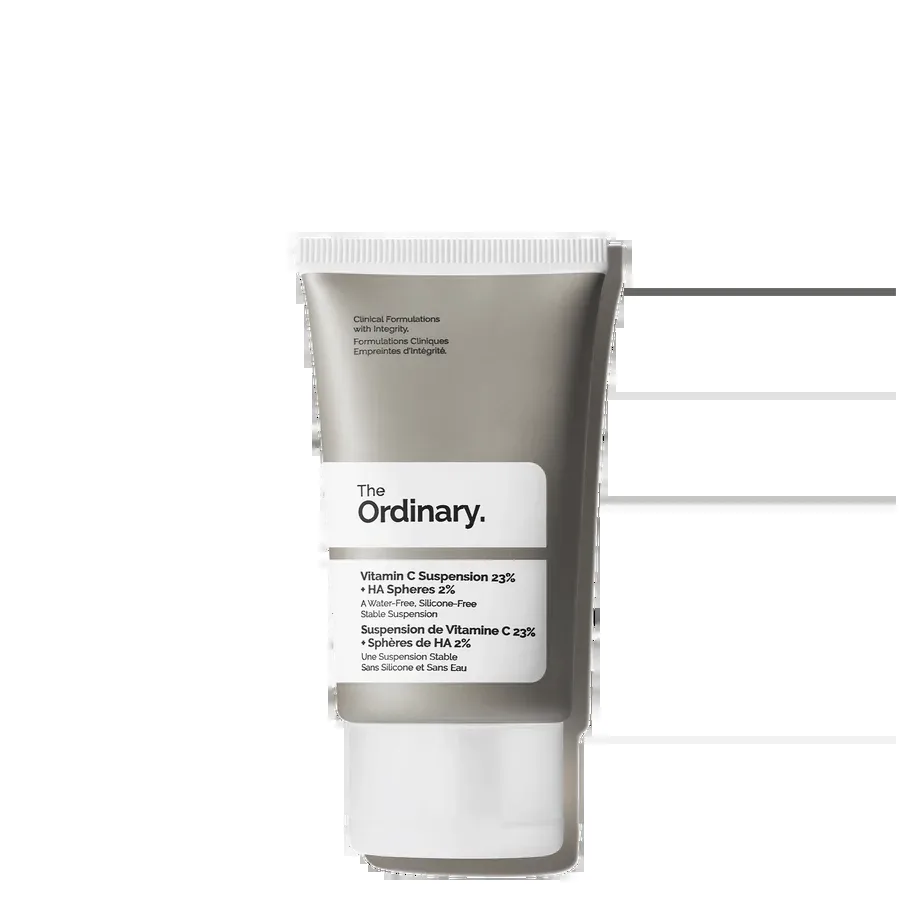
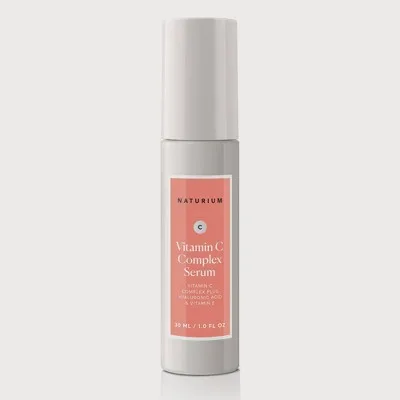
This is why format and packaging carry weight in an assessment. A vitamin C product formulated as an anhydrous suspension, like The Ordinary Vitamin C Suspension 23%, is making a different stability bet than a water-based serum such as Naturium Vitamin C Complex Serum, and each bet comes with its own trade in feel and penetration. Neither is automatically right. Both are decisions the percentage does not describe. The ingredient decoder is built to surface that layer of a formula rather than the headline.
What 'gentle' is often doing
Partial neutralisation is a legitimate and often sensible formulation choice. Raising the pH of an acid product lowers the free-acid fraction, which lowers both sting and exfoliation, and for a lot of skin that is exactly the right trade.
The problem is descriptive rather than chemical. "Gentle" is presented as a property added to the formula — a soothing complex, a clever delivery system, a kinder molecule — when frequently it is simply less free acid, achieved by moving one number. A product can be gentle because it is well designed, or gentle because it is weak, and from the front of the box these are indistinguishable.
The honest version of the sentence is available whenever a brand discloses pH alongside concentration, which is why disclosure carries weight in our assessment and non-disclosure explicitly does not carry a penalty. That distinction matters: punishing brands for not publishing data would reward the ones that publish selectively.
The same lesson runs through prescription topicals from a different direction — topical steroid potency is classed by measured vasoconstriction and vehicle, not by the percentage on the tube, which is why a lower-numbered ointment can outrank a higher-numbered cream. Dermatology sorted this out for its own drug classes decades ago. Cosmetics still sells the number.
How this actually enters a score
None of the above would matter if the assessment quietly ranked by percentage anyway. Here is the machinery that replaces it.
Formulation craft is a scored component worth 10 of the 50 points in Formula Quality, assessed as a four-item checklist normalised to 100: pH appropriate for the active (3 points), delivery supports the active (2), no formulated-in antagonism (3), and photostability if the product is positioned for daytime use (2). Those four items are, deliberately, the four mechanisms above.
The more important rule is what happens when we cannot tell. Since version 4.3, a craft item is scored only when it can be determined from the INCI, disclosed data, or published measurement. Otherwise it scores Unknown: the point is awarded at its neutral midpoint and the leaf's confidence drops. Unknown is never rounded up into "good", which would credit marketing, and never rounded down into "bad", which would punish brands for not disclosing. Uncertainty is absorbed by confidence; it is not absorbed by the score.
The same asymmetry runs through the other components. In irritation assessment, a pH known to be outside the appropriate band for its active costs four points, while an unknown pH costs nothing and instead lowers confidence. In value, a disclosed concentration enables a dose-adjusted comparison worth up to five points either way against the category — and the absence of disclosure is never penalised.
There is also a hard stop. Gate G5, the neutralised-hero gate, applies when a rule-derivable antagonism or photostability failure voids the product's headline claim. It caps Formula Quality at 50 outright, and it only lifts on a reformulation that resolves the conflict. A hero ingredient that cannot work in the formula it is sitting in does not get partial credit for being present.
When you are reasoning about a product yourself and the percentage is genuinely all you have, the useful questions are the same four: is there a stated pH, and is it plausible for this active; is the base one that would carry this molecule or fight it; is the packaging protecting something fragile; and does anything else in the formula neutralise the thing you are buying it for. Four unanswered questions is not a bad product. It is a low-confidence read, which is a different verdict and a more honest one. A structured acid routine is worth more than a higher number, for exactly the reasons above.
Products mentioned
Independently reviewed and scored — the real products behind this piece.


- Routine How to Build a Glycolic Acid Routine (Without Wrecking Your Barrier) A structured acid routine is worth more than a higher percentage.
- Ingredient Glycolic Acid (AHA) pKa 3.83 — the acid whose free-acid arithmetic makes the point most cleanly.
- Ingredient Salicylic Acid (BHA) A different pKa and a lipophilic route, so percentage does not compare across classes.
- Ingredient Vitamin C (L-Ascorbic Acid) Where pH threshold, absorption ceiling, and degradation all bite at once.
- Question What strength of steroid am I on, and does it matter? Prescription dermatology already classes potency by measurement and vehicle rather than by percentage.
References
- Topical L-ascorbic acid: percutaneous absorption studies — Dermatologic Surgery, 2001
- Rapid determination of L-ascorbic acid content in vitamin C serums by ultra-high-performance liquid chromatography-tandem mass spectrometry — International Journal of Cosmetic Science, 2022
- Optimization of topical therapy: partitioning of drugs into stratum corneum — Pharmaceutical Research, 1990
- Vehicle effects on human stratum corneum absorption and skin penetration — Toxicology and Industrial Health, 2017
Every cited link is verified to resolve to the paper named. Where a source could not be independently confirmed, it is listed without a link rather than pointing you somewhere wrong.
Frequently asked
Can a 5% acid really outperform a 10% one?
Yes, when the pH differs. Only undissociated free acid exfoliates, and glycolic acid's pKa of 3.83 means roughly half is free at pH 3.83 but only around 18% at pH 4.5. A 5% product formulated near pH 3.6 can present more free acid to skin than a 10% product formulated at 4.5, despite half the stated concentration.
Why can't you just score products by percentage?
Because concentration is one of three terms governing how much active reaches skin — the others being partition into the stratum corneum and diffusion within it, both set by the vehicle. Our methodology instead scores formulation craft as a four-item checklist worth 10 of the 50 Formula Quality points, covering pH appropriateness, delivery, antagonism, and photostability.
What happens to the score when a brand does not disclose pH?
Nothing happens to the score. Since version 4.3 an undeterminable craft item is marked Unknown, awarded at the neutral midpoint, and the leaf's confidence drops instead. A pH known to be out of band costs four points in irritation assessment; an unknown pH costs zero, because penalising non-disclosure would punish honesty and reward selective publishing.
Is a higher percentage of vitamin C better?
Only up to a point, and only for the right molecule. Percutaneous absorption work found L-ascorbic acid must be below pH 3.5 to enter skin and that absorption was maximal at 20%, with no gain above it. The same study found magnesium ascorbyl phosphate, ascorbyl-6-palmitate and dehydroascorbic acid did not raise skin L-ascorbic acid levels at all.
How can I judge a formula when the percentage is all I'm given?
Ask four questions: is a pH stated and plausible for this active, does the base carry or fight the molecule, does the packaging protect something fragile, and does anything else in the formula neutralise what you bought it for. Four unanswered questions is not a bad product — it is a low-confidence read, which is a different and more honest verdict.